All species › Parrots › African and New World parrots › Sulphur-winged Parakeet
Position in the tree Birds Aves › Birds with a flexible palate Neognathae › All other modern birds Neoaves › Landbirds Telluraves › Falcons, parrots and passerines Australaves › Falcons and passerines Eufalconimorphae › Parrots and passerines Psittacopasserae
Sulphur-winged Parakeet | Pyrrhura hoffmanni
Hoffmanns parkiet | Perico aliazufrado
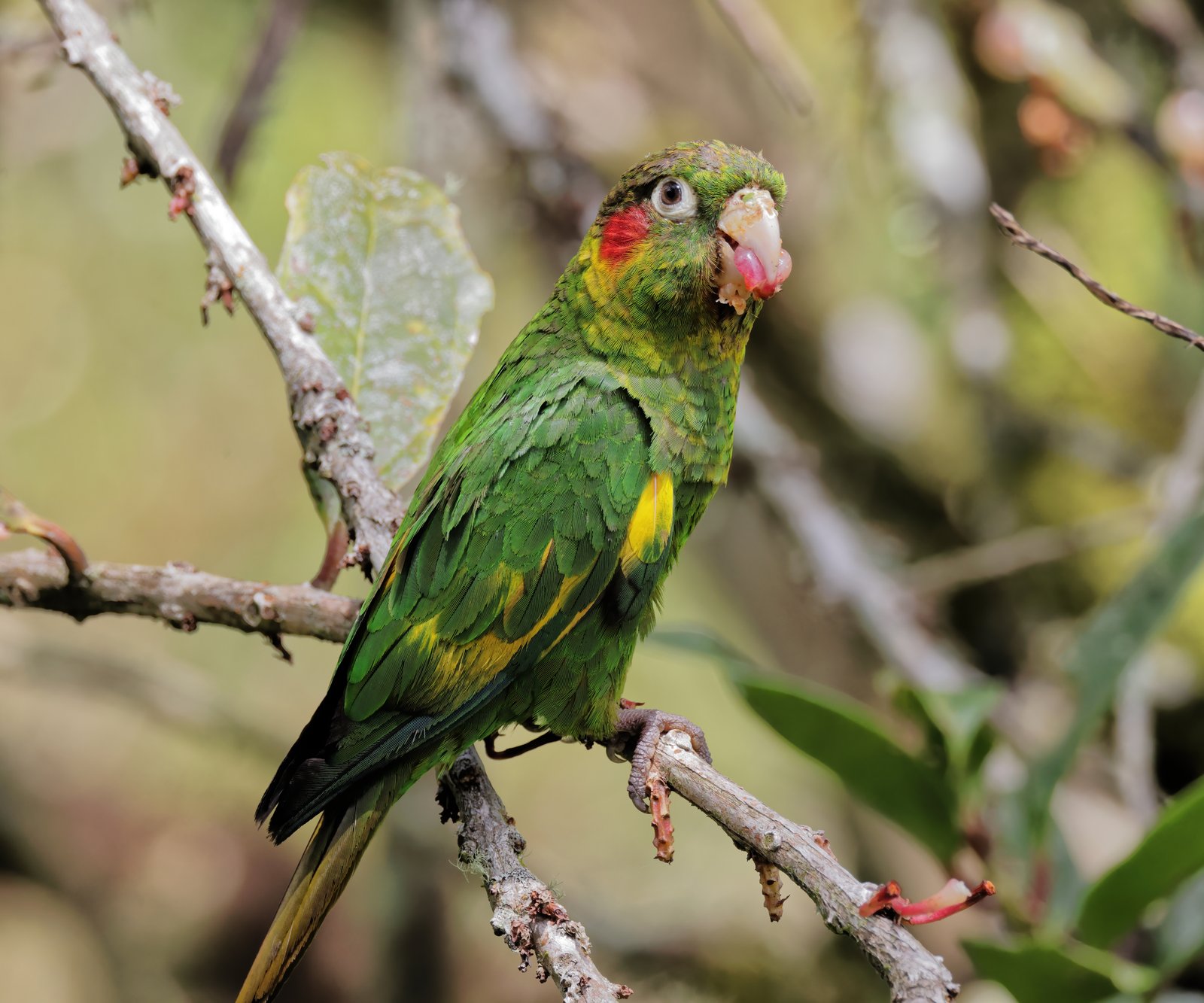
The Sulphur-winged Parakeet is a green, long-tailed parakeet of the mountains of Costa Rica and western Panama, with a red ear patch and a broad yellow band in the wing that shows mainly in flight. It lives in small groups that move noisily through the montane forest.
Voice
A rasping, high dreet-dreet or cheek-cheek, mainly in flight, and a soft chatter from feeding groups.
Recording: Yoann Blanchon — CC BY-NC-SA 4.0 · converted to mono · xeno-canto
Identification
23–24 cm, with a long, pointed tail. Green; the feathers of the head and neck have yellow tips, giving the head a yellow-scaled look, and there is a red patch on the ear coverts. In flight the wing shows a broad sulphur-yellow band across the base of the primaries and secondaries; little of this is visible on perched birds. The tail is olive-green to dull reddish-brown above and reddish-brown below. The bill is pale horn, around the eye a bare, pale ring. The sexes are alike. Birds in western Panama (P. h. gaudens) have more yellow on the head than those in Costa Rica.
Confusion species
Barred Parakeet Bolborhynchus lineola is smaller, with a short, pointed tail and black barring. Pacific Parakeet Psittacara strenuus and Finsch's Parakeet Psittacara finschi are larger, without a red ear patch or yellow in the wing; Finsch's Parakeet has a red forehead and red and yellow on the edge of the wing. Orange-chinned Parakeet Brotogeris jugularis is smaller, with a short tail.
Habitat
Montane rainforest and cloud forest, forest edges, clearings with scattered trees and shade coffee, mostly between about 900 and 2500 m, locally higher. After the breeding season some move to lower slopes. It eats fruit, seeds and flowers, often in fruiting trees along forest edges. It nests in a tree cavity.
Where the bird is most at home, classified by the vegetation units of Mexico and Central America.





Range and movements
The mountains of southern Costa Rica, especially the Cordillera de Talamanca and the Fila Costeña, and of western Panama in Chiriquí, Bocas del Toro, Ngäbe-Buglé and Veraguas.
- Resident
- dark = core range, pale = thinly spread
How and when to look
Groups are often seen around San Vito and Las Cruces in southern Costa Rica and around Boquete, Cerro Punta and Volcán Barú in Chiriquí; the yellow wing band is the best field mark in flight.
Conservation status
Least Concern. Fairly common within its small range; locally sensitive to clearance of montane forest.
Scientific name
Pyrrhura hoffmanni | (Cabanis, 1861)
Cabanis described the species in 1861 as Conurus hoffmanni; because it was later moved to another genus, the author and year stand in brackets. The genus Pyrrhura was introduced in 1856 by Bonaparte. Pyrrhura is Greek, from purrhos 'red' and oura 'tail', after the maroon tail of many species. hoffmanni honours the German physician and naturalist Karl Hoffmann (1823–1859), who collected in Costa Rica. The specimen the first description was based on came from Costa Rica.