All species › Parrots › African and New World parrots › Subandean Parakeet
Position in the tree Birds Aves › Birds with a flexible palate Neognathae › All other modern birds Neoaves › Landbirds Telluraves › Falcons, parrots and passerines Australaves › Falcons and passerines Eufalconimorphae › Parrots and passerines Psittacopasserae
Subandean Parakeet | Pyrrhura subandina
Sinúparkiet | Cotorra del Sinú
The Subandean Parakeet is a small, long-tailed parakeet of the genus Pyrrhura consisting of two widely separated forms: the nominate form from the Sinú Valley in north-western Colombia and the Azuero Parakeet P. s. eisenmanni of the Azuero Peninsula in Panama. In the guide area only the Azuero Parakeet occurs, in a small forest area in the south-west of the peninsula.
No photograph of a living wild bird of this species with a suitable Creative Commons licence exists. Do you have one that meets the rules? Send it in.
Voice
Shrill, rapidly repeated cries, a rasping kreek-kreek and a soft chatter from perched groups; usually heard in flight.
No recording with a suitable Creative Commons licence is available for this species yet.
Identification
21–23 cm, with a long, graduated tail. Mostly green. A narrow reddish-brown band on the forehead, a dark brown crown and chestnut cheeks with a pale buffy patch on the ear coverts. The neck and breast are brown with pale feather edges, giving a scaly pattern. A reddish-brown patch on the belly; the bend of the wing is red and the primaries are blue. The tail is green to reddish-brown above and dark reddish-brown below. The sexes are alike.
Confusion species
Sulphur-winged Parakeet Pyrrhura hoffmanni, in the mountains of Costa Rica and western Panama, has a red ear patch, yellow in the wing and no scaly breast; it does not occur on the Azuero Peninsula. Brown-throated Parakeet Eupsittula pertinax has an unscaled grey-brown throat and lives in open lowlands. Orange-chinned Parakeet Brotogeris jugularis is smaller, with a short tail and an orange chin spot.
Habitat
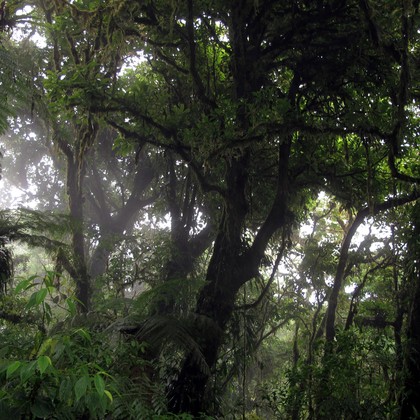
Humid foothill and montane forest between about 300 and 1600 m, also forest edges and old secondary forest. It lives in small groups that move through the canopy eating fruit, seeds and flowers.
Where the bird is most at home, classified by the vegetation units of Mexico and Central America.


Range and movements
In the guide area only in Panama, in the Cerro Hoya massif in the south-west of the Azuero Peninsula (Veraguas and Los Santos). Outside the guide area the nominate form lives in the lower Sinú Valley in north-western Colombia, where it has not been recorded with certainty since 1949.
How and when to look
In Cerro Hoya National Park and the surrounding forest remnants small groups fly over the forest calling loudly in the morning; the birds often stay hidden in the canopy and are best found by their calls.
Conservation status
Not assessed as a species in this sense. The Azuero Parakeet has a very small range and a small population, dependent on the forest remnants around Cerro Hoya; clearance for cattle ranching is the main threat. The Colombian nominate form may be extinct.
Scientific name
Pyrrhura subandina | Todd, 1917
Todd described the species in 1917 and placed it straight away in the genus where it still stands. The genus Pyrrhura was introduced in 1856 by Bonaparte. Pyrrhura is Greek, from purrhos 'red' and oura 'tail', after the maroon tail of many species. subandina is Latin, from sub 'at the foot of' and andinus 'Andean', after its range in the Sinú valley at the foot of the Andes. The specimen the first description was based on came from Jaraquiel, Sinú valley, Colombia.