The habitats of Mexico and Central America
Every species in this guide is linked to the habitats where it most occurs in Mexico and Central America, built up from the macrogroups of NatureServe's International Vegetation Classification (IVC). The classification has eleven main groups, from open sea to farmland and built-up land, and beneath them forty-eight more specific formations — from mangrove and Chocó-Darién rainforest to cloud forest, pine-oak forest and the Sonoran Desert. Each bird carries at most three of those: not everywhere it has ever turned up, but where it truly belongs.
Select a habitat to read its description.
Open sea and oceanic islands A
Every habitat governed by sea water, from the deep Pacific Ocean off the west coast to the Gulf of Mexico and the Caribbean Sea in the east. The subdivision follows depth and seabed: the open ocean beyond the shelf edge, the coastal water above the shelf, the reefs and seagrass beds in shallow clear water, and the remote oceanic islands with their own birds. For birds the range runs from storm petrels and shearwaters that come ashore only to breed to pelicans and terns fishing close inshore.
-
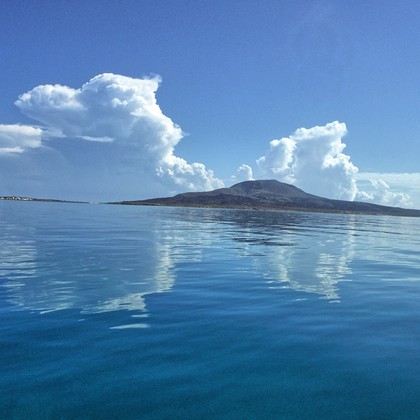 Open ocean A1
open water of the Gulf of California off Isla Coronados, Baja California Sur, Mexico
54 species
The deep water beyond the edge of the continental shelf, where the seabed drops away to thousands of metres. That edge is the boundary with Coastal waters and continental shelf; reefs and seagrass always lie inside it. The Pacific side is richer than the Caribbean: upwelling of cool, nutrient-rich water, as in the Costa Rica Dome off Central America, draws large numbers of seabirds. Here Wedge-tailed Shearwater, Galapagos Shearwater, Wedge-rumped Storm Petrel, Black Storm Petrel and Nazca Booby forage; Red-necked Phalarope and Red Phalarope winter at sea, and Pomarine Jaeger and Sabine's Gull pass through on migration. In the warmer, poorer Caribbean Sea, Sooty Tern and Bridled Tern are the usual sights.
-
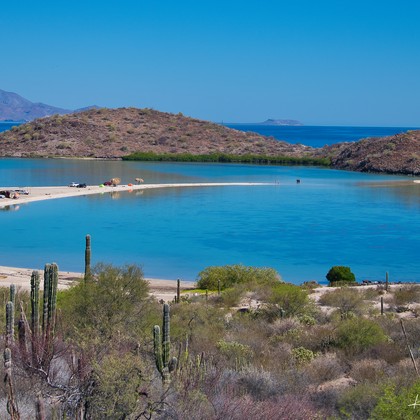 Coastal waters and continental shelf A2
Playa El Requesón, Bahía Concepción
83 species
The open water above the continental shelf, from the surf to the edge where Open ocean begins. The Gulf of California, the Gulf of Fonseca and the Gulf of Honduras largely belong here; where reef or seagrass shapes the seabed, Coral reef and seagrass beds begins, and lagoons behind a barrier beach fall under Lagoon, estuary and salt pan. In the Gulf of California upwelling makes the sea exceptionally rich in fish. Here hunt the birds seen from any quayside: Brown Pelican plunges onto shoals of sardines, Blue-footed Booby and Brown Booby dive in flocks, Magnificent Frigatebird snatches fish from the surface, and Royal Tern and Elegant Tern fish close inshore. Off Baja California, Pacific Loon and Surf Scoter spend the winter.
-
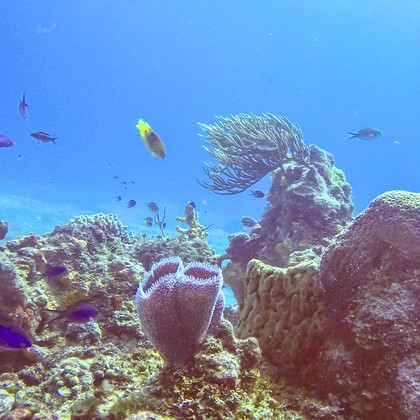 Coral reef and seagrass beds A3
coral reef in Arrecifes de Cozumel National Park, Quintana Roo, Mexico
4 species
Shallow, clear sea over coral reef, seagrass or seaweed beds. The water beyond, over bare sand or silt, belongs to Coastal waters and continental shelf; whatever dries out at low tide belongs to Tidal flats and mudflats. The Mesoamerican Barrier Reef runs for about a thousand kilometres from northern Quintana Roo past Belize and Guatemala to the Bay Islands of Honduras; in the shallow lagoons behind it grows turtle grass, <em>Thalassia testudinum</em>. On the Pacific side reefs are scarce, with Cabo Pulmo in Baja California Sur as a well-known example. Birds use the reef as a fishing ground: Brown Booby dives into the channels, Bridled Tern and Sandwich Tern fish over the reef crest, and Osprey hunts over the clear water.
-
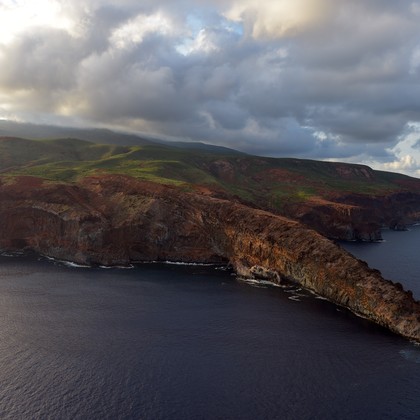 Oceanic islands A4
Revillagigedo Islands, Mexico
27 species
Remote volcanic islands and atolls far offshore that were never connected to the mainland, with their own species or large seabird colonies. Islands closer to the coast, such as Cozumel, the Islas Marías and the Bay Islands, take the formations of their vegetation, and small rocks and cays fall under Rocky islets, cays and seabird colonies. In the Pacific lie Guadalupe off Baja California, the Revillagigedo Islands, Clipperton atoll and Isla del Coco off Costa Rica. Each has its own land birds: Guadalupe Junco on Guadalupe, Socorro Mockingbird, Socorro Wren and Clarion Wren in the Revillagigedos, Cocos Cuckoo, Cocos Tyrannulet and Cocos Finch on Isla del Coco. Laysan Albatross nests on Guadalupe, and Townsend's Shearwater breeds only in the Revillagigedo Islands.
Coast B
The narrow strip where land meets sea, along the long Pacific coast from Baja California to Darién, and the Atlantic coast along the Gulf of Mexico and the Caribbean Sea. The subdivision follows substrate and water: loose sand, bare rock, mud that dries out, forest and herbs in salt water, lagoons and salt pans, and the small islets just offshore. For birds the coast is a crossroads: large numbers of shorebirds from the north winter here or rest on migration, and herons, terns and seabirds nest in colonies.
-
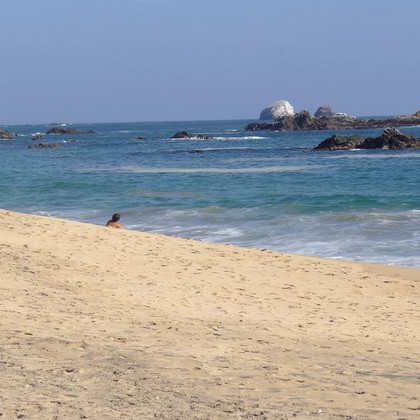 Sandy beach and dunes B1
sandy beach at Mazunte, Oaxaca, Mexico
64 species
Beaches, barrier beaches and coastal dunes, from bare sand to low growth of creeping plants and shrubs. Where mangrove begins behind the beach it passes into Mangrove, and where rock forms the shore into Rocky shore and sea cliffs. Beach morning glory, <em>Ipomoea pes-caprae</em>, creeps over the sand, and on the Caribbean side sea grape, <em>Coccoloba uvifera</em>, grows on the beach ridge. Large dune fields lie along the coast of Veracruz and on the Pacific side of Baja California. Sanderling, Hudsonian Whimbrel and Willet run along the tideline; Snowy Plover and Wilson's Plover nest on the bare sand, and Least Tern and Black Skimmer rest in flocks on the beach.
-
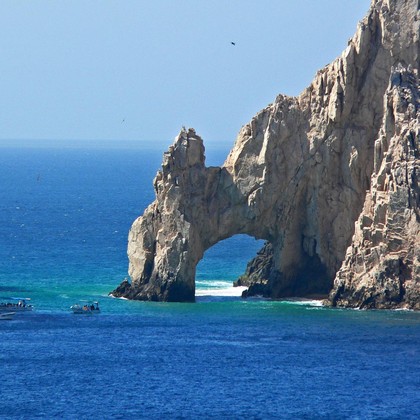 Rocky shore and sea cliffs B2
El Arco, Cabo San Lucas, Baja California Sur, Mexico
28 species
Rocky shoreline with surf, tide pools and cliffs rising straight from the sea. Inland rocks and cliffs belong to Cliffs, canyons and rocky slopes, and sandy bays between the headlands to Sandy beach and dunes. This formation is best developed along the Pacific coast of Baja California and on the rocky headlands of the Mexican and Central American mainland; the Caribbean coast is mostly low. On the wet rocks Ruddy Turnstone, Wandering Tattler, Surfbird and Spotted Sandpiper search for food. Along Baja California they are joined by Black Turnstone and Black Oystercatcher, while Brandt's Cormorant and Western Gull rest on the cliffs; in the Gulf of California Yellow-footed Gull takes the latter's place.
-
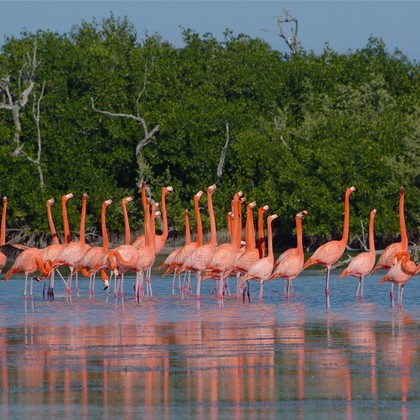 Tidal flats and mudflats B3
Ría Lagartos, Yucatán
68 species
Flats of mud and sand that are exposed at low tide, without taller vegetation. Where salt-tolerant plants cover the higher parts, Salt marsh begins, and whatever stays permanently under water belongs to Lagoon, estuary and salt pan. The largest flats lie where the tidal range is great: in the northern Gulf of California, in the lagoons of Sinaloa and Nayarit and in the Bay of Panama, where mud is exposed for kilometres. The Bay of Panama is one of the most important staging sites on the continent, where hundreds of thousands of Western Sandpipers and Semipalmated Sandpipers refuel on migration. Marbled Godwit, Long-billed Curlew, Short-billed Dowitcher, Black-bellied Plover and Semipalmated Plover also feed here, and Reddish Egret hunts in the shallows with spread wings.
-
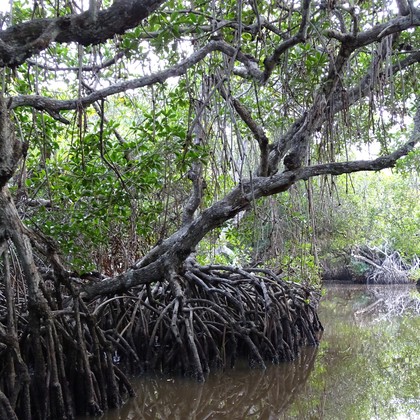 Mangrove B4
Tecolutla, Veracruz
144 species
Tidal forest of salt-tolerant trees along both coasts, from tall mangrove forest to low scrub. Bare mudflats belong to Tidal flats and mudflats, and where the water turns fresh further inland mangrove gives way to Swamp forest and palm swamp. At the water's edge red mangrove, <em>Rhizophora mangle</em>, stands on stilt roots, with black mangrove, <em>Avicennia germinans</em>, and white mangrove, <em>Laguncularia racemosa</em>, behind it. Large mangrove areas lie in Marismas Nacionales in Nayarit, in the Gulf of Fonseca and at Térraba-Sierpe in Costa Rica. Typical are Mangrove Warbler, Mangrove Vireo, Mangrove Cuckoo and Rufous-necked Wood Rail; Common Black Hawk hunts crabs here, Boat-billed Heron roosts by day among the dense roots, and the endemic Mangrove Hummingbird lives on the Pacific coast of Costa Rica.
-
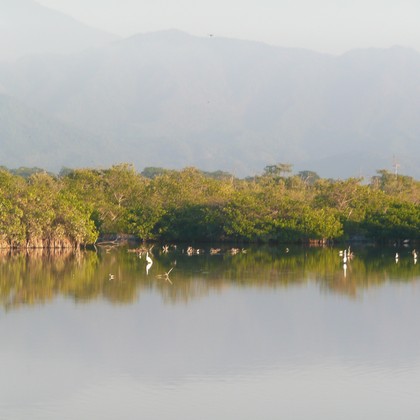 Salt marsh B5
La Tovara, Nayarit, Mexico
57 species
Low herbaceous growth on saline ground behind the coast, flooded at spring tides or storm surges. Bare salt flats and salt pans belong to Lagoon, estuary and salt pan, and where the water turns fresh Freshwater marsh and wet grassland begins. Characteristic plants are glasswort, <em>Salicornia</em>, and saltwort, <em>Batis maritima</em>, with saltgrass, <em>Distichlis spicata</em>, on the higher parts. The largest salt marshes lie along the lagoons of Baja California, Sonora and Sinaloa and along the coast of Yucatán. Ridgway's Rail breeds in the Pacific marshes and Clapper Rail on the Gulf coast, and Savannah Sparrow searches for seeds among the salt plants; American White Ibis, Tricolored Heron and Willet feed in the creeks.
-
 Lagoon, estuary and salt pan B6
salt evaporation ponds at Celestún, Yucatán, Mexico
138 species
Brackish and salt open water behind barrier beaches and in river mouths, with the bare salt flats and salt works around it. The vegetated margins belong to Mangrove or Salt marsh, and salt lakes far inland to Inland saline and alkaline lakes. Lagoons line almost the whole coast: Ojo de Liebre and San Ignacio in Baja California, the Laguna Madre in Tamaulipas, Celestún and Ría Lagartos in Yucatán, and the salt pans around the Gulf of Fonseca. American Flamingo feeds in the shallow lagoons of Yucatán and breeds at Ría Lagartos; Brant winters in the lagoons of Baja California, and the Laguna Madre is an important wintering site for Redhead. American White Pelican, Roseate Spoonbill, American Avocet and Caspian Tern are common visitors.
-
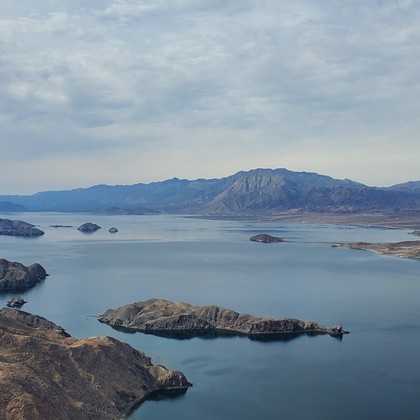 Rocky islets, cays and seabird colonies B7
Isla Mitlán, Bahía de los Ángeles, Baja California, Mexico
52 species
Small islets, rocks and coral cays close to the coast, bare or sparsely vegetated, where seabirds can breed safe from land predators. Large islands take the formations of their vegetation, and remote islands in the ocean fall under Oceanic islands. In the Gulf of California most of the world population of Heermann's Gull and Elegant Tern breeds on tiny Isla Rasa, while Yellow-footed Gull, Blue-footed Booby and Craveri's Murrelet nest on other islands in the gulf. Isla Isabel off Nayarit is known for its colonies of Blue-footed Booby and Magnificent Frigatebird. On the Caribbean side Red-footed Booby and Magnificent Frigatebird breed on Half Moon Caye in Belize, and Sooty Tern and Brown Noddy on Arrecife Alacranes off Yucatán.
Inland waters C
All fresh water, and inland salt water, beyond the influence of the sea: lakes and reservoirs, rivers and streams, and the salt and soda lakes of the dry plateaus. Marshes and riparian forest along that water form a main group of their own. Mexico and Central America have few large natural lakes, with Lake Nicaragua and Lake Chapala as the largest, but a dense network of rivers and many reservoirs. For birds this means grebes, ducks and cormorants on open water, and kingfishers, herons and the dipper along running water.
-
 Lakes, reservoirs and ponds C1
Lake Atitlán, Guatemala
137 species
Still fresh water, from crater lakes and highland lakes to reservoirs, fish ponds and seasonal pools. Shores with reeds, cattails and bulrushes belong to Freshwater marsh and wet grassland, and inland salt lakes to Inland saline and alkaline lakes. Well-known examples are Lake Chapala and Lake Pátzcuaro on the Mexican Plateau, Lake Atitlán in Guatemala, Lake Nicaragua and Gatún Lake in the Panama Canal. Least Grebe and Pied-billed Grebe breed on small waters, Western Grebe and Clark's Grebe on the large lakes of the plateau. In winter American Coot, Lesser Scaup, Blue-winged Teal and American White Pelican gather, and Northern Jacana walks over the floating plants.
-
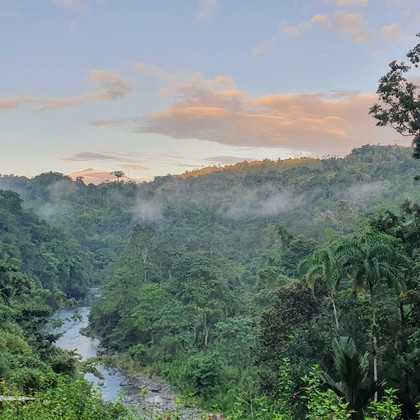 Rivers and streams C2
Pacuare River, Costa Rica
78 species
Running fresh water, from fast mountain streams with waterfalls to broad, slow lowland rivers with sandbars. The forest along the banks belongs to Floodplain and gallery forest or Riparian woodland in arid and temperate regions, and where the tide pushes in the coast begins. Major rivers are the Usumacinta and the Grijalva, the Río Coco between Honduras and Nicaragua, the Río San Juan and the Chagres in Panama. Mountain streams hold American Dipper and, in Costa Rica and Panama, Torrent Tyrannulet, Buff-rumped Warbler and Fasciated Tiger Heron. Along lowland rivers Ringed Kingfisher, Amazon Kingfisher and Green Kingfisher fish, Collared Plover nests on the sandbars and Mangrove Swallow hunts low over the water; in winter Louisiana Waterthrush walks along the stones.
-
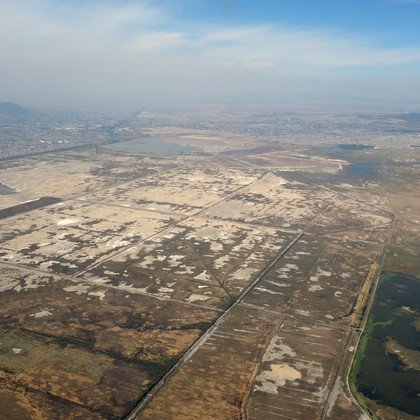 Inland saline and alkaline lakes C3
Lake Texcoco, Atenco
34 species
Salt, brackish or alkaline lakes and playas inland, often shallow and partly or entirely dry in the dry season. Coastal lagoons with salt water fall under Lagoon, estuary and salt pan, fresh lakes under Lakes, reservoirs and ponds. They lie in the closed basins of the Mexican Plateau and the Chihuahuan Desert; the best-known example is what remains of Lake Texcoco near Mexico City. For waterbirds they are important wintering sites: Northern Shoveler, Northern Pintail and Eared Grebe gather in large numbers, Sandhill Crane winters around the lagoons of Chihuahua, and American Avocet, Black-necked Stilt, Snowy Plover and Wilson's Phalarope feed along the bare shores.
Wetlands and riparian forest D
Wet habitats where vegetation takes over from open water: herbaceous marshes and wet grasslands, forests standing in water for long periods, and the forests along rivers. Open water without vegetation belongs to Inland waters, and mangrove and salt marsh in salt water to the Coast. In the tropical lowlands these are the great floodplains of Tabasco, Belize and the Caribbean coast of Central America; in the dry north they are narrow green ribbons along the rivers. For birds they are rich in rails, herons and storks, and in dry country a lifeline for songbirds.
-
 Freshwater marsh and wet grassland D1
Lake Pátzcuaro, Michoacán
175 species
Herbaceous marshes with cattails, bulrushes and tall grasses, wet meadows that flood in the rainy season, and small bogs in the mountains. Where trees stand in the marsh it is Swamp forest and palm swamp; open water belongs to Lakes, reservoirs and ponds. In Mexico such marshes are called tular, after the cattail, <em>Typha</em>, or popal, after the water plant <em>Thalia geniculata</em>. Large examples are the Pantanos de Centla in Tabasco and Palo Verde and Caño Negro in Costa Rica; near Toluca lie the remnants of the marshes of the Río Lerma, home to Aztec Rail and Black-polled Yellowthroat, two species found only in central Mexico. In the lowlands Snail Kite, Limpkin, Purple Gallinule, Northern Jacana and Black-bellied Whistling Duck are typical.
-
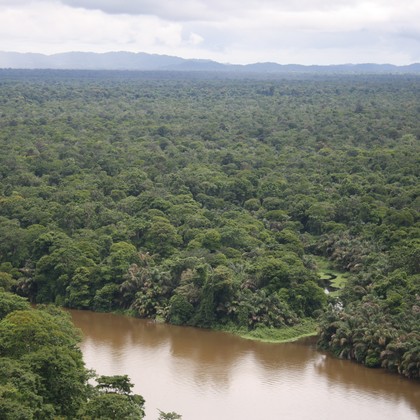 Swamp forest and palm swamp D2
Tortuguero, Costa Rica
54 species
Forest that stands with its feet in fresh water for much of the year, with trees and palms that tolerate prolonged flooding. Mangrove along the salt coast is a different formation, and forest flooded only temporarily by high river water belongs to Floodplain and gallery forest. In Yucatán, Petén and Belize, logwood, <em>Haematoxylum campechianum</em>, forms tintales in hollows that flood in the rainy season. Along the Caribbean coast of Nicaragua, Costa Rica and Panama grow swamps of the raffia palm, <em>Raphia taedigera</em>, as at Tortuguero, and in a few places swamp forest with <em>Pterocarpus officinalis</em>. In the dim forest Agami Heron and Sungrebe fish along quiet creeks, Boat-billed Heron roosts in the trees by day, and in winter Prothonotary Warbler forages over the water.
-
 Floodplain and gallery forest D3
Usumacinta River near Yaxchilán, Chiapas, Mexico (border with Guatemala)
275 species
Tropical forest along rivers and on floodplains that is temporarily flooded in the rainy season, and the narrow gallery forests that follow rivers through savanna and dry forest. Forest standing in water for long periods is Swamp forest and palm swamp, and riverside forest in the dry and temperate north of Mexico belongs to Riparian woodland in arid and temperate regions. Extensive floodplain forest lines the Usumacinta and the Río San Juan, and in Darién grow forests of cativo, <em>Prioria copaifera</em>. Gallery forests run as green ribbons through the dry Pacific lowlands, as in Guanacaste. Here Muscovy Duck nests in tree holes, Bare-throated Tiger Heron stands motionless on the bank, and Amazon Kingfisher and American Pygmy Kingfisher fish from branches over the water.
-
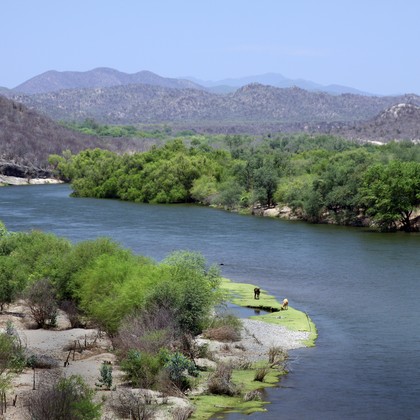 Riparian woodland in arid and temperate regions D4
Yaqui River, Sonora, Mexico
170 species
Woodland and scrub along rivers and arroyos in the dry and temperate north and centre of Mexico, where groundwater keeps alive trees that are otherwise absent from the landscape. The humid tropical forest along rivers in the south belongs to Floodplain and gallery forest. Along the water grow cottonwood, <em>Populus fremontii</em>, willow, sycamore, <em>Platanus</em>, and the sabino or ahuehuete, <em>Taxodium mucronatum</em>, the national tree of Mexico; on the flats behind lie dense mesquite bosques, <em>Prosopis</em>. Such riparian woodlands line the Río Bravo, the Yaqui and the Conchos and fill the canyons of the Sierra Madre. They attract Bell's Vireo, Yellow-billed Cuckoo and Vermilion Flycatcher, Black Phoebe hunts from stones in the stream, and Elegant Trogon breeds in the sycamore canyons of Sonora.
Humid lowland forest E
Evergreen and semi-evergreen forests of the warm, wet lowlands and lower mountain slopes, where rain falls for most of the year. Forest that sheds its leaves in the dry season belongs to Dry forest and thorn scrub, and forest above about 1200 m to Montane forest. The core lies on the Caribbean side, from southern Veracruz and the Selva Lacandona through Petén and Belize to the Caribbean lowlands of Central America and Darién. For birds this is the richest group in the guide, with toucans, trogons, manakins, antbirds and large forest eagles.
-
 Lowland rainforest E1
Sirena, Corcovado National Park, Costa Rica
423 species
Tall, closed rainforest from sea level to about 500 to 700 m, with giant trees, lianas and a dark understorey. Higher up it grades into Foothill (submontane) forest, and in eastern Panama into Chocó-Darién rainforest. The largest continuous forests lie in the Selva Lacandona in Chiapas, in Petén and Belize, in the Mosquitia of Honduras and Nicaragua and around La Selva in Costa Rica; on the Pacific side rainforest grows on the Osa Peninsula. Characteristic trees are the ceiba, <em>Ceiba pentandra</em>, and mahogany, <em>Swietenia macrophylla</em>. Great Curassow and Great Tinamou walk the forest floor, Ocellated Antbird follows army ant swarms, Keel-billed Toucan and Slaty-tailed Trogon sit in the canopy, Great Green Macaw forages in the Caribbean lowlands and Harpy Eagle hunts monkeys and sloths.
-
 Foothill (submontane) forest E2
Braulio Carrillo National Park, Costa Rica
481 species
Humid forest on the lower mountain slopes, roughly between 500 and 1200 m, where the forest is still tall and rich in species but cooler and often wetter than in the lowlands. Below lies Lowland rainforest, above Northern Middle American cloud forest or Costa Rica-Panama highland forest. This belt is best developed on the Caribbean slope of Costa Rica and western Panama, as in Braulio Carrillo, but also at Pico Bonito in Honduras. Tree ferns of the genus <em>Cyathea</em> and palms fill the understorey. A distinct group of foothill specialists lives here: Keel-billed Motmot, Tody Motmot, Lattice-tailed Trogon, Snowcap, Dull-mantled Antbird, Emerald Tanager and Speckled Tanager, and Bare-necked Umbrellabird breeds in this belt.
-
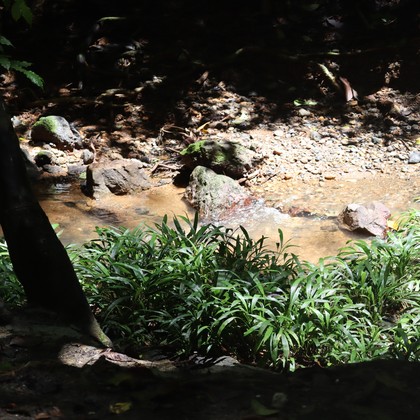 Chocó-Darién rainforest E3
Nuquí, Chocó, Colombia
193 species
Very wet lowland rainforest of eastern Panama, in Darién and the east of Guna Yala, where South American plants and animals reach their northern limit. Rainforest further west belongs to Lowland rainforest, the mountains of Darién to Costa Rica-Panama highland forest. Most of it lies in Darién National Park and along the Tuira and Chucunaque rivers. Cuipo, <em>Cavanillesia platanifolia</em>, and espavé, <em>Anacardium excelsum</em>, rise above the canopy. Harpy Eagle and Crested Eagle breed in these forests, and within the area of the guide Dusky-backed Jacamar, Grey-cheeked Nunlet, Golden-headed Manakin, Black Oropendola and Chestnut-fronted Macaw live mainly here.
-
 Secondary forest and forest edge E4
Sarapiquí River, Costa Rica
687 species
Young forest, rank growth and scrub that springs up after logging, fire or abandoned farming, and the sunny edges of old forest. In Mexico it is called acahual, in Guatemala and Honduras guamil, in Nicaragua and Costa Rica tacotal. Old closed forest belongs to the other formations of Humid lowland forest or to Dry forest and thorn scrub, and open land with scattered trees to Pasture and grazing land with trees. Fast-growing pioneers such as guarumo, <em>Cecropia</em>, and balsa, <em>Ochroma pyramidale</em>, and dense stands of <em>Heliconia</em> set the scene. Barred Antshrike and Buff-throated Saltator live in the thickets, Rufous-tailed Hummingbird visits the flowers, Common Squirrel Cuckoo creeps through the treetops, Crimson-collared Tanager is common on the Caribbean side and Blue-black Grassquit sings in open patches.
Dry forest and thorn scrub F
Forests and scrub of regions with a long, pronounced dry season, when many trees drop their leaves and the landscape stays bare and grey for months. The wetter evergreen forest belongs to Humid lowland forest, and true desert to Desert, semi-desert and chaparral. Most of it lies along the Pacific slope from Sonora to Panama, with the north of Yucatán and dry interior valleys besides. For birds they are rich in species of their own, with many endemics of western Mexico and Yucatán, and with motmots, magpie-jays, parrots and quails.
-
 Pacific tropical dry forest F1
Guanacaste, Costa Rica
261 species
Deciduous and semi-deciduous forest along the Pacific slope, from Sonora and Sinaloa through the Balsas Depression to Guanacaste and the Arco Seco of Panama. In the rainy season the forest is dense and green, in the dry season largely bare. Open thorny scrub with columnar cacti belongs to Thorn scrub and cactus forest. Well-known sites are Chamela in Jalisco and Santa Rosa in Costa Rica; characteristic trees are species of <em>Bursera</em> and the guanacaste, <em>Enterolobium cyclocarpum</em>. In western Mexico live Black-throated Magpie-Jay, West Mexican Chachalaca, Lilac-crowned Amazon and Golden-cheeked Woodpecker, and in the Balsas Depression Balsas Screech Owl. Further south White-throated Magpie-Jay, Yellow-naped Amazon, Hoffmann's Woodpecker and Long-tailed Manakin belong to this forest.
-
 Yucatán and Caribbean-interior seasonal forest F2
Uxmal, Yucatán, Mexico
183 species
Semi-deciduous to deciduous forest on limestone in the north of the Yucatán Peninsula, and similar dry forest in dry valleys on the Caribbean side of Guatemala and Honduras, such as the Motagua and Aguán valleys. The more humid forest of southern Yucatán and Petén belongs to Lowland rainforest. The forest is low to medium tall and grows on thin soil with cenotes; common trees are gumbo-limbo, <em>Bursera simaruba</em>, chechem, <em>Metopium brownei</em>, and tzalam, <em>Lysiloma latisiliquum</em>. Northern Yucatán has its own group of birds: Yucatan Jay, Yucatan Woodpecker, Yucatan Flycatcher, Orange Oriole, Rose-throated Tanager, Yucatan Amazon and Yucatan Bobwhite. Honduran Emerald lives in the Aguán valley.
-
 Thorn scrub and cactus forest F3
Sierra Gorda, Querétaro
198 species
Low, thorny scrub with columnar cacti in the driest tropical and subtropical regions. Taller deciduous forest belongs to Pacific tropical dry forest, and true desert to Sonoran Desert, Baja California desert or Chihuahuan Desert and plateau scrub. It occurs in Sinaloa and Sonora, in the Tehuacán-Cuicatlán valley, where <em>Neobuxbaumia tetetzo</em> forms whole cactus forests, in the Tamaulipan scrub with mesquite, <em>Prosopis</em>, and in the Motagua valley in Guatemala. Elegant Quail lives in the northwest, Boucard's Wren, Grey-breasted Woodpecker and Bridled Sparrow in the dry valleys of Puebla and Oaxaca, and Tamaulipas Crow, Long-billed Thrasher and Olive Sparrow in Tamaulipas. Lesser Roadrunner runs through the scrub from Mexico into Central America.
Montane forest G
Forests of the mountains, roughly from 1000 to 1200 m up to the tree line at almost 4000 m. Lower forest belongs to Humid lowland forest or Dry forest and thorn scrub, and the treeless grasslands above to Savannas and montane grasslands. The subdivision follows moisture, altitude and region: cloud forest and highland rainforest on the wet slopes, pine-oak and oak forest on drier slopes in the south and north, and conifer forest on the highest summits. For birds the mountains are rich in endemics, from quetzals and guans to jays, hummingbirds and warblers, and a wintering ground for many North American warblers.
-
 Northern Middle American cloud forest G1
El Cielo, Tamaulipas
189 species
Humid montane forest rich in mosses and epiphytes, roughly between 1000 and 3000 m, on the wet slopes of the Sierra Madre Oriental and the Sierra Madre del Sur, in Chiapas and in the highlands of Guatemala and Honduras into Nicaragua. In Costa Rica and Panama it gives way to Costa Rica-Panama highland forest, and on drier slopes to Tropical highland pine-oak forest. Well-known sites are El Triunfo in Chiapas, the Sierra de las Minas in Guatemala and Cusuco in Honduras. Sweetgum, <em>Liquidambar styraciflua</em>, oaks and tree ferns are draped with bromeliads and orchids. Resplendent Quetzal and Highland Guan eat fruit in the canopy, Horned Guan lives only in Chiapas and Guatemala and Bearded Wood Partridge in the Sierra Madre Oriental. Blue-throated Motmot, Azure-hooded Jay and Golden-browed Warbler also belong to this forest.
-
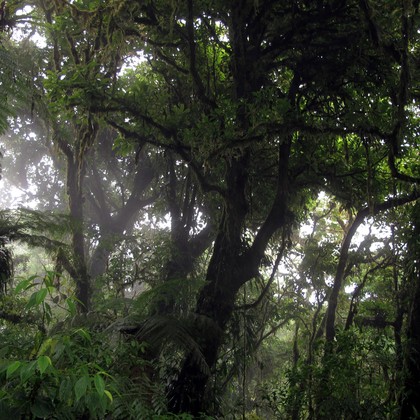 Costa Rica-Panama highland forest G2
Monteverde, Costa Rica
220 species
Cloud forest, oak forest and elfin forest of the mountains of Costa Rica and western Panama, from the Cordillera de Tilarán at Monteverde through the Cordillera Central to the Talamanca and Volcán Barú, and also on Cerro Pirre and Tacarcuna in Darién. Cloud forest further north belongs to Northern Middle American cloud forest, and the treeless land above the tree line to Montane grassland, zacatonal and páramo. High in the Talamanca grow oak forests of <em>Quercus costaricensis</em> with an understorey of bamboo, <em>Chusquea</em>. Many species are confined to these mountains, such as Black Guan, Prong-billed Barbet, Fiery-throated Hummingbird, Silvery-throated Jay, Long-tailed Silky-flycatcher, Black-and-yellow Phainoptila, Flame-throated Warbler, Collared Whitestart and Yellow-thighed Brushfinch. In the mountains of Darién live Pirre Warbler, Beautiful Treerunner and Varied Solitaire.
-
 Tropical highland pine-oak forest G3
Chimaltenango, Guatemala
241 species
Open to closed forest of pines and oaks on the drier slopes of the highlands, from the Trans-Mexican Volcanic Belt through Oaxaca and Chiapas to Guatemala, Honduras and northern Nicaragua, mostly between about 1200 and 3000 m. Forest further north belongs to Madrean oak and pine-oak woodland, and conifer forest above about 3000 m to High montane conifer forest. Characteristic are <em>Pinus oocarpa</em>, <em>Pinus pseudostrobus</em> and many species of <em>Quercus</em>, as around San Cristóbal de las Casas and in the highlands of Guatemala. Pink-headed Warbler lives in Chiapas and Guatemala, Rufous-collared Thrush, Black-throated Jay and Belted Flycatcher from Chiapas to Honduras, Bushy-crested Jay from Guatemala to Nicaragua and Grey-barred Wren in the Mexican highlands. Olive Warbler and Grace's Warbler forage in the pines, and in winter Golden-cheeked Warbler and Hermit Warbler arrive from the north.
-
 Madrean oak and pine-oak woodland G4
Sierra of Jalisco, Mexico
192 species
Oak and pine-oak woodland of the Sierra Madre Occidental, the Sierra Madre Oriental and the Sky Islands, isolated ranges in Sonora, from low open oak woods to montane conifer forest on the highest ridges. The tropical pine-oak forest further south belongs to Tropical highland pine-oak forest, the highest conifer forest to High montane conifer forest. Many oaks, <em>Quercus</em>, grow here, with pines such as <em>Pinus engelmannii</em> and <em>Pinus arizonica</em>. Thick-billed Parrot nests in old pines of the Sierra Madre Occidental, Maroon-fronted Parrot on cliffs of the Sierra Madre Oriental in Nuevo León and Coahuila. Eared Quetzal and Tufted Jay live in the west, and Mexican Jay, Arizona Woodpecker, Bridled Titmouse, Mexican Chickadee, Elegant Trogon and Montezuma Quail are characteristic throughout.
-
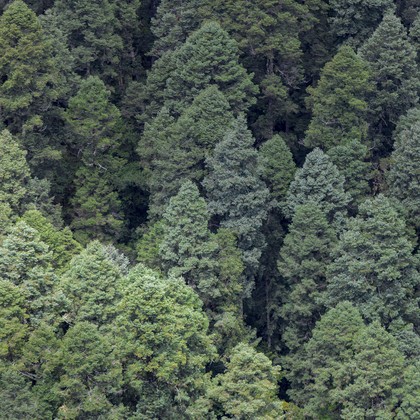 High montane conifer forest G5
El Chico National Park, Hidalgo, Mexico
81 species
Conifer forest of the highest mountains and volcanoes, roughly between 2800 and 4000 m. Lower forest belongs to Tropical highland pine-oak forest or Madrean oak and pine-oak woodland, and above the tree line begins Montane grassland, zacatonal and páramo. On the volcanoes of the Trans-Mexican Volcanic Belt, such as Nevado de Toluca and Pico de Orizaba, sacred fir, <em>Abies religiosa</em>, grows with open forest of <em>Pinus hartwegii</em> above it up to the tree line; similar forest stands on the volcanoes of Guatemala. In Baja California the forest of the Sierra San Pedro Mártir with <em>Pinus jeffreyi</em> belongs here. Red Warbler, Strickland's Woodpecker, Golden-crowned Kinglet and Red Crossbill live in the high forest of Mexico, and in the Sierra San Pedro Mártir Mountain Chickadee, Pygmy Nuthatch and the reintroduced California Condor.
Savannas and montane grasslands H
Open grassland with scattered trees or shrubs, in the tropical lowlands and high in the mountains. Sown pasture and fields belong to Farmland and built-up land, and dry grassland of the north to Desert, semi-desert and chaparral. The subdivision follows altitude and tree species: lowland savannas with scattered broadleaf trees, savannas with Caribbean pine, and treeless grasslands above or between the montane forests. For birds these are habitats of ground nesters and open-country species, such as quails, sparrows, meadowlarks, flycatchers and raptors that hunt from a perch or on the wing.
-
 Lowland savanna and open grassland H1
pine savanna at Payne's Creek, Belize
139 species
Natural grassy plains with scattered trees and shrubs in the lowlands, often on poor soil that becomes waterlogged in the rainy season. Savanna with Caribbean pine belongs to Pine savanna, and sown pasture to Pasture and grazing land with trees. Larger savannas lie in Tabasco and Campeche, in the Pacific lowlands from Chiapas to Nicaragua and in Coclé in Panama; characteristic trees are jícaro, <em>Crescentia alata</em>, nance, <em>Byrsonima crassifolia</em>, and chaparro, <em>Curatella americana</em>. Double-striped Thick-knee rests in the grass by day, White-tailed Hawk and Aplomado Falcon hunt over the plain, Fork-tailed Flycatcher and Eastern Meadowlark perch on shrubs and posts, and Botteri's Sparrow, Wedge-tailed Grass Finch and Grassland Yellow Finch live in the grass.
-
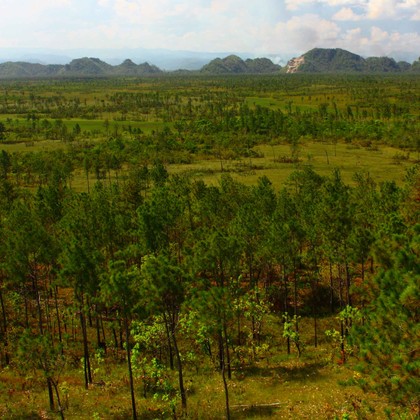 Pine savanna H2
Maya Mountains, Belize
46 species
Open grassland with scattered Caribbean pines, <em>Pinus caribaea</em>, on poor, sandy soil in the lowlands of Belize, Petén and the Mosquitia of Honduras and Nicaragua. Pine forest in the mountains belongs to Tropical highland pine-oak forest, savanna without pines to Lowland savanna and open grassland. Nance, <em>Byrsonima crassifolia</em>, and oaks grow between the pines, and the palmetto <em>Acoelorraphe wrightii</em> in wet hollows; regular fires keep the landscape open. Yellow-headed Amazon nests in these savannas in Belize and Yucatan Bobwhite lives here in the Mosquitia. Acorn Woodpecker, Grace's Warbler, Hepatic Tanager and Rusty Sparrow are pine birds that here come down almost to sea level, and Vermilion Flycatcher hunts from low branches.
-
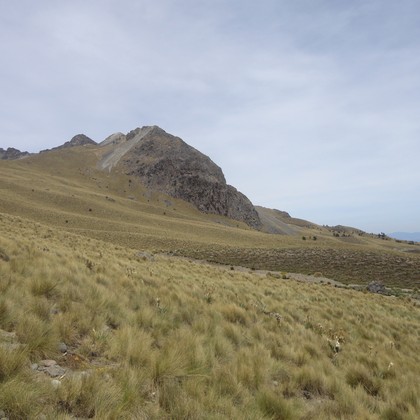 Montane grassland, zacatonal and páramo H3
zacatonal on the Nevado de Toluca, State of Mexico, Mexico
55 species
Treeless grasslands and dwarf scrub above the tree line or in openings between the montane forests, mostly high in the mountains. Lower natural grasslands belong to Lowland savanna and open grassland, and dry grassland of the north to Semi-desert grassland. On the Mexican volcanoes grows zacatonal of tall tussocks of <em>Muhlenbergia</em> and <em>Festuca</em>, in Guatemala there are mountain meadows on the Cuchumatanes plateau, and in Costa Rica and Panama páramo with dwarf bamboo, <em>Chusquea</em>, covers Cerro de la Muerte and Chirripó. Striped Sparrow lives in the zacatonal of central Mexico and the endangered Sierra Madre Sparrow only in a few grasslands south of Mexico City. Volcano Junco, Timberline Wren, Volcano Hummingbird and Peg-billed Finch live in the páramo.
Desert, semi-desert and chaparral I
Dry, open landscapes in northern Mexico, where more water evaporates than falls as rain. Thorn scrub and cactus forest of the tropics belong to Dry forest and thorn scrub, and grassland of the tropical lowlands and the mountains to Savannas and montane grasslands. The subdivision follows the great deserts: the Sonoran Desert, the desert of the Baja California peninsula, the Chihuahuan Desert on the plateau, the semi-desert grassland and the Mediterranean scrub of the northwest. For birds these are habitats of quails, thrashers, wrens, sparrows and raptors, and of hummingbirds drawn to cactus and agave flowers.
-
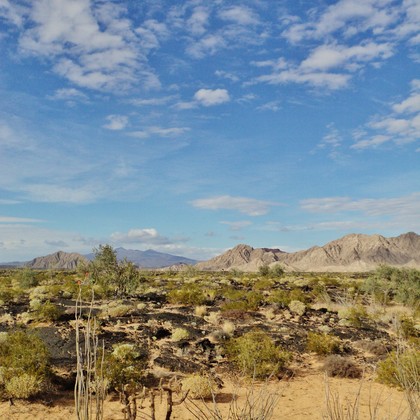 Sonoran Desert I1
El Pinacate, Sonora
62 species
Desert scrub with columnar cacti and small thorny trees in the lowlands of Sonora and northeastern Baja California. The middle and south of the peninsula belong to Baja California desert, and the lower thorn scrub further south to Thorn scrub and cactus forest. In the Altar Desert and around Hermosillo and Bahía de Kino grow saguaro, <em>Carnegiea gigantea</em>, cardón, <em>Pachycereus pringlei</em>, palo verde, <em>Parkinsonia microphylla</em>, and ironwood, <em>Olneya tesota</em>. Gila Woodpecker and Gilded Flicker excavate nest holes in the saguaros, which are later used by Elf Owl. Gambel's Quail walks in small groups beneath the shrubs, Cactus Wren, Curve-billed Thrasher and Bendire's Thrasher sing from the cacti, Costa's Hummingbird visits flowering shrubs, and Harris's Hawk hunts in family groups.
-
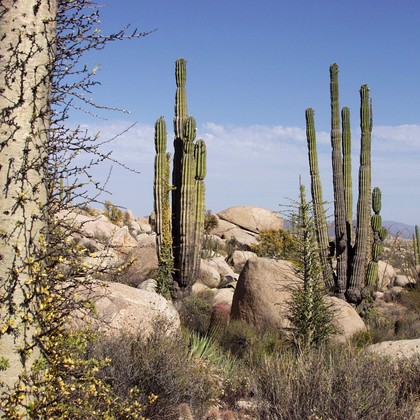 Baja California desert I2
Cataviña, Baja California, Mexico
36 species
Desert and sarcocaulescent scrub of the middle and south of the Baja California peninsula, with thick-stemmed shrubs that store water in their trunks. The Mediterranean scrub of the northwest belongs to Chaparral and coastal sage scrub, and the desert across the Gulf of California to Sonoran Desert. Around Cataviña the boojum or cirio, <em>Fouquieria columnaris</em>, grows among granite boulders and cardón, <em>Pachycereus pringlei</em>, and in the Vizcaíno stands the elephant tree, <em>Pachycormus discolor</em>. Grey Thrasher occurs only on the peninsula, and LeConte's Thrasher lives on the barest plains of the Vizcaíno. California Quail, Gila Woodpecker, Cactus Wren, California Gnatcatcher and Costa's Hummingbird are widespread.
-
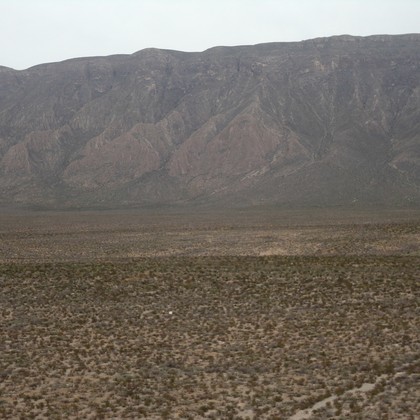 Chihuahuan Desert and plateau scrub I3
Coahuila, Mexico
75 species
Scrub of creosote bush, agave and yucca in the Chihuahuan Desert and the dry basins of the Mexican Plateau. Where grass dominates, Semi-desert grassland begins, and the lower thorny scrub of Tamaulipas belongs to Thorn scrub and cactus forest. In the Bolsón de Mapimí, around Cuatro Ciénegas and on the plateau of San Luis Potosí grow creosote bush, <em>Larrea tridentata</em>, lechuguilla, <em>Agave lechuguilla</em>, palm yucca, <em>Yucca filifera</em>, and ocotillo, <em>Fouquieria splendens</em>. Scaled Quail and Greater Roadrunner run between the shrubs, Black-throated Sparrow, Crissal Thrasher and Pyrrhuloxia are characteristic, and Chihuahuan Raven nests in yuccas and on poles. Lucifer Sheartail visits the flowering agaves.
-
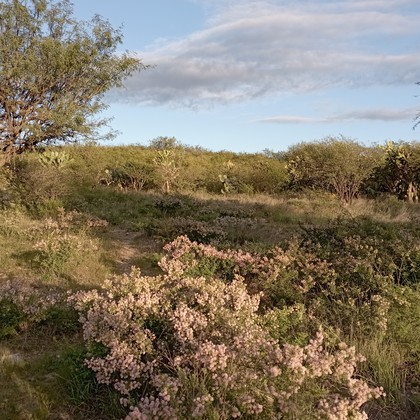 Semi-desert grassland I4
xeric scrub near Dolores Hidalgo, Guanajuato, Mexico
80 species
Open grassland with scattered yuccas and mesquite shrubs on the plateau of Chihuahua, Durango and Zacatecas. Grassland of the tropical lowlands belongs to Lowland savanna and open grassland, montane meadow to Montane grassland, zacatonal and páramo, and closed scrub to Chihuahuan Desert and plateau scrub. Near Janos and in the Valle Colombia lie vast plains of blue grama, <em>Bouteloua gracilis</em>, with colonies of black-tailed prairie dogs. Burrowing Owl nests in their burrows, and Aplomado Falcon and Golden Eagle hunt overhead. Chihuahuan Meadowlark and Cassin's Sparrow breed in the grass, and in winter Ferruginous Hawk, Mountain Plover, Baird's Sparrow and Chestnut-collared Longspur arrive from the north. The endangered Worthen's Sparrow lives in southeastern Coahuila.
-
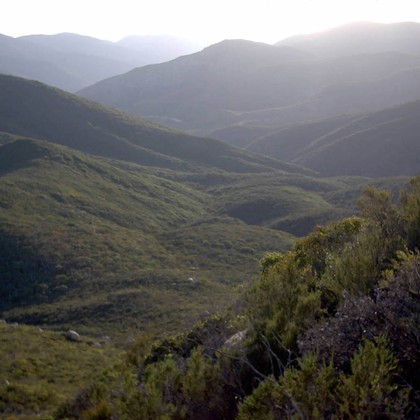 Chaparral and coastal sage scrub I5
hills between Ensenada and Real de Castillo, Baja California, Mexico
48 species
Dense evergreen scrub and grassland with wet winters and dry summers in northwestern Baja California, and the interior chaparral of northern Mexico. Desert belongs to Sonoran Desert or Baja California desert, and the conifer forest of the mountains to High montane conifer forest. Between Tijuana, Tecate and Ensenada grow chamise, <em>Adenostoma fasciculatum</em>, California sagebrush, <em>Artemisia californica</em>, and <em>Ceanothus</em>; the interior chaparral with shrub oaks and manzanita, <em>Arctostaphylos</em>, covers dry mountain slopes from Sonora to Coahuila and Nuevo León. California Thrasher, Wrentit, California Towhee and California Quail are characteristic, and California Gnatcatcher lives in the low coastal sage scrub. Anna's Hummingbird, Bewick's Wren and Spotted Towhee are also common.
Rocks, volcanoes and caves J
Habitats where bare rock, lava or a cave shapes the landscape and plants play only a small part. Sea cliffs and rocky islets belong to Coast, and vegetated mountain and volcano slopes take the forest formation of their altitude. The subdivision follows the origin of the relief: cliffs, canyons and scree slopes, young volcanic cones and lava fields, and the caves, sinkholes and cenotes of the limestone country. For birds these are above all nesting and roosting sites for swifts, falcons, wrens, parakeets and motmots, which breed on the rock and feed in the surrounding land.
-
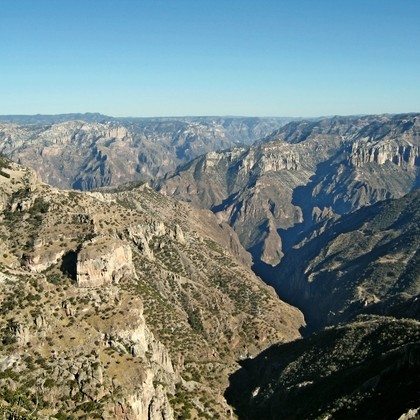 Cliffs, canyons and rocky slopes J1
Copper Canyon, Chihuahua, Mexico
44 species
Rock faces, canyons and scree slopes inland, from the dry mountains of the north to the gorges of Chiapas. Sea cliffs belong to Rocky shore and sea cliffs, and bare lava and ash cones to Volcanoes and lava fields. In the Copper Canyon in the Sierra Tarahumara the gorges are more than 1500 m deep, and in the Sumidero Canyon in Chiapas the walls rise to about 1000 m above the river. Agaves, <em>Agave</em>, grow on the rocks, and in the north sotol, <em>Dasylirion</em>. Canyon Wren sends its falling song between the walls, Rock Wren forages on scree slopes, and White-throated Swift nests in crevices and White-collared Swift also behind waterfalls. Peregrine Falcon and, in the north, Golden Eagle breed on ledges.
-
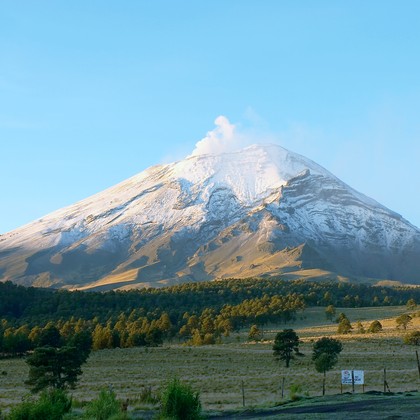 Volcanoes and lava fields J2
Popocatépetl from Paso de Cortés, Mexico
7 species
Bare or sparsely vegetated volcanic cones, ash fields and lava fields, known in Mexico as malpaís or pedregal. Vegetated volcano slopes take the forest formation of their altitude, and rock faces of other rock belong to Cliffs, canyons and rocky slopes. In the Pinacate in Sonora craters and black lava flows lie in the middle of the desert, Paricutín in Michoacán arose in 1943 in a maize field, and in Mexico City the palo loco, <em>Pittocaulon praecox</em>, grows on the lava field of the Pedregal de San Ángel. In the crater of Masaya in Nicaragua Pacific Parakeet nests in the walls, among the sulphur fumes. Rock Wren and Black-throated Sparrow live on the lava of the Pinacate, and Volcano Junco on the bare summit of Irazú in Costa Rica.
-
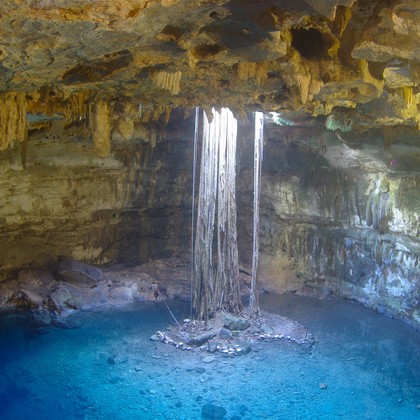 Caves and cenotes J3
Cenote Dzitnup, Yucatán, Mexico
5 species
Caves, sinkholes and cenotes, above all in the limestone of Yucatán and the Sierra Madre Oriental, where birds breed or spend the night. The surrounding forest takes its own formation, and open rock faces belong to Cliffs, canyons and rocky slopes. The cenotes of Yucatán are collapsed caves reaching down to the groundwater, where aerial roots of figs, <em>Ficus</em>, hang down the walls to the water. Turquoise-browed Motmot digs nest tunnels in the soft walls, and Cave Swallow builds mud nests there. In the Sótano de las Golondrinas in San Luis Potosí, a shaft more than 300 m deep, large flocks of White-collared Swift and Green Parakeet roost and spiral out at dawn. American Barn Owl spends the day in cave entrances.
Farmland and built-up land K
Land shaped by people for crops, livestock, tree crops and housing, from the milpa beside a village to the great cities. Natural grasslands belong to Savannas and montane grasslands, and young forest on abandoned land to Humid lowland forest. The subdivision follows land use: fields, pasture, shade coffee and cacao, plantations and orchards, wet crops, built-up land, and harbours and dumps. For birds it is a mixed habitat: open-country species spread with deforestation, shade coffee shelters forest birds and wintering warblers, and rice fields draw herons and shorebirds.
-
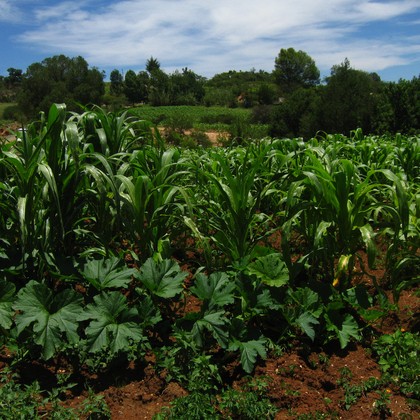 Arable fields and milpa K1
Tilantongo, Oaxaca, Mexico
138 species
Fields of maize and beans, sugar cane, sorghum and cotton, and the fallow land between them. Pasture belongs to Pasture and grazing land with trees, and rice to Rice fields and fish ponds. The milpa, in which maize, <em>Zea mays</em>, is grown together with beans, <em>Phaseolus</em>, and squash, <em>Cucurbita</em>, is the land of smallholders from Mexico to Panama; large blocks of sorghum and sugar cane lie in Sinaloa, Tamaulipas and the Pacific lowlands of Central America. Blue-black Grassquit, Morelet's Seedeater and Groove-billed Ani live along edges and in fallow land, Ruddy Ground Dove and Inca Dove pick up seeds from the ground, and after harvest flocks of Red-winged Blackbird and Bronzed Cowbird feed on the leftover grain. On migration large flocks of Dickcissel settle in the fields, and the introduced Ring-necked Pheasant lives in the Mexicali Valley.
-
 Pasture and grazing land with trees K2
Coronado, Costa Rica
333 species
Sown pastures or grasslands created by grazing, with scattered trees, living fences and watering ponds, now one of the largest landscapes of the region. Natural savanna belongs to Lowland savanna and open grassland, and fields to Arable fields and milpa. In Tabasco, Veracruz, Petén, Olancho and Guanacaste the potreros have replaced much old forest; the fences grow from cuttings of madre cacao, <em>Gliricidia sepium</em>, and gumbo-limbo, <em>Bursera simaruba</em>. Cattle Egret follows the cattle, Crested Caracara and Roadside Hawk watch for prey from posts, and Tropical Kingbird and Fork-tailed Flycatcher perch on the wires. Southern Lapwing is spreading through the pastures. In winter Scissor-tailed Flycatcher and Western Kingbird hunt from the fences, and on migration Upland Sandpiper rests in short grass.
-
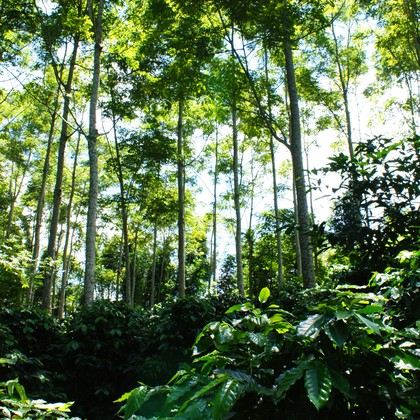 Shade coffee, cacao and agroforestry K3
shade-grown coffee (agroforestry) in the Sierra Norte de Puebla, Mexico
200 species
Coffee and cacao groves under a canopy of shade trees, and other crops in which trees are kept. Sun coffee and tree monocultures belong to Plantations and orchards. In the Soconusco in Chiapas, around Coatepec in Veracruz and in the highlands of Guatemala and Costa Rica, coffee, <em>Coffea arabica</em>, grows under inga trees, <em>Inga</em>; cacao, <em>Theobroma cacao</em>, stands under tall trees in Tabasco and Bocas del Toro. For forest birds shade coffee works as a substitute forest: Rufous-capped Warbler lives there all year, and in the cacao Keel-billed Toucan and Collared Aracari search for fruit. In winter Tennessee Warbler, Wilson's Warbler, Black-throated Green Warbler, Black-and-white Warbler and Golden-winged Warbler are numerous, and Baltimore Oriole drinks nectar from the flowering inga trees alongside Tennessee Warbler.
-
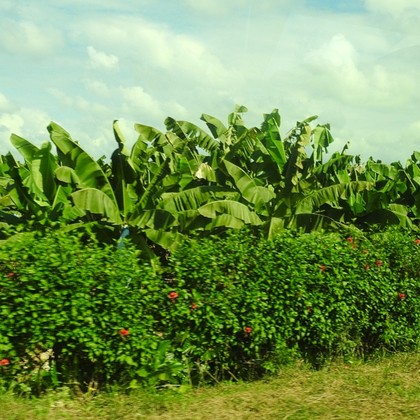 Plantations and orchards K4
Costa Rica
54 species
Oil palm, bananas, citrus, mango, coconut and avocado, and timber plantations of teak, pine and eucalyptus. Coffee and cacao under shade trees belong to Shade coffee, cacao and agroforestry. Oil palm, <em>Elaeis guineensis</em>, covers large parts of the Aguán valley in Honduras, of Petén and Chiapas and of the Pacific coast of Costa Rica; bananas, <em>Musa</em>, grow in the Caribbean lowlands and citrus, <em>Citrus</em>, in Veracruz and Nuevo León. Few species live in the dense monocultures, but Groove-billed Ani, Great Kiskadee, Social Flycatcher, Blue-grey Tanager, Palm Tanager and Clay-colored Thrush do occur. In orchards Red-lored Amazon, Orange-fronted Parakeet and Melodious Blackbird eat ripe fruit, and in winter Baltimore Oriole looks for nectar and fruit there.
-
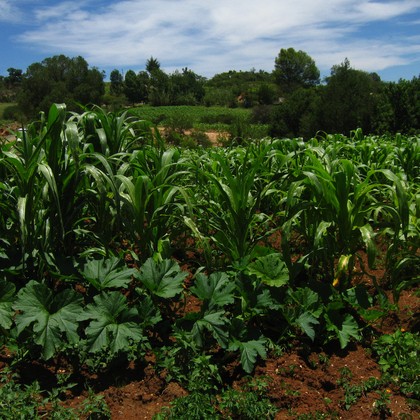 Rice fields and fish ponds K5
Tilantongo, Oaxaca, Mexico
106 species
Rice fields, irrigated fields, fish ponds and shrimp farms, which take the place of natural marshes for many waterbirds. Natural marshes belong to Freshwater marsh and wet grassland, and salt works to Lagoon, estuary and salt pan. Rice, <em>Oryza sativa</em>, is grown on a large scale in Campeche, around Palo Verde in Guanacaste and in the Pacific lowlands of Panama, and shrimp farms (camaroneras) line the coast of Sonora, Sinaloa and the Gulf of Fonseca. Newly flooded or harvested fields draw American White Ibis, Wood Stork, Great Egret, Black-necked Stilt and Fulvous Whistling Duck, and in winter Least Sandpiper, Long-billed Dowitcher, Lesser Yellowlegs and Blue-winged Teal. In drained ponds Neotropic Cormorant and Snowy Egret hunt for stranded fish.
-
 Villages, towns, gardens and parks K6
Oaxaca, Mexico
308 species
Villages and towns with their gardens, squares, parks and yards, from a hamlet with fruit trees to Mexico City. Harbours, industrial sites and dumps belong to Harbours, dumps and industrial sites. Squares and parks are often planted with jacaranda, <em>Jacaranda mimosifolia</em>, figs, <em>Ficus</em>, and flowering shrubs such as bougainvillea, <em>Bougainvillea</em>, which attract hummingbirds: Rufous-tailed Hummingbird in Central America, Cinnamon Hummingbird along the Pacific coast, and Broad-billed Hummingbird and Berylline Hummingbird in the Mexican highlands. Great-tailed Grackle roosts by the thousand in the trees of the squares, Inca Dove and Clay-colored Thrush live in gardens, and House Finch sings on the rooftops of Mexico City. House Sparrow, Rock Pigeon and Eurasian Collared-Dove are introduced and widespread, Common Starling occurs in northern Mexico, and American Barn Owl nests in church towers.
-
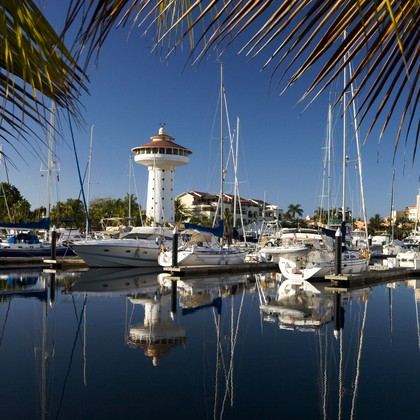 Harbours, dumps and industrial sites K7
Ixtapa-Zihuatanejo, Guerrero, Mexico
35 species
Harbours, piers, airports, dumps and industrial sites, where refuse and fish waste draw large gatherings of scavengers and gulls. Residential areas belong to Villages, towns, gardens and parks, and natural shores to Coast. On dumps from Mexico to Panama Black Vulture and Turkey Vulture are always present, together with Crested Caracara, Cattle Egret and Great-tailed Grackle. In fishing ports such as Mazatlán, Guaymas and Puntarenas, Brown Pelican, Magnificent Frigatebird and Laughing Gull wait by the boats for scraps, and Royal Tern and Neotropic Cormorant rest on piers and mooring posts. Along the Gulf of California Heermann's Gull and Yellow-footed Gull join them, and in Ensenada Western Gull.
Classification: Faber-Langendoen, D. et al. (2018), <em>The EcoVeg approach in the Americas</em> (Phytocoenologia 48: 215–237), based on the macrogroups of NatureServe's International Vegetation Classification (IVC), as mapped for North America, Central America and the Caribbean; see also Ferrer-Paris et al. (2019). Formations outside the scope of this vegetation classification (open sea, coral reef, unvegetated coast, open water, caves, farmland and built-up land) follow a separate classification written for this guide. The names and descriptions were translated and written for this guide.