All species › Gamebirds › New World quail › Spotted Wood Quail
Position in the tree Birds Aves › Birds with a flexible palate Neognathae › Fowl Galloanserae
Spotted Wood Quail | Odontophorus guttatus
Gevlekte tandkwartel | Codorniz bolonchaco
The Spotted Wood Quail is the most widespread wood quail of the guide area, from southern Mexico to western Panama. It lives on the floor of humid forest, in the north also in the lowlands, in Costa Rica and Panama mainly in montane forest. The species does not occur outside the guide area.
Voice
A loud, rhythmic and rolling duet or chorus, a rapid repetition of whistled phrases, mainly at dawn and dusk. When alarmed a soft clucking.
Recording: Manuel Grosselet — CC BY-NC-SA 4.0 · converted to mono · xeno-canto
Identification
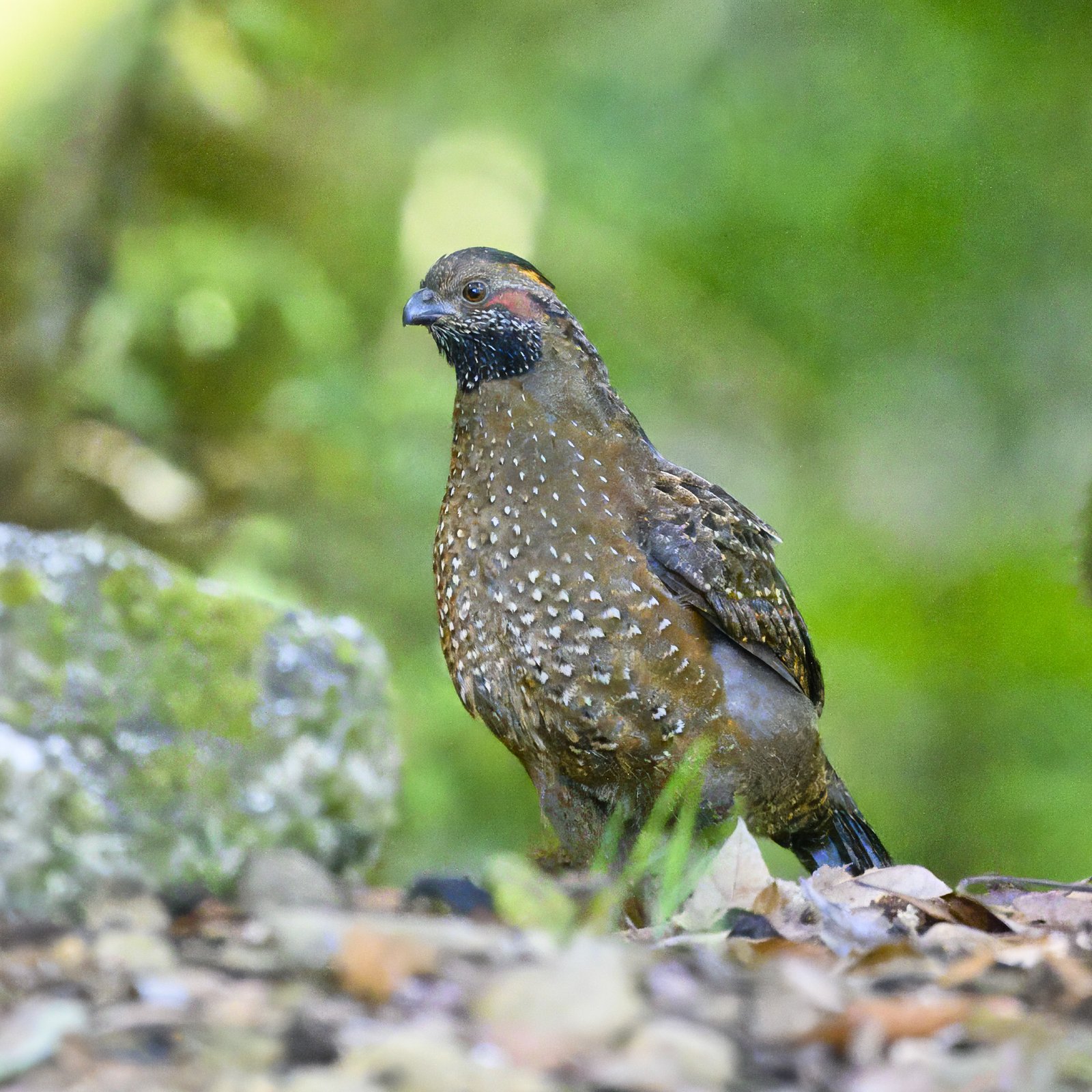
24–27 cm; a stocky wood quail with a short tail and a full, bushy crest, which is orange in the centre in the male and dark brown in the female. The throat is black with fine white streaks. The underparts are brown to rufous-brown or olive-brown, with conspicuous white, black-edged teardrop spots on the breast and belly. The upperparts are brown, finely vermiculated black, with small pale spots on the wing coverts. The bill is black, the legs grey.
Confusion species
Black-breasted Wood Quail Odontophorus leucolaemus in the montane forest of Costa Rica and Panama is much darker, with a white throat, a black breast and no white spots. Singing Quail Dactylortyx thoracicus in Mexico and northern Central America is smaller, without a distinct crest and without teardrop spots, with a cinnamon or grey throat. Marbled Wood Quail Odontophorus gujanensis of the lowlands in Costa Rica and Panama is plain dark brown with orange-red skin around the eye.
Habitat
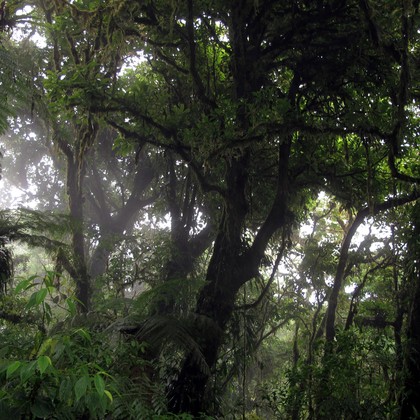
The floor of humid evergreen forest, cloud forest and pine-oak forest, with dense undergrowth and plenty of leaf litter. In Mexico, Belize and Guatemala also in lowland rainforest and semi-evergreen seasonal forest from near sea level; in Costa Rica and Panama mainly from about 1000 to 3000 m. It lives in groups of five to ten birds that scratch together in the litter for seeds, fruit and invertebrates.
Where the bird is most at home, classified by the vegetation units of Mexico and Central America.





Range and movements
In Mexico in southern Veracruz, Oaxaca, Tabasco, Chiapas and the southern Yucatán Peninsula (Campeche and Quintana Roo), further in Belize, Guatemala, Honduras, Nicaragua and Costa Rica, and in western Panama in Chiriquí, Bocas del Toro and Veraguas. The species does not occur outside the guide area.
- Resident
- dark = core range, pale = thinly spread
How and when to look
In Costa Rica at Monteverde, in the Savegre valley at San Gerardo de Dota and on the slopes of Barú in Chiriquí, where groups sometimes walk slowly across forest trails. In Belize and Guatemala in large lowland forests, but there mostly heard.
Conservation status
Not threatened. Fairly common in large forests; outside protected areas vulnerable to hunting and forest loss.
Scientific name
Odontophorus guttatus | (Gould, 1838)
Gould described the species in 1838 as Ortyx guttata; because it was later moved to another genus, the author and year stand in brackets. The genus Odontophorus was introduced in 1816 by Vieillot. Odontophorus is Greek, from odous, odontos 'tooth' and -phoros 'bearing': 'tooth-bearer', after the serrated edge of the lower mandible. guttatus is Latin for 'spotted', from gutta 'drop', after the white teardrop spots on the underparts. The specimen the first description was based on came from Gulf of Honduras.