All species › Gamebirds › New World quail › Black-breasted Wood Quail
Position in the tree Birds Aves › Birds with a flexible palate Neognathae › Fowl Galloanserae
Black-breasted Wood Quail | Odontophorus leucolaemus
Zwartborsttandkwartel | Corcovado pechinegro
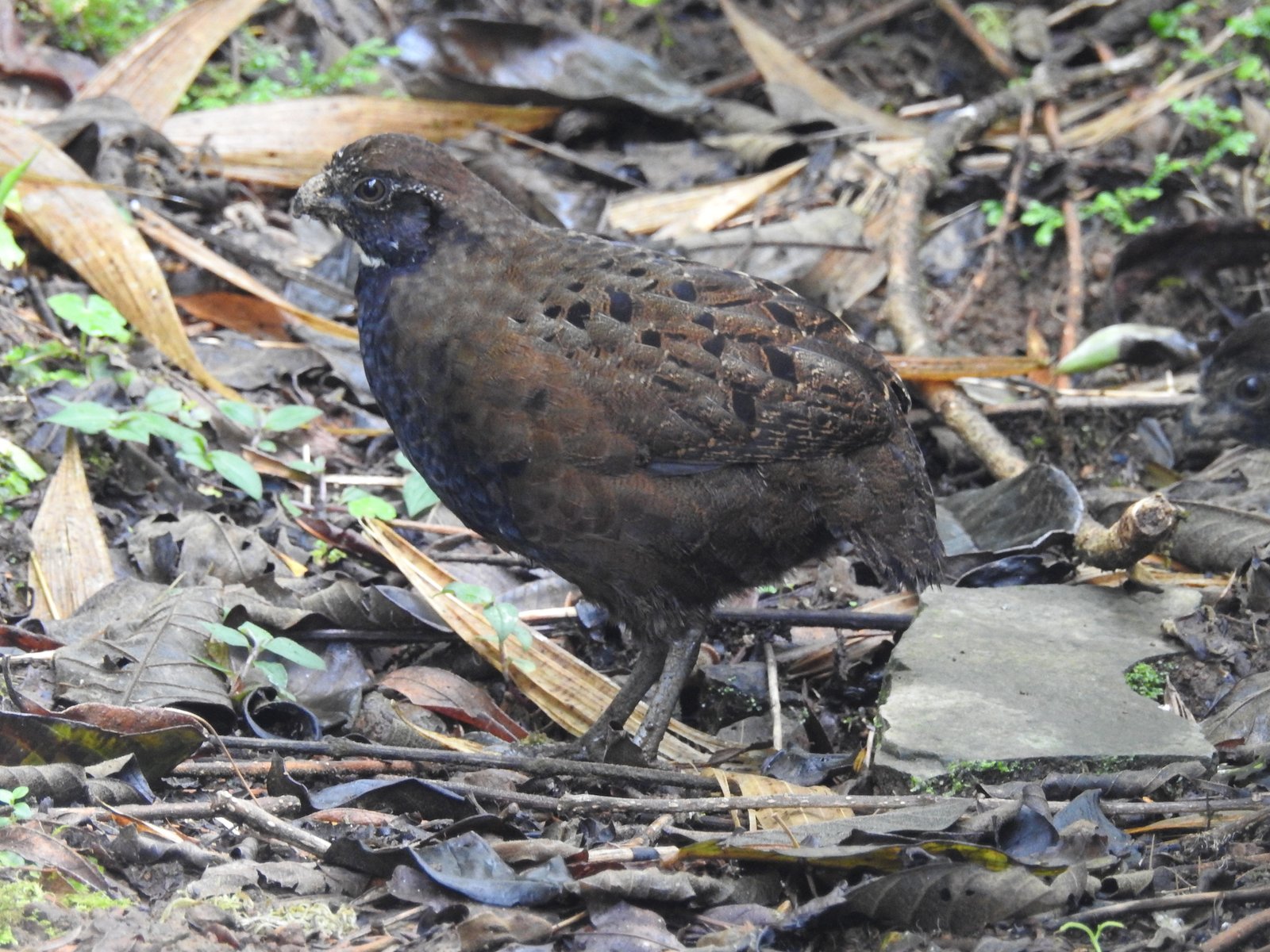
The Black-breasted Wood Quail is a very dark wood quail with a white throat, found in the wet montane forest of Costa Rica and western Panama. Groups live hidden in dense undergrowth and are heard far more often than seen. The species does not occur outside the guide area.
Voice
A fast, rhythmic and rolling duet or chorus of whistled notes, repeated by the group for minutes on end, mainly at dawn. Also soft squeaky and clucking contact notes.
Recording: Jorge Gabriel Campos — CC BY-NC-SA 4.0 · shortened to the first 60 s, mono · xeno-canto
Identification
22–25 cm; a small, stocky wood quail with a short tail and a short, dark brown crest. The plumage is largely blackish-brown. The throat is white, sharply set off against a black breast; the extent of white varies between birds and is small in some. The belly and flanks are dark brown with fine black and pale barring. The upperparts are dark brown, finely vermiculated black. The bill is black, the legs dark grey. Male and female are almost alike.
Confusion species
Spotted Wood Quail Odontophorus guttatus lives in the same montane forest but is browner, with an orange or brown crest, a black throat with white streaks and white teardrop spots on the underparts. Black-eared Wood Quail Odontophorus melanotis lives lower and has a black throat and a chestnut breast. Marbled Wood Quail Odontophorus gujanensis of the lowlands is plain brown with orange-red skin around the eye.
Habitat
The floor of wet montane forest and cloud forest, mainly on the Caribbean side, from about 700 to 1850 m, with a preference for dense undergrowth, steep slopes and ravines. It lives in groups of four to ten birds that forage together in the leaf litter and on the mossy ground for seeds, fruit and invertebrates.
Where the bird is most at home, classified by the vegetation units of Mexico and Central America.


Range and movements
In Costa Rica in the Cordillera de Tilarán, the Cordillera Central and the Talamanca range, and in western Panama in Chiriquí, Bocas del Toro and Veraguas. The species does not occur outside the guide area.
- Resident
- dark = core range, pale = thinly spread
How and when to look
In the cloud forest of Monteverde and in Braulio Carrillo, and in Panama in the Fortuna area in Chiriquí. The chorus is the best clue; on a quiet approach a group sometimes crosses a trail.
Conservation status
Not threatened. Locally fairly common in large protected forests; with its small range it is nevertheless vulnerable to the loss and fragmentation of montane forest.
Scientific name
Odontophorus leucolaemus | Salvin, 1867
Salvin described the species in 1867 and placed it straight away in the genus where it still stands. The genus Odontophorus was introduced in 1816 by Vieillot. Odontophorus is Greek, from odous, odontos 'tooth' and -phoros 'bearing': 'tooth-bearer', after the serrated edge of the lower mandible. leucolaemus is Greek, from leukos 'white' and laimos 'throat', after the white throat. The specimen the first description was based on came from Cordillera de Tolé, Veraguas, Panama.