All species › Gamebirds › New World quail › Tacarcuna Wood Quail
Position in the tree Birds Aves › Birds with a flexible palate Neognathae › Fowl Galloanserae
Tacarcuna Wood Quail | Odontophorus dialeucos
Zwartkeeltandkwartel | Corcovado del Tacarcuna
The Tacarcuna Wood Quail is one of the least known birds of the guide area. It lives only in the montane forest of the Serranía del Darién on the border of Panama and Colombia and was not described until 1963, from birds collected on Cerro Malí and Cerro Tacarcuna. Almost nothing has been published on its voice, food or breeding.
No photograph of a living wild bird of this species with a suitable Creative Commons licence exists. Do you have one that meets the rules? Send it in.
Voice
Almost unknown. Probably, as in related wood quails, a rhythmic duet given mainly at dawn.
Recording: Isaac N Pizarro T — CC BY-NC-SA 4.0 · converted to mono · xeno-canto
Identification
22–28 cm; a stocky wood quail with a short tail. The male has a black crown and a black throat, with a white supercilium, white lores and a white chin. The sides of the neck and the mantle are cinnamon; the back and rump are olive-brown with black vermiculation. The breast and belly are chestnut with small white spots. The female resembles the male but has warmer, ochre-brown underparts. Young birds have less white on the chin and more black on the throat.
Confusion species
In its small range no other wood quail occurs at the same elevation; the black-and-white head with chestnut underparts is distinctive. Marbled Wood Quail Odontophorus gujanensis lives lower in Darién, is plain dark brown and has orange-red skin around the eye. Tawny-faced Quail Rhynchortyx cinctus is smaller, without a crest, with a rufous-orange face. Choco Tinamou Crypturellus kerriae has no crest and no black-and-white head and lives in the foothills.
Habitat
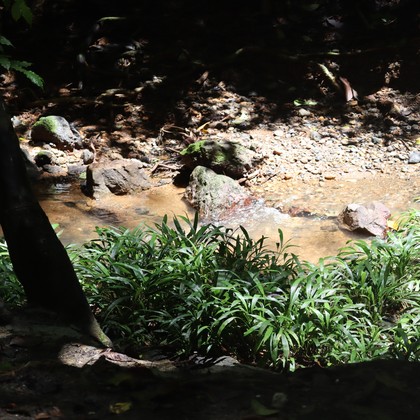
The floor of wet montane forest and cloud forest between about 1050 and 1450 m. Probably, like other wood quails, in small groups that forage in the leaf litter; data are lacking.
Where the bird is most at home, classified by the vegetation units of Mexico and Central America.

Range and movements
In the guide area only in the Serranía del Darién in eastern Darién Province, Panama, known from Cerro Tacarcuna and Cerro Malí. Outside the guide area in the same mountains on the Colombian side, in north-western Chocó. The entire range covers only a few hundred square kilometres.
How and when to look
The area is remote, reachable only on a multi-day expedition on foot, and lies in the border zone with Colombia, where access is restricted. The species is therefore rarely recorded.
Conservation status
Not threatened according to the current assessment; previously classed as Vulnerable and later as Near Threatened. The range is very small, but the forest in these remote mountains is largely intact and the population appears stable. The Panamanian part lies within Darién National Park.
Scientific name
Odontophorus dialeucos | Wetmore, 1963
Wetmore described the species in 1963 and placed it straight away in the genus where it still stands. The genus Odontophorus was introduced in 1816 by Vieillot. Odontophorus is Greek, from odous, odontos 'tooth' and -phoros 'bearing': 'tooth-bearer', after the serrated edge of the lower mandible. dialeucos is Greek, from dia- 'thoroughly' and leukos 'white': 'intermixed with white', after the white markings on head and throat. The specimen the first description was based on came from Serranía del Darién (Cerro Malí), Panama.