All species › Parrots › African and New World parrots › Scarlet Macaw
Position in the tree Birds Aves › Birds with a flexible palate Neognathae › All other modern birds Neoaves › Landbirds Telluraves › Falcons, parrots and passerines Australaves › Falcons and passerines Eufalconimorphae › Parrots and passerines Psittacopasserae
Scarlet Macaw | Ara macao
Geelvleugelara | Guacamaya roja
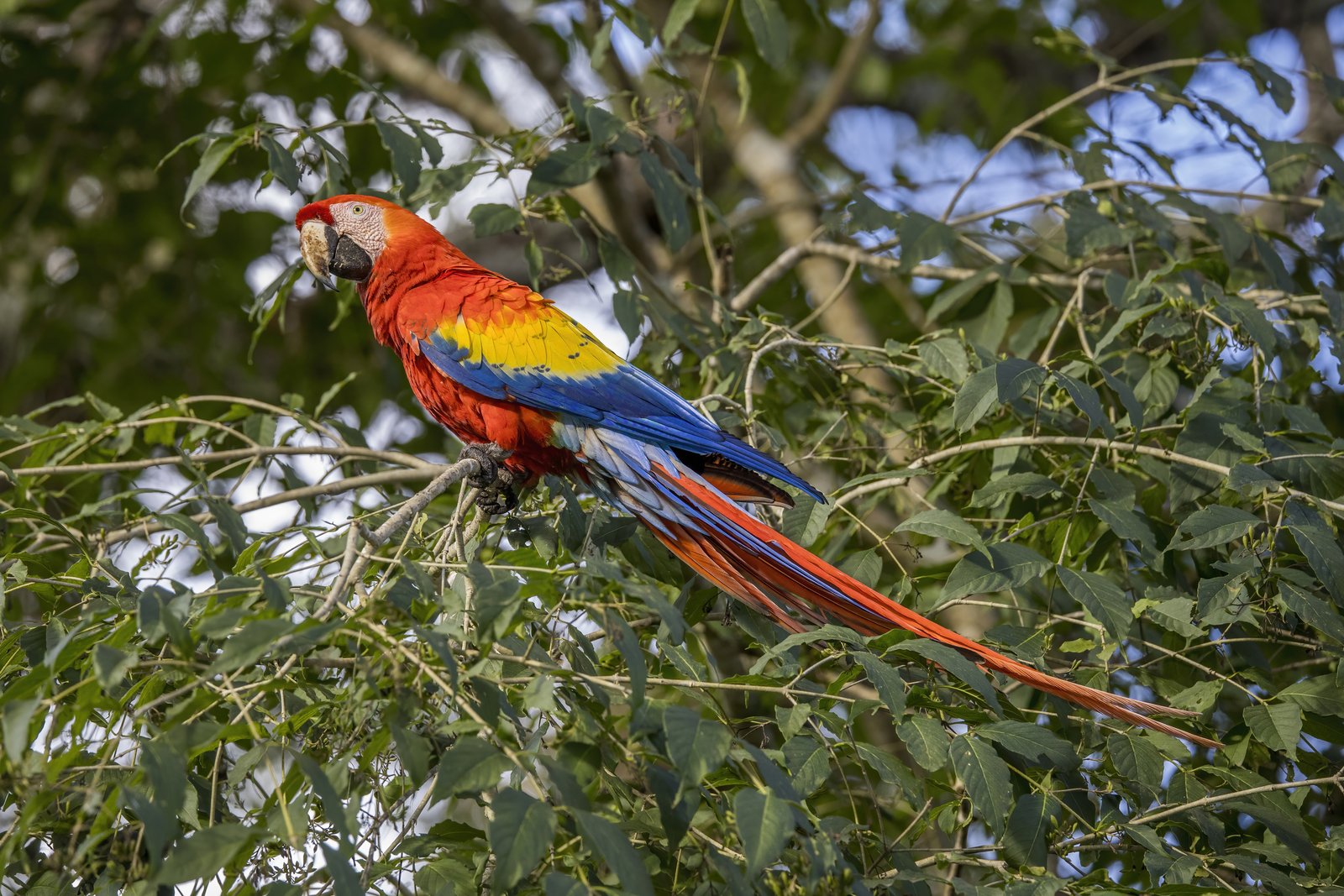
The Scarlet Macaw is the large red macaw of the guide area, with a range that extends from southern Mexico into South America. In Mesoamerica it has disappeared from much of its former range and now lives mainly in a few large forest areas. It is the national bird of Honduras.
Voice
A loud, raw, grating raaa-ah, mainly in flight and audible over a great distance; perched groups give lower growls and screeches.
Recording: Mauricio Cuéllar-Ramírez — CC BY-NC-SA 4.0 · shortened to the first 60 s, mono · xeno-canto
Identification
81–96 cm, more than half of it tail. The body is scarlet, the greater wing coverts yellow with green tips, and the flight feathers, rump and tail tip blue. The face is bare and white, the upper mandible pale horn, the lower black. The sexes are alike. Birds from Mexico to Nicaragua (A. m. cyanopterus) are slightly larger and show more blue on the wing coverts and narrower green tips to the yellow than those of Costa Rica and Panama (A. m. macao). Flight is on slow, deep beats, usually in pairs or family groups.
Confusion species
Red-and-green Macaw Ara chloropterus, in the guide area only in eastern Panama, is a darker red, has green instead of yellow wing coverts and lines of small red feathers on the bare face. Military Macaw Ara militaris and Great Green Macaw Ara ambiguus are green with a red forehead.
Habitat
Humid and semi-deciduous lowland forest, gallery forest along rivers and forest bordering mangroves, also semi-open country with large isolated trees; mostly below 1000 m. It eats seeds, nuts and fruit in the canopy, and visits clay banks along rivers. It nests in a cavity high in a large, often dead tree.
Where the bird is most at home, classified by the vegetation units of Mexico and Central America.






Range and movements
Locally from southern Mexico to Panama: the Selva Lacandona in eastern Chiapas, the Petén in Guatemala, southern Belize, the Mosquitia in Honduras, north-eastern and south-eastern Nicaragua, the Pacific side of Costa Rica (Carara, Osa) and in Panama mainly Coiba and the southern Azuero Peninsula. Released groups live at Palenque and in Los Tuxtlas in Mexico and at Copán in Honduras, among other places. Outside the guide area in northern and central South America, south to Bolivia and Brazilian Amazonia.
- Resident
- dark = core range, pale = thinly spread
How and when to look
Macaws are best seen on their daily flights between roost and feeding areas, shortly after sunrise and before sunset. In Costa Rica they fly around Carara and along the Tárcoles River and on the Osa Peninsula; the call can be heard long before the birds themselves.
Conservation status
Least Concern. In Mesoamerica the species has declined sharply through deforestation and nest poaching for the trade, and the northern subspecies has been reduced to small, scattered groups. Reintroduction and nest-protection projects are under way in Mexico, Guatemala, Honduras and Costa Rica, among others.
Scientific name
Ara macao | (Linnaeus, 1758)
Linnaeus described the species in 1758 as Psittacus Macao; because it was later moved to another genus, the author and year stand in brackets. The genus Ara was introduced in 1799 by De Lacépède. Ara comes from Tupí, where ará is an onomatopoeic name for the macaws. macao comes from Portuguese macau, an old name for macaws; its further origin is unclear (possibly Tupi, or confusion with Macau). The specimen the first description was based on came from South America (not specified).