All species › Parrots › African and New World parrots › Great Green Macaw
Position in the tree Birds Aves › Birds with a flexible palate Neognathae › All other modern birds Neoaves › Landbirds Telluraves › Falcons, parrots and passerines Australaves › Falcons and passerines Eufalconimorphae › Parrots and passerines Psittacopasserae
Great Green Macaw | Ara ambiguus
Buffons ara | Guacamayo verde mayor
The Great Green Macaw is the heaviest macaw of the guide area, a green macaw of the humid lowlands on the Caribbean side of Central America. It depends heavily on the almendro (Dipteryx oleifera), a tall tree that provides both food and nest cavities. The species is critically endangered and can now be found in only a few places.
Voice
A heavy, raw, grating raa-aah, mainly in flight and audible over a great distance; pairs often call together.
Recording: Martin W — CC BY-NC 4.0 · converted to mono · iNaturalist
Identification
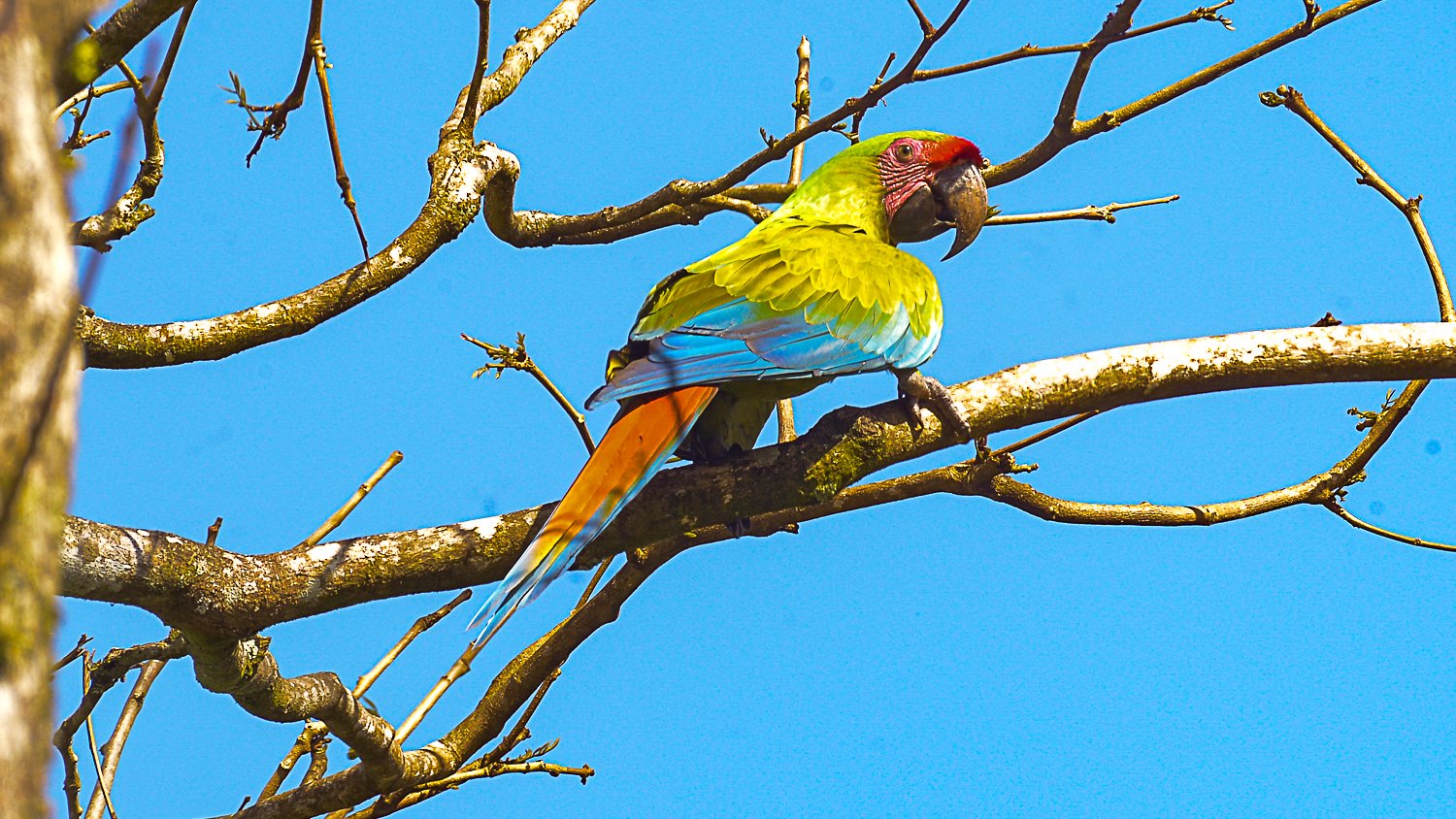
85–90 cm including the long, pointed tail. Mostly pale, yellowish green, with a red forehead and a bare white face with lines of small black feathers. The flight feathers are blue, the lower back and rump pale blue. The tail is reddish brown above with a blue tip and olive-yellow below. The bill is heavy and dark. The sexes are alike.
Confusion species
Military Macaw Ara militaris is very similar but in the guide area occurs only in Mexico; it is smaller and darker green. Scarlet Macaw Ara macao and Red-and-green Macaw Ara chloropterus are red. Chestnut-fronted Macaw Ara severus in eastern Panama is much smaller, with a brown forehead and red underwing.
Habitat
Humid lowland and foothill forest, especially with almendro trees, also forest edges and semi-open country with scattered large trees; mostly below 600 m. It eats seeds, nuts and fruit, especially those of the almendro, and nests in cavities in this tree.
Where the bird is most at home, classified by the vegetation units of Mexico and Central America.





Range and movements
Locally on the Caribbean side of Honduras (Mosquitia) and Nicaragua (including along the Río San Juan), in northern Costa Rica (the San Carlos and Sarapiquí plains) and in Panama, mainly in Darién and on the Caribbean side of Veraguas. Released birds live on the southern Caribbean coast of Costa Rica, at Manzanillo. Outside the guide area in north-western Colombia and, as a separate subspecies, in western Ecuador.
- Resident
- dark = core range, pale = thinly spread
How and when to look
In northern Costa Rica in the Maquenque and Sarapiquí area, where pairs fly over the forest in the morning; on the Caribbean coast at Manzanillo the released birds are seen regularly.
Conservation status
Critically Endangered. Deforestation, especially the felling of almendro trees, and nest poaching for the trade have reduced the species to small, fragmented populations. Projects protecting nests and forest are under way in Costa Rica and Nicaragua, and a reintroduction project in Costa Rica.
Scientific name
Ara ambiguus | (Bechstein, 1811)
Bechstein described the species in 1811 as Psittacus ambiguus; because it was later moved to another genus, the author and year stand in brackets. The genus Ara was introduced in 1799 by De Lacépède. Ara comes from Tupí, where ará is an onomatopoeic name for the macaws. ambiguus is Latin for 'doubtful, ambiguous', probably because this macaw so closely resembles the Military Macaw. The specimen the first description was based on came from northwestern Colombia (designated).