All species › Parrots › African and New World parrots › Red-and-green Macaw
Position in the tree Birds Aves › Birds with a flexible palate Neognathae › All other modern birds Neoaves › Landbirds Telluraves › Falcons, parrots and passerines Australaves › Falcons and passerines Eufalconimorphae › Parrots and passerines Psittacopasserae
Red-and-green Macaw | Ara chloropterus
Groenvleugelara | Guacamayo aliverde
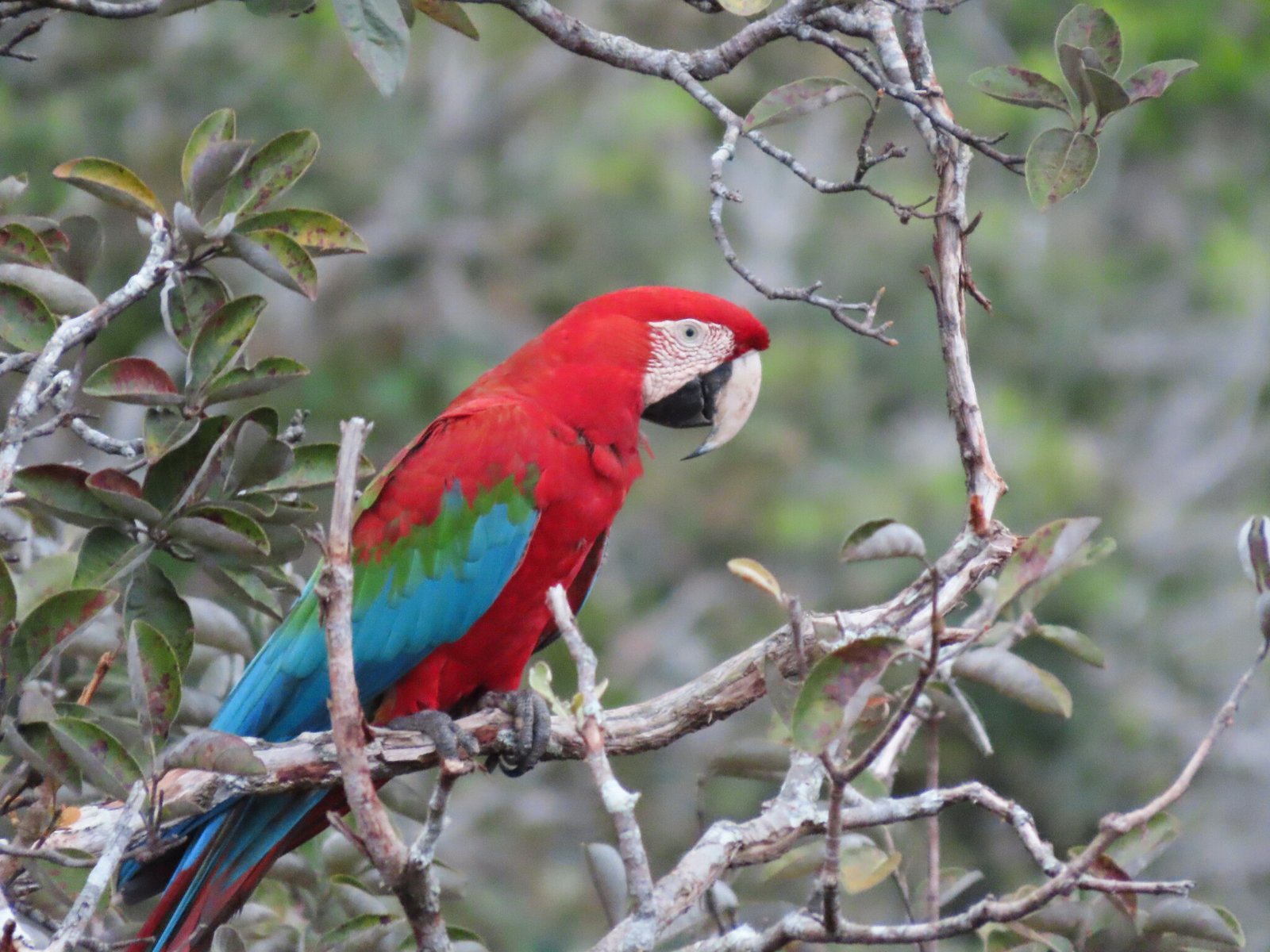
The Red-and-green Macaw is a large, dark red macaw of South America that occurs in the guide area only in eastern Panama. It resembles the Scarlet Macaw but has green instead of yellow on the wing. In Panama it lives mainly in the large, unbroken forests of Darién.
Voice
A loud, raw, grating raaa-ah, very like that of the Scarlet Macaw; mainly in flight and audible over a great distance.
Recording: JAYRSON ARAUJO DE OLIVEIRA — CC BY-NC-SA 4.0 · converted to mono · xeno-canto
Identification
90–95 cm including the long, pointed tail. The head, breast and belly are deep crimson, the median wing coverts green, and the flight feathers, rump and tail tip blue. The face is bare and white, with distinct lines of small red feathers. The upper mandible is pale horn, the lower black. The sexes are alike.
Confusion species
Scarlet Macaw Ara macao, in Panama mainly on Coiba and the Azuero Peninsula, is a paler scarlet, has yellow instead of green wing coverts and a bare white face without red feathers. Seen from below in flight the two species are very similar.
Habitat
Extensive humid lowland and foothill forest, also gallery forest along rivers; in Darién up into the hills of the Serranía de Pirre. It eats seeds, nuts and fruit and visits clay banks. It nests in cavities in large trees.
Where the bird is most at home, classified by the vegetation units of Mexico and Central America.




Range and movements
In the guide area only in eastern Panama, mainly in Darién (including around Cana) and locally in Guna Yala and eastern Panamá province. Scattered records in Mexico and Costa Rica involve escaped cage birds. Outside the guide area in northern and central South America, south to Bolivia, Paraguay and northern Argentina, where it had disappeared and has been reintroduced in the Esteros del Iberá since 2015.
- Resident
- dark = core range, pale = thinly spread
How and when to look
In Darién pairs and small groups fly over the forest in the morning and evening, for example around Cana; the red feathers on the face can only be seen at close range on perched birds.
Conservation status
Least Concern. It has declined globally through deforestation and trapping for the trade, and in Panama it is restricted to the east, where most of its habitat lies in Darién.
Scientific name
Ara chloropterus | Gray, 1859
Gray described the species in 1859 and placed it straight away in the genus where it still stands. The genus Ara was introduced in 1799 by De Lacépède. Ara comes from Tupí, where ará is an onomatopoeic name for the macaws. chloropterus is Greek for 'green-winged', from khlōros 'green' and pteron 'wing', after the green median wing coverts. The specimen the first description was based on came from not stated.