All species › Cranes, rails and allies › Cranes › Sandhill Crane
Position in the tree Birds Aves › Birds with a flexible palate Neognathae › All other modern birds Neoaves › Birds of the elements Elementaves › Cranes and waders Gruimorphae
Sandhill Crane | Antigone canadensis
Canadese kraanvogel | Grulla canadiense
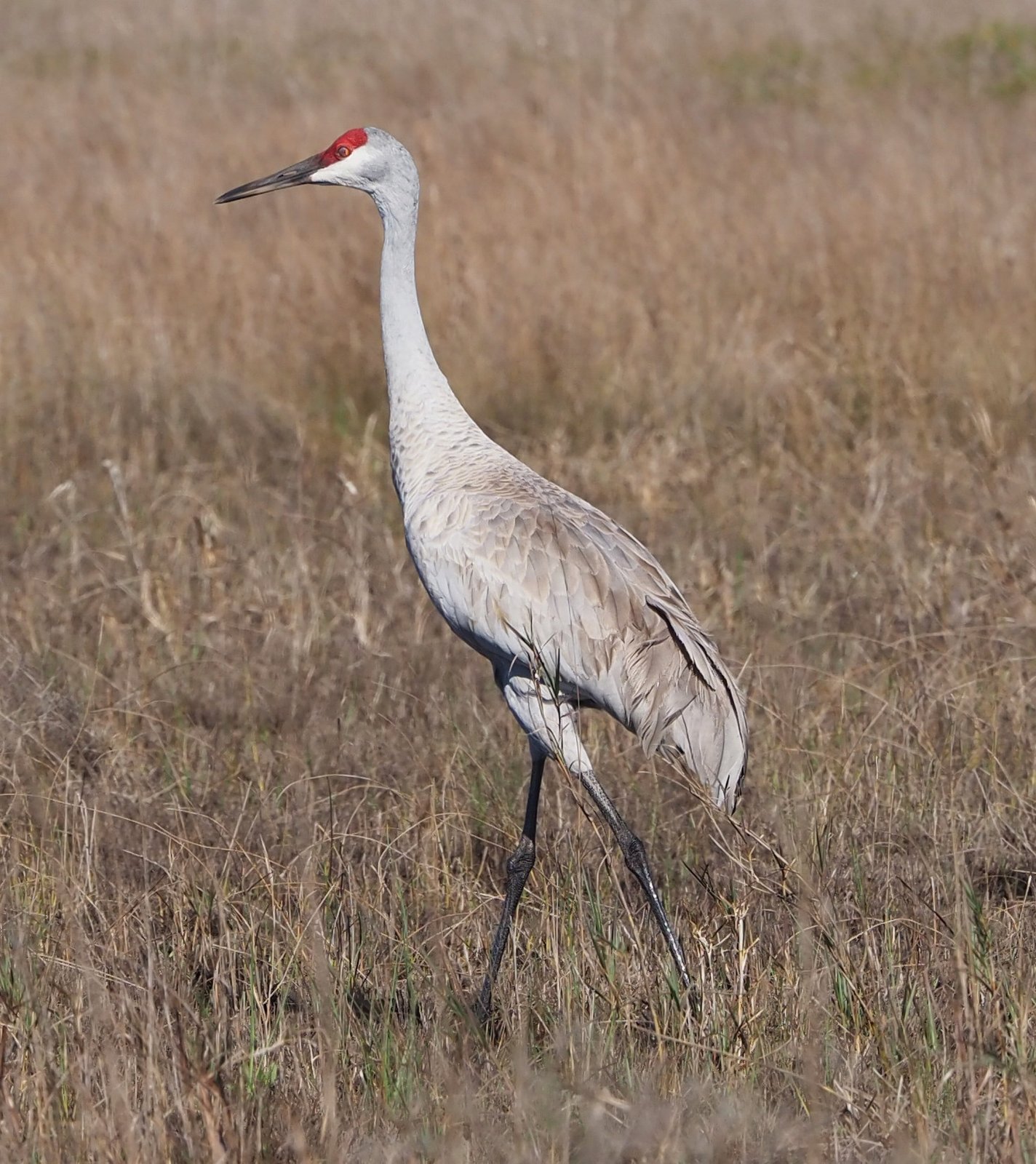
The Sandhill Crane is a large grey crane with a red crown, the only crane that occurs regularly in the guide area. It breeds in North America and north-eastern Siberia and partly winters in northern Mexico. There, thousands of birds gather in winter around shallow lakes on the plateau, from where they fly out by day to fields and grasslands.
Voice
A loud, rolling trumpeting, garroo-oo-oo, with a strongly rolled r, carrying for kilometres; flocks in flight are often heard before they are seen. Pairs call in duet. Young birds give a high, whistled peeping, still in their first winter.
Recording: Don Profota — CC BY-NC-SA 4.0 · converted to mono · xeno-canto
Identification
86–122 cm; size varies strongly between the smaller northern and the larger southern forms. Tall, slender and long-legged, with a long neck and a straight, dark bill. The plumage is plain grey; the adult has a bare red crown and whitish cheeks and throat. Feathers may be stained rusty brown by iron-rich mud that the birds apply while preening. The inner secondaries form a drooping ‘bustle’ over the tail. Juveniles lack the red crown and are browner on the head, neck and upperparts. It flies with neck and legs outstretched, on slow beats with a quick, short upstroke; flocks often fly in lines or V-formation and circle high on thermals.
Confusion species
Great Blue Heron Ardea herodias is about as tall, but flies with the neck retracted, has a yellow, dagger-shaped bill and a black head stripe. Wood Stork Mycteria americana is white with black flight feathers and a bare dark head with a thick, curved bill. No other cranes occur in the guide area today.
Habitat
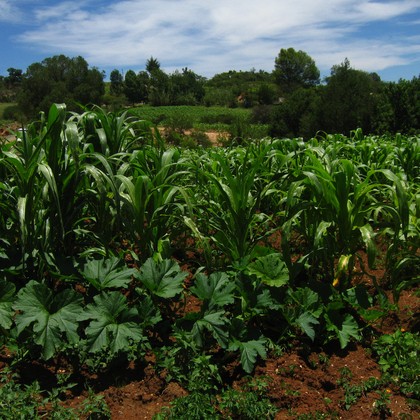
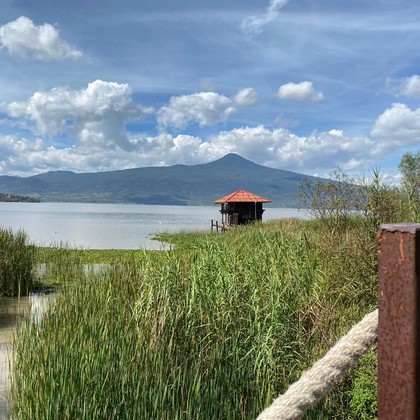
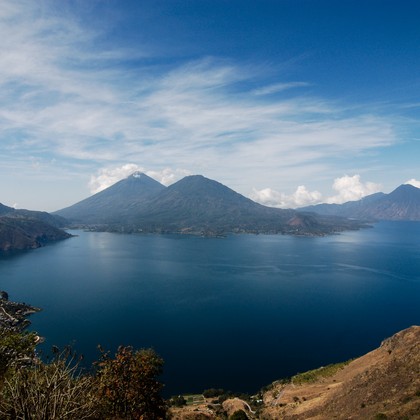
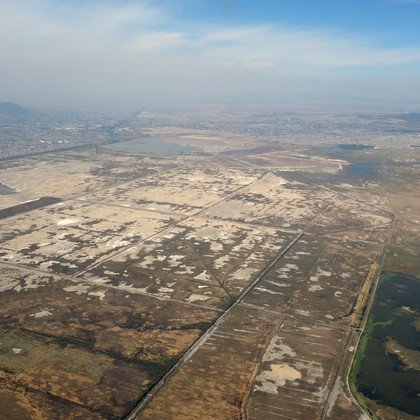
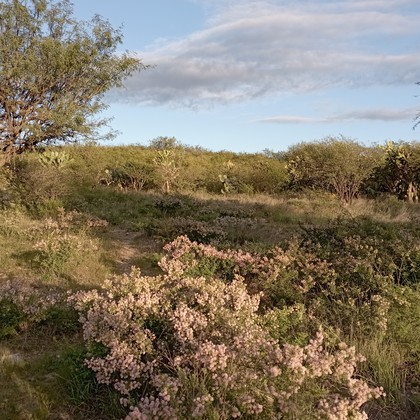
In winter shallow fresh and brackish lakes and lagoons on the plateau as roost sites, with surrounding fields of maize, bean and grain stubble, wet grassland and semi-desert grassland for foraging; mainly between 1000 and 2500 m, in the north-east also in the lowlands. It forages on foot for grain, tubers, seeds, insects and other small animals. It roosts in flocks, standing in shallow water.
Where the bird is most at home, classified by the vegetation units of Mexico and Central America.
Range and movements
Winter visitor to northern Mexico: mainly in Chihuahua and Durango, with large roosts such as Laguna de Babícora and Laguna de Santiaguillo, and further in Sonora, Coahuila, Nuevo León, Zacatecas and northern Tamaulipas. Scarce further south; single vagrants have been reported as far as the Yucatán Peninsula and even Costa Rica. Outside the guide area it breeds from north-eastern Siberia and Alaska across Canada to the Great Lakes, with resident populations in Florida, Mississippi, southern Georgia and Cuba; most birds winter in the southern United States.
- Winter visitor (c. Oct–Mar)
- dark = core range, pale = thinly spread
How and when to look
Laguna de Babícora in Chihuahua is the best-known site from November to February; at sunrise the birds fly in flocks from the roost to the fields and return before sunset. They are also seen regularly around Janos in Chihuahua and at Laguna de Santiaguillo in Durango. In the fields the birds keep their distance; watching from the road causes the least disturbance.
Conservation status
Globally not threatened and increasing in North America. The wintering birds depend on a small number of lakes and lagoons, which are threatened by groundwater pumping, drought and the conversion of grassland to arable farming. Hunting also plays a role locally.
Scientific name
Antigone canadensis | (Linnaeus, 1758) (GBIF: Grus canadensis)
Linnaeus described the species in 1758 as Ardea canadensis; because it was later moved to another genus, the author and year stand in brackets. The genus Antigone was introduced in 1853 by Reichenbach. Antigone comes from Greek myth: Antigone, daughter of King Laomedon of Troy, compared her beauty with Hera's and was turned into a stork. Linnaeus seems to have confused her with Gerana, queen of the pygmies, who for the same offence was changed into a crane. canadensis is modern Latin for 'from Canada'. The specimen the first description was based on came from Hudson Bay.