All species › Cranes, rails and allies › Finfoots › Sungrebe
Position in the tree Birds Aves › Birds with a flexible palate Neognathae › All other modern birds Neoaves › Birds of the elements Elementaves › Cranes and waders Gruimorphae
Sungrebe | Heliornis fulica
Kleine fuutkoet | Pájaro cantil
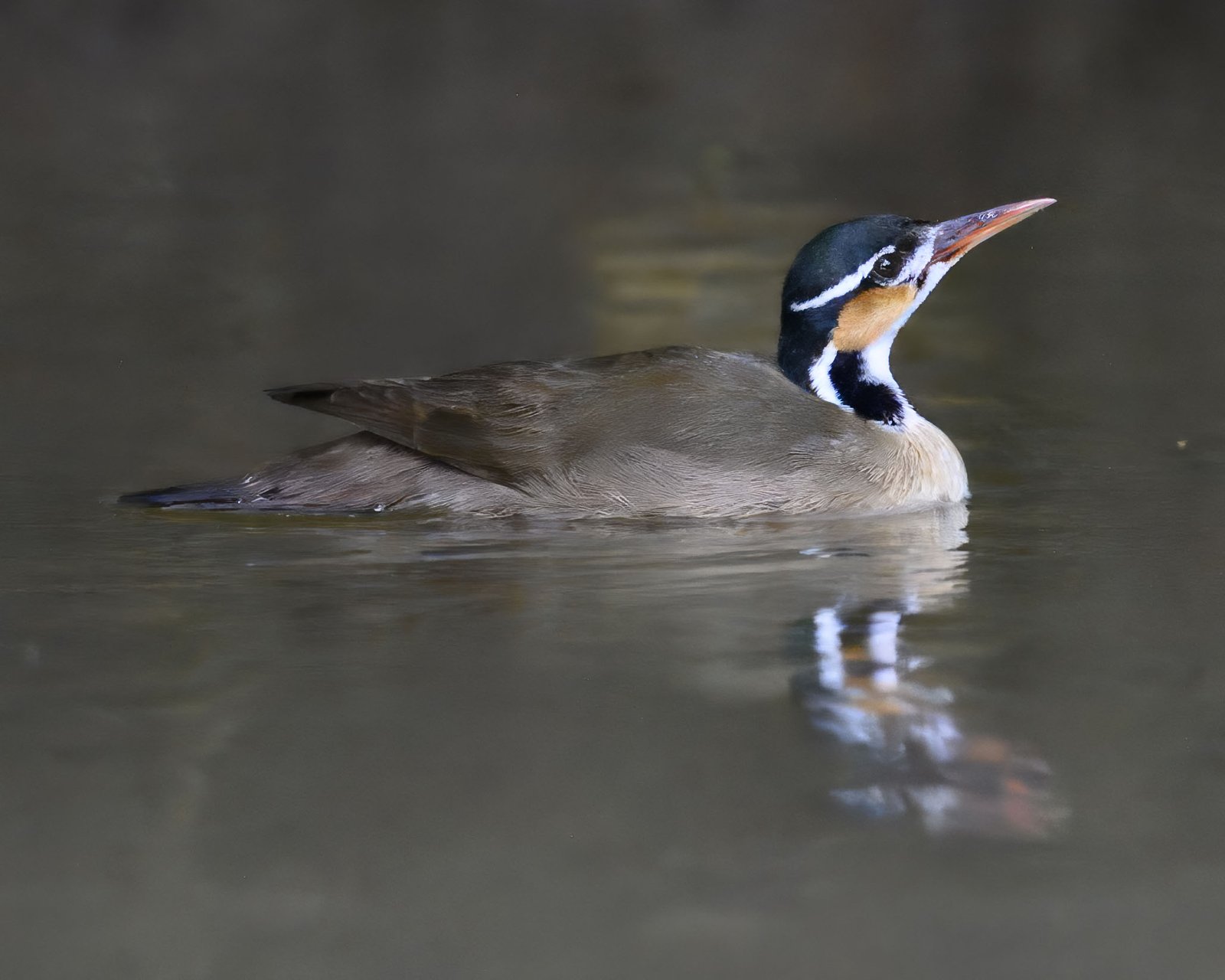
The Sungrebe is a small, shy waterbird of shaded riverbanks in the lowlands, the smallest of the three finfoots in the world and the only one in the Americas. It swims low in the water along overhanging branches and seldom dives. The male can carry the young in skin pockets beneath the wings, even in flight. In the guide area it lives on the Caribbean and Gulf side from southern Mexico to Panama.
Voice
Seldom heard. A series of hollow, somewhat barking or cooing notes, ooo-ah ooo-ah, and soft clucking calls, mainly in the breeding season.
Recording: JAYRSON ARAUJO DE OLIVEIRA — CC BY-NC-SA 4.0 · converted to mono · xeno-canto
Identification
26–33 cm. A slender, elongated waterbird with a narrow head, a thin neck and a fairly long, broad tail with a narrow white tip. The upperparts are olive-brown, the underparts white. The crown and hindneck are black, with a white stripe above the eye and a white stripe down the side of the neck, separated by a black band; the foreneck is also striped black and white. In the breeding season the female has a rufous patch on the cheek and a red upper mandible; the male has whitish cheeks and a darker bill. The feet are lobed and boldly banded black and yellow, clearly visible when the bird climbs onto a branch or takes off. It swims with a bobbing head, the tail often spread on the water.
Confusion species
Least Grebe Tachybaptus dominicus is stockier and greyer, with a yellow eye and almost no tail, and dives frequently. Pied-billed Grebe Podilymbus podiceps is larger and plain brown, with a thick, short bill and no striped head or tail. Female Anhingas Anhinga anhinga also swim low along banks, but are much larger, with a long, snake-like neck and a dagger-shaped bill. Sunbittern Eurypyga helias lives along the same streams but walks on the bank and has long orange legs.
Habitat
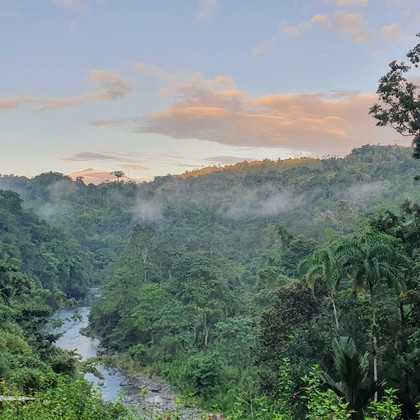
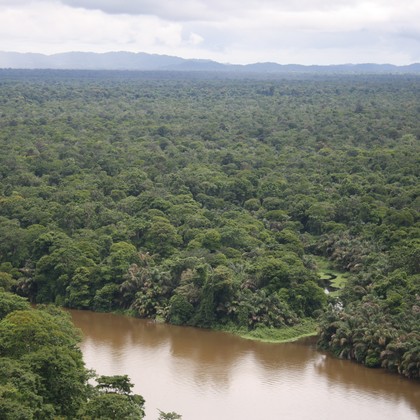
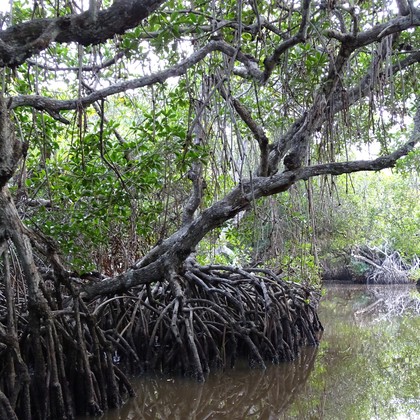
Slow-flowing rivers, streams, creeks and channels with dense, overhanging bank vegetation in floodplain forest, swamp forest and rainforest, also shaded edges of lagoons, oxbows, lakes and mangroves; in the lowlands, mostly below 500 m. It forages at the water surface and among branches for insects, spiders, crustaceans, frogs and small fish. It rests and roosts on branches over the water. The nest is a platform of twigs and reeds in a shrub or on a branch over water.
Where the bird is most at home, classified by the vegetation units of Mexico and Central America.


Range and movements
In Mexico on the Gulf side from southern Tamaulipas and eastern San Luis Potosí through Veracruz, northern Oaxaca, Tabasco and Chiapas to the southern Yucatán Peninsula. Further in the lowlands of Belize, Guatemala, Honduras and Nicaragua, mainly on the Caribbean side, and in Costa Rica and Panama, where also locally on the Pacific side. Outside the guide area in South America, from Colombia and Venezuela to Bolivia and north-eastern Argentina.
- Resident
- Summer visitor (c. Apr–Sep)
- Winter visitor (c. Oct–Mar)
- Passage (Mar–Apr, Oct–Nov)
- dark = core range, pale = thinly spread
How and when to look
Best found from a boat or canoe on quiet, shaded channels and rivers, such as at Tortuguero and Caño Negro in Costa Rica, along the New River to Lamanai in Belize and in the wetlands of Tabasco and Chiapas. The birds often swim close to the bank under overhanging branches and vanish into the vegetation when disturbed; drifting quietly or waiting at one spot gives the best chance.
Conservation status
Not threatened, but seldom seen because of its secretive habits and probably often overlooked. The species is sensitive to the clearing of riverside forest and the pollution of lowland rivers.
Scientific name
Heliornis fulica | (Boddaert, 1783)
Boddaert described the species in 1783 as Colymbus fulica; because it was later moved to another genus, the author and year stand in brackets. The genus Heliornis was introduced in 1791 by Bonnaterre. Heliornis is Greek, from hēlios 'sun' and ornis 'bird': 'sun-bird'. fulica is the Latin word for 'coot', after its coot-like way of swimming. The specimen the first description was based on came from Cayenne, French Guiana.