All species › Cranes, rails and allies › Limpkin › Limpkin
Position in the tree Birds Aves › Birds with a flexible palate Neognathae › All other modern birds Neoaves › Birds of the elements Elementaves › Cranes and waders Gruimorphae
Limpkin | Aramus guarauna
Koerlan | Carao
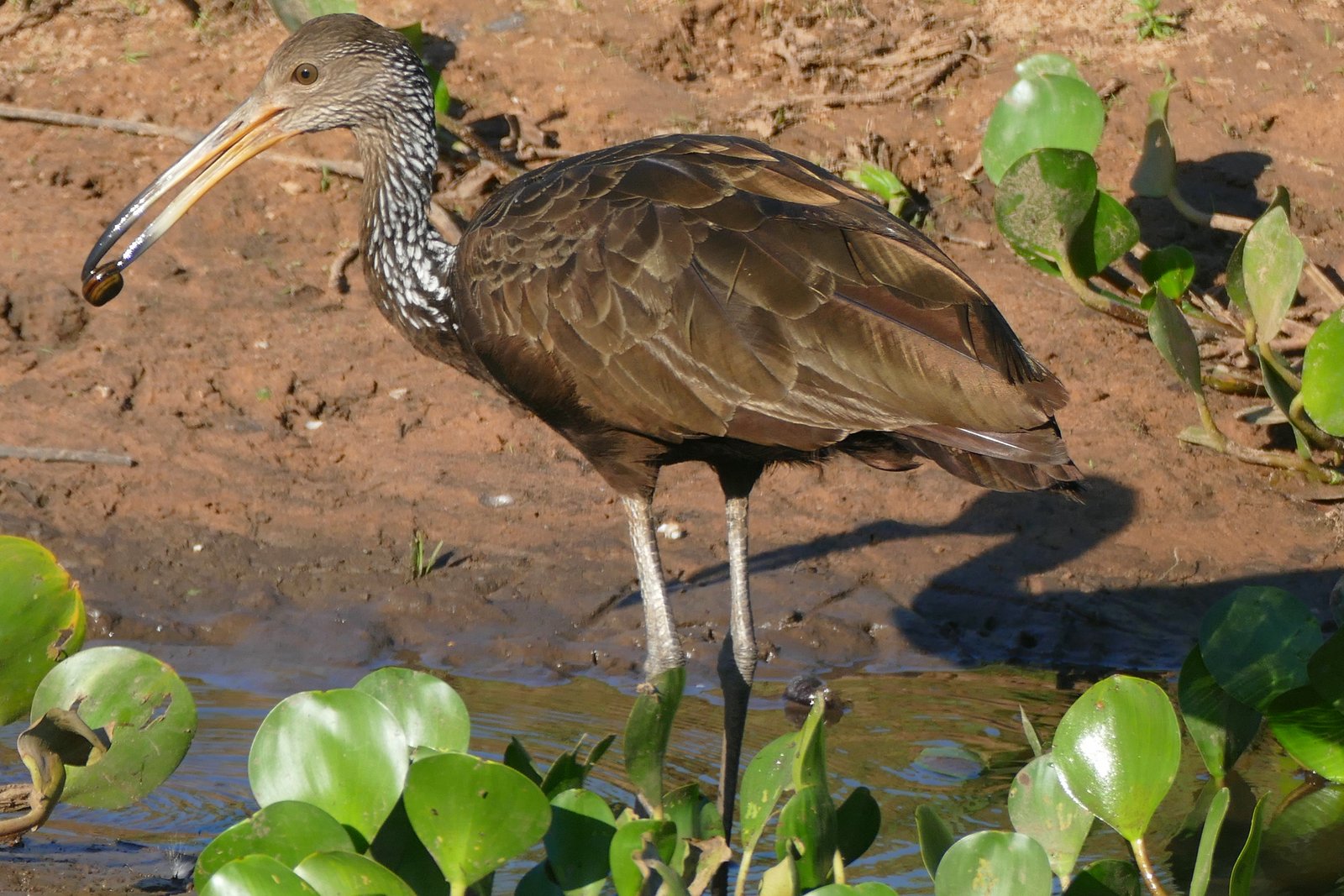
The Limpkin is a large, brown marsh bird with long legs and a long, slightly curved bill, the only species in its family. It specialises in eating large freshwater snails (apple snails). In the guide area it is resident in freshwater marshes, riverbanks and mangroves in the lowlands, from western and eastern Mexico to Panama. Its loud, wailing call carries far at dusk and at night.
Voice
A very loud, wailing, far-carrying scream, krr-AOW or kree-ow, often repeated several times. Calls mainly at dusk and at night, most of all in the breeding season. Also soft clucking and clicking sounds.
Recording: Juan Freile — CC BY-NC-SA 4.0 · converted to mono · xeno-canto
Identification
56–71 cm. A slender, long-legged bird with a long neck, about the size of a small heron but built like an ibis or crane. The plumage is dark chocolate brown, with fine white streaks on the head and neck and larger white, triangular spots on the mantle, breast and wing coverts; the flight feathers and tail are plain dark brown. The throat is pale. The bill is long, yellowish at the base and darker towards the tip, slightly decurved; the tip of the lower mandible is slightly twisted, an adaptation for extracting snails from their shells. The legs are dark olive-grey. The sexes are alike; juveniles are paler and less clearly spotted. It flies with the neck outstretched and the legs dangling, on stiff beats with a short, quick upstroke.
Confusion species
Glossy Ibis Plegadis falcinellus and White-faced Ibis Plegadis chihi are smaller and darker, with a more strongly curved bill and no white spots; they often fly in flocks with fast beats and glides. Young American White Ibises Eudocimus albus are grey-brown with a white belly and rump and a pinkish-orange bill. Green Ibis Mesembrinibis cayennensis is stockier, dark with a green gloss, and has shorter legs. Young tiger herons, such as Bare-throated Tiger Heron Tigrisoma mexicanum, are finely barred rather than spotted white and have a straight, dagger-shaped bill.
Habitat
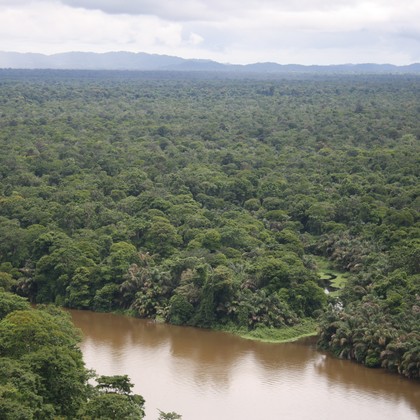
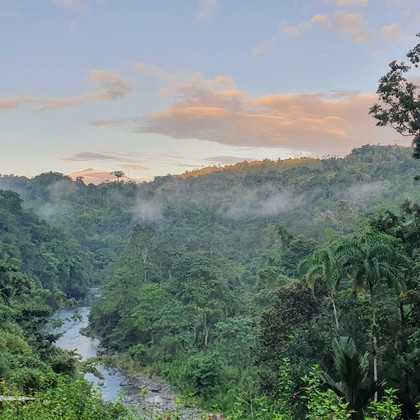
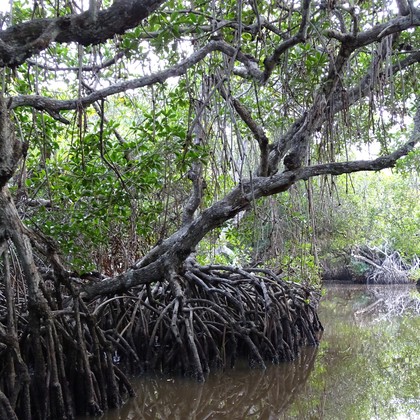
Freshwater marshes with open water and floating vegetation, the banks of slow-flowing rivers and lakes, floodplain forest, palm swamps and mangroves, locally also rice fields and ditches; mainly in the lowlands, up to about 1500 m. It wades through shallow water in search of apple snails, as well as freshwater mussels, insects and small animals. Empty snail shells often lie in heaps at regular feeding spots. The nest is a platform of plant material in dense waterside vegetation, a shrub or low in a tree over water.
Where the bird is most at home, classified by the vegetation units of Mexico and Central America.


Range and movements
In Mexico on the Pacific side from Sinaloa and Nayarit south through Jalisco and Colima to Oaxaca and Chiapas, and on the Gulf side from southern Tamaulipas through Veracruz and Tabasco to the whole Yucatán Peninsula. Further in the lowlands of all of Central America, from Belize and Guatemala to Panama, especially in large wetlands. Birds in the guide area belong to the subspecies A. g. dolosus. Outside the guide area in Florida, on Cuba, Hispaniola and Jamaica and in South America to northern Argentina.
- Resident
- dark = core range, pale = thinly spread
How and when to look
Good places are the mangroves and freshwater marshes around San Blas in Nayarit, the lagoons of the Yucatán Peninsula, Crooked Tree in Belize and Palo Verde and Caño Negro in Costa Rica. The birds are often seen best from a boat along the banks. Heaps of empty apple-snail shells betray their presence; in the evening the call is a good clue.
Conservation status
Not threatened. In the guide area locally common in large wetlands, but it has declined through drainage, pollution of fresh water and hunting. Because the species depends heavily on apple snails, it is sensitive to changes in water level and water quality.
Scientific name
Aramus guarauna | (Linnaeus, 1766)
Linnaeus described the species in 1766 as Scopolax Guarauna; because it was later moved to another genus, the author and year stand in brackets. The genus Aramus was introduced in 1816 by Vieillot. Aramus probably goes back to a Greek word for an unidentified waterbird; the exact origin is uncertain. guarauna is probably taken from Guarauna, the Tupi name Marcgrave recorded for this bird in Brazil. The specimen the first description was based on came from South America (not specified).