All species › Potoos › Potoos › Great Potoo
Position in the tree Birds Aves › Birds with a flexible palate Neognathae › All other modern birds Neoaves › Birds of the elements Elementaves › Nightjars and swifts Strisores
Great Potoo | Nyctibius grandis
Vale reuzennachtzwaluw | Nictibio grande
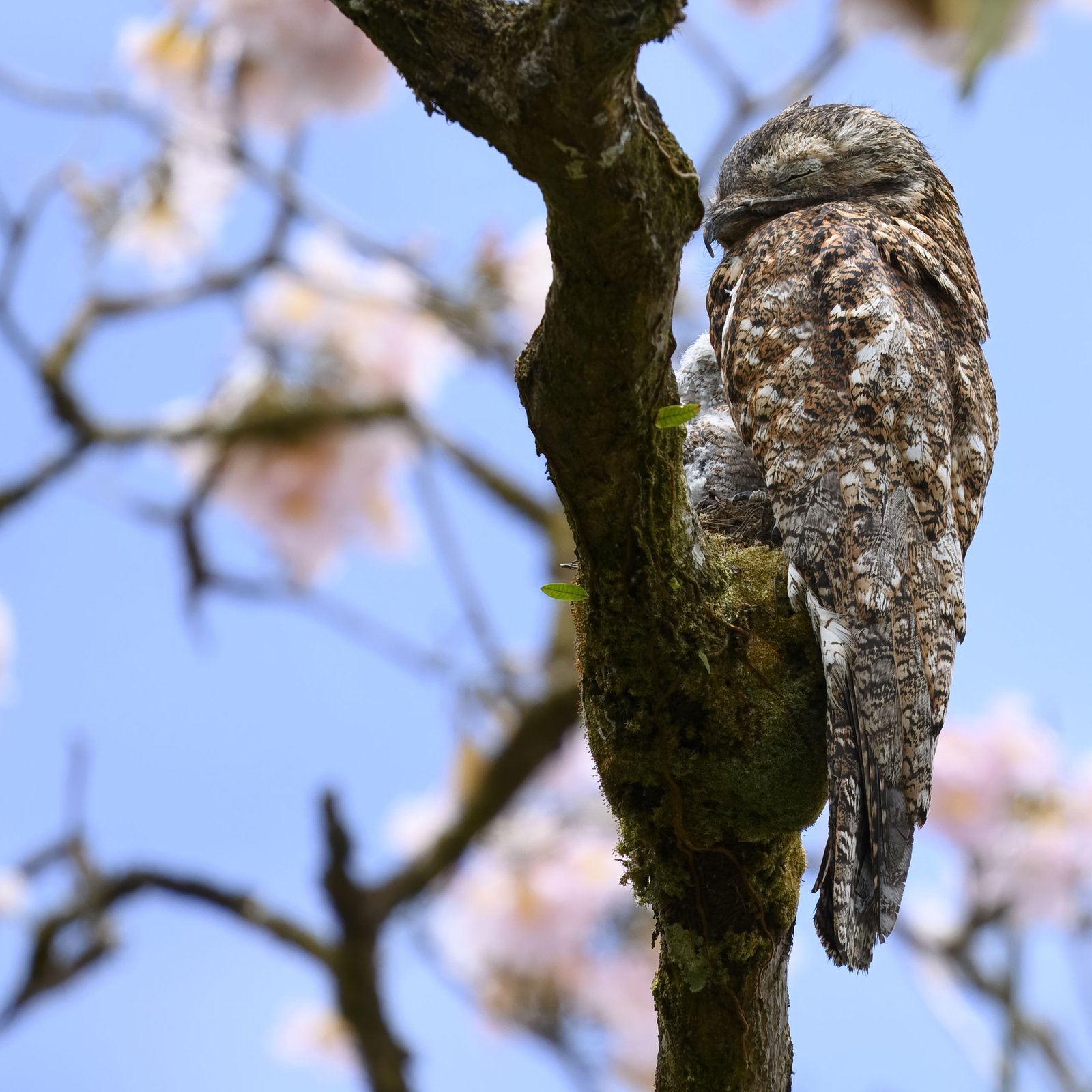
The Great Potoo is the largest member of its family, a pale, owl-like nocturnal bird with a huge head and a very wide gape. By day it sits motionless high in a tree, on or against a thick branch, looking like an outgrowth of the wood. In the guide area it is resident in humid lowland forest, from south-eastern Mexico to Panama. Its deep, growling call is one of the most striking night sounds of the rainforest.
Voice
A deep, harsh, growling bwaaaarr or gwaaah, repeated a few times with pauses, mainly after sunset and on moonlit nights. Sounds more like a mammal than a bird.
Recording: Mauricio Cuellar Ramirez (@Birding.travel) — CC BY-NC-SA 4.0 · converted to mono · xeno-canto
Identification
48–60 cm. A very large, bulky potoo with a broad, rounded head, a short bill with an enormously wide gape, long, broad wings and a long, rounded tail. The plumage is mainly dirty white to pale grey with fine brown and black vermiculation and speckling, sometimes with a browner tinge; the tail is finely barred. The eyes are large and dark brown, not yellow, and shine orange in torchlight. The sexes are alike. Juveniles are even whiter and more softly marked.
Confusion species
Common Potoo Nyctibius griseus and Northern Potoo Nyctibius jamaicensis are smaller and slimmer, more darkly mottled grey-brown, with a row of black spots across the breast, a dark moustachial stripe and yellow eyes. Owls such as Spectacled Owl Pulsatrix perspicillata and Mottled Owl Strix virgata have a facial disc, a powerful hooked bill and a short tail.
Habitat
Tall, mature humid forest in the lowlands and foothills, also forest edges, gallery forest and clearings with tall, scattered trees; mostly below 1200 m. By day it roosts high in the canopy or on a thick, horizontal branch. At night it hunts from a high perch for large flying insects such as beetles and moths, and sometimes also catches bats. It lays a single egg without a nest in a hollow or against a knot on a high, thick branch.
Where the bird is most at home, classified by the vegetation units of Mexico and Central America.





Range and movements
In Mexico only in eastern Chiapas. Further in the lowlands on the Caribbean side of Guatemala, in Belize, in northern Honduras and eastern Nicaragua, and on both slopes of Costa Rica and Panama. Outside the guide area through northern South America to Bolivia and south-eastern Brazil.
- Resident
- dark = core range, pale = thinly spread
How and when to look
Best found by listening for the growling call on clear, moonlit nights and then searching high in the trees with a torch for the eyeshine. By day, regular roosts are sometimes known to local guides, for example at Pico Bonito in Honduras, in the Sarapiquí lowlands of Costa Rica and along the Pipeline Road near Gamboa in Panama. A torch should be used sparingly.
Conservation status
Not threatened. In the guide area locally fairly common in large, unbroken forests, but sensitive to the felling of tall forest and old trees.
Scientific name
Nyctibius grandis | (Gmelin, 1789)
Gmelin described the species in 1789 as Caprimulgus grandis; because it was later moved to another genus, the author and year stand in brackets. The genus Nyctibius was introduced in 1816 by Vieillot. Nyctibius is Greek, from nux, nuktos 'night' and bios 'life': 'night-living', after its nocturnal habits. grandis is Latin for 'great, large': this is the largest potoo. The specimen the first description was based on came from Cayenne, French Guiana.