All species › Potoos › Potoos › Common Potoo
Position in the tree Birds Aves › Birds with a flexible palate Neognathae › All other modern birds Neoaves › Birds of the elements Elementaves › Nightjars and swifts Strisores
Common Potoo | Nyctibius griseus
Grijze reuzennachtzwaluw | Nictibio común
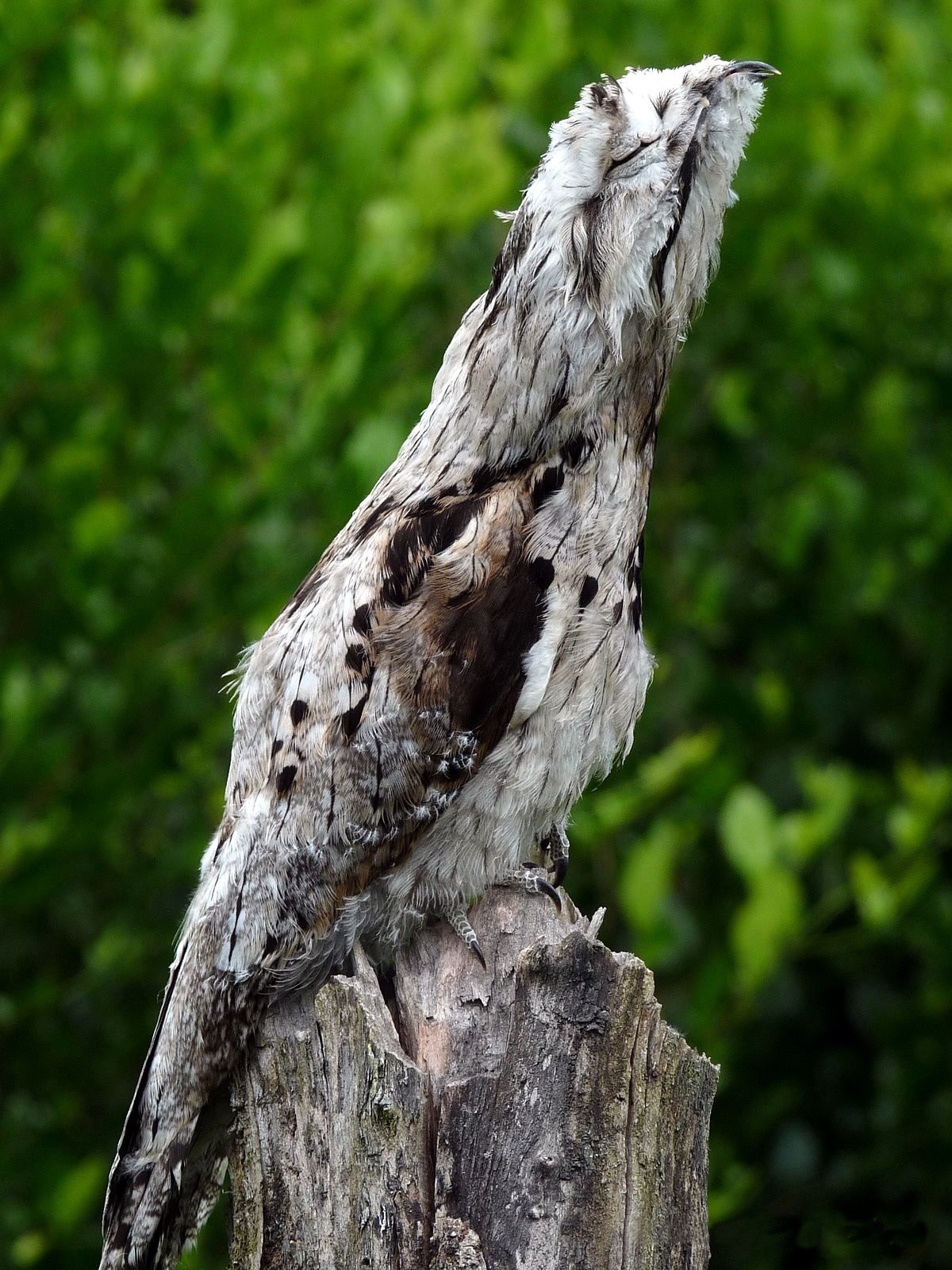
The Common Potoo is a nocturnal bird that by day perches upright and motionless on a broken branch or post, head raised and eyes almost closed, looking exactly like a piece of dead wood. It becomes active only after sunset. In the guide area it is resident in the south, from south-eastern Nicaragua to Panama. Birds further north, formerly included in this species, are now treated as Northern Potoo.
Voice
A series of five to eight loud, mournful whistles, boo-ou, boo-ou, bo-ou, bo-ou, falling in pitch and volume. Sings mainly at night, most on moonlit nights.
Recording: José María Loaiza B. — CC BY-NC-SA 4.0 · converted to mono · xeno-canto
Identification
33–38 cm. A slim potoo with a large, flat head, a tiny bill with a very wide gape, long wings and a long tail. The plumage is finely mottled and streaked in grey, brown, black and white, with a row of black spots across the breast and a dark moustachial stripe. The eyes are large and yellow; in a resting bird only narrow slits remain visible. At night the eyes shine orange-red in torchlight. The sexes are alike; there are greyer and browner birds.
Confusion species
Northern Potoo Nyctibius jamaicensis, which occurs close to this species in north-western Costa Rica, is hardly separable in the field: slightly larger, with a slightly bigger head, but with a very different, harsh, croaking call. Great Potoo Nyctibius grandis is much larger and paler, with dark eyes. Nightjars such as Pauraque Nyctidromus albicollis are smaller and rest lying flat, on the ground or lengthwise on a branch, not upright. Owls have a facial disc and a powerful hooked bill.
Habitat
Open and semi-open woodland, forest edges and clearings, gallery forest, swamp forest, savanna with scattered trees and farmland and pasture with old trees, posts and dead trunks, mainly in the lowlands and lower hills. At night it hunts from a perch for large flying insects such as beetles and moths, then returns to the same perch. It lays a single white, purple-spotted egg without a nest in a hollow on top of a broken branch; the incubating bird sits on it upright.
Where the bird is most at home, classified by the vegetation units of Mexico and Central America.





Range and movements
In south-eastern Nicaragua, mainly in the lowlands along the Río San Juan. In Costa Rica in the Caribbean lowlands and the southern Pacific lowlands, and throughout Panama in the lowlands and lower hills. Old reports from further north in Central America and Mexico refer to Northern Potoo. Outside the guide area through almost all of South America to northern Argentina and Uruguay, and in Trinidad and Tobago.
- Resident
- dark = core range, pale = thinly spread
How and when to look
Best found by listening for the song on clear, moonlit nights and then locating the bird with a torch by its eyeshine. By day, roosting birds are sometimes known to local guides, for example along the canals of Tortuguero in Costa Rica and around Gamboa in Panama; the same post or branch is often used for days. A torch should be used sparingly.
Conservation status
Not threatened. The species has a very large range and tolerates semi-open and cultivated land as long as trees or posts remain.
Scientific name
Nyctibius griseus | (Gmelin, 1789)
Gmelin described the species in 1789 as Caprimulgus griseus; because it was later moved to another genus, the author and year stand in brackets. The genus Nyctibius was introduced in 1816 by Vieillot. Nyctibius is Greek, from nux, nuktos 'night' and bios 'life': 'night-living', after its nocturnal habits. griseus is Medieval Latin for 'grey', after the grey-brown, bark-like plumage. The specimen the first description was based on came from Cayenne, French Guiana.