All species › Owls › Owls › Great Horned Owl
Position in the tree Birds Aves › Birds with a flexible palate Neognathae › All other modern birds Neoaves › Landbirds Telluraves › Raptors, owls, kingfishers and woodpeckers Afroaves › Hawks and owls Hieraves
Great Horned Owl | Bubo virginianus
Amerikaanse oehoe | Búho cornudo
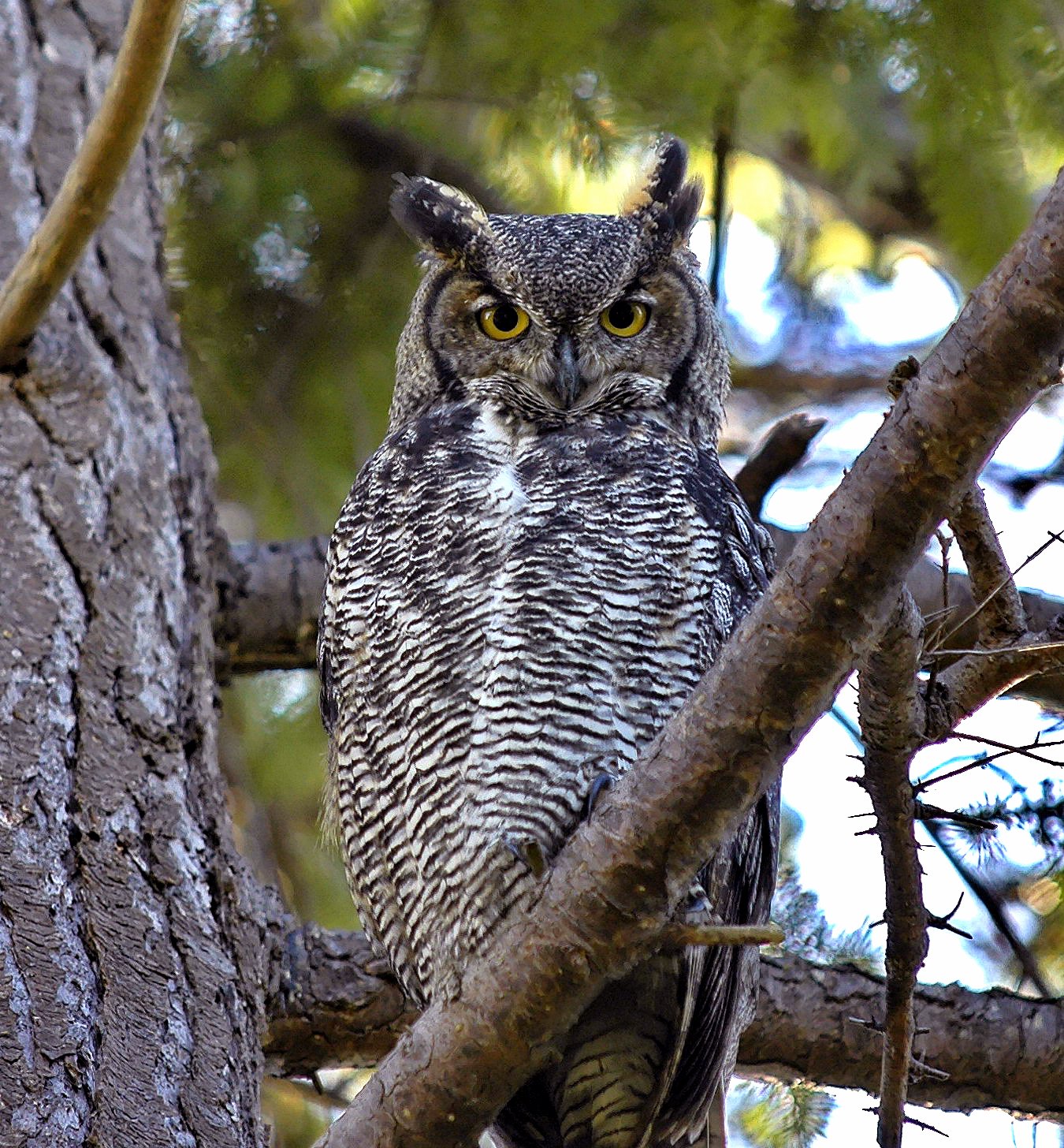
The Great Horned Owl is the largest owl in the north of the guide area and one of the most widespread birds of prey in the Americas, from Alaska to southern South America. In Mexico and northern Central America it lives in desert, dry scrub, open woodland and canyons. It is resident and hunts mainly at dusk and by night, taking prey from beetles to rabbits, skunks and other owls.
Voice
A deep, soft hooting of four to six notes in a fixed rhythm, hoo-hoohoo-hoo-hoo, carrying far. The female calls higher than the male and pairs often call in alternation. Also barking and screeching calls; young beg with a hoarse, drawn-out screech. Heard mainly at dusk, most in winter, when pairs advertise their territory.
Recording: Richard E. Webster — CC BY-NC-SA 4.0 · shortened to the first 60 s, mono · xeno-canto
Identification
46–63 cm, large and heavily built, with long, widely spaced ear tufts and large yellow eyes. The facial disc is orange-brown to grey with a black rim; below the bill is a white throat patch that puffs out when calling. The upperparts are mottled grey-brown; the underparts are pale with dense dark bars. Birds from the northwestern deserts are paler and greyer than those from more humid regions. The female is clearly larger than the male.
Confusion species
Striped Owl Asio clamator is smaller and slimmer, with dark streaks rather than bars on the underparts, a pale facial disc with a black rim and brown eyes. Stygian Owl Asio stygius is smaller and darker, with closely set ear tufts. Spectacled Owl Pulsatrix perspicillata lacks ear tufts, has a dark breast band and white ‘spectacles’ around the eyes, and lives in humid lowland forest. Screech owls (Megascops) also have ear tufts but are much smaller.
Habitat
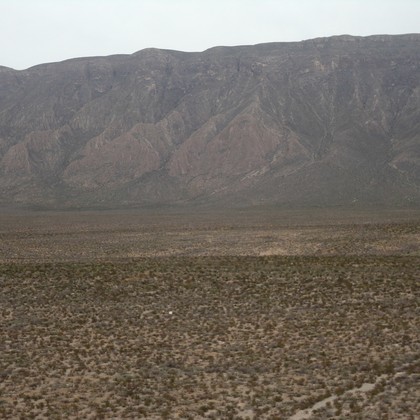
Very varied: desert with cacti and shrubs, semi-desert grassland, thorn scrub, canyons and cliffs, open oak and pine-oak woodland and farmland with copses and tree lines; in the south also savanna and dry forest. Closed rainforest is avoided. It nests in old nests of other raptors and ravens, on cliff ledges, in hollow trees and sometimes on buildings. It hunts from a perch for mammals up to the size of a hare, birds, reptiles and large insects.
Where the bird is most at home, classified by the vegetation units of Mexico and Central America.






Range and movements
Widespread in Mexico, including Baja California, from the US border south across the northern and central highlands and the dry Pacific slope; a separate subspecies lives in the northern Yucatán Peninsula and Belize. Also locally in the highlands and dry lowlands of Guatemala, El Salvador, Honduras and Nicaragua, where the southern limit of its range in Central America lies. In Costa Rica and Panama only a few uncertain reports. Outside the guide area from Alaska and Canada through the United States, and again in South America.
- Resident
- dark = core range, pale = thinly spread
How and when to look
At dusk it is often seen on a post, a dead tree or a cliff edge, with the silhouette of its two ear tufts against the sky. In the deserts of Sonora and Baja California and in the Chihuahuan Desert it can be heard after sunset in winter. By day it hides in a tree or a rock crevice; songbirds mobbing it noisily sometimes give away its roost.
Conservation status
Not threatened. The species is widespread and the population is large. In Central America it is locally scarce and sometimes persecuted or disturbed, but it adapts well to farmland with trees.
Scientific name
Bubo virginianus | (Gmelin, 1788)
Gmelin described the species in 1788 as Strix virginiana; because it was later moved to another genus, the author and year stand in brackets. The genus Bubo was introduced in 1805 by Duméril. Bubo is the Latin word for the eagle-owl. virginianus is Latin for 'of Virginia', after the type locality. The specimen the first description was based on came from Virginia, USA.