All species › Owls › Owls › Flammulated Owl
Position in the tree Birds Aves › Birds with a flexible palate Neognathae › All other modern birds Neoaves › Landbirds Telluraves › Raptors, owls, kingfishers and woodpeckers Afroaves › Hawks and owls Hieraves
Flammulated Owl | Psiloscops flammeolus
Amerikaanse dwergooruil | Tecolote ojo oscuro
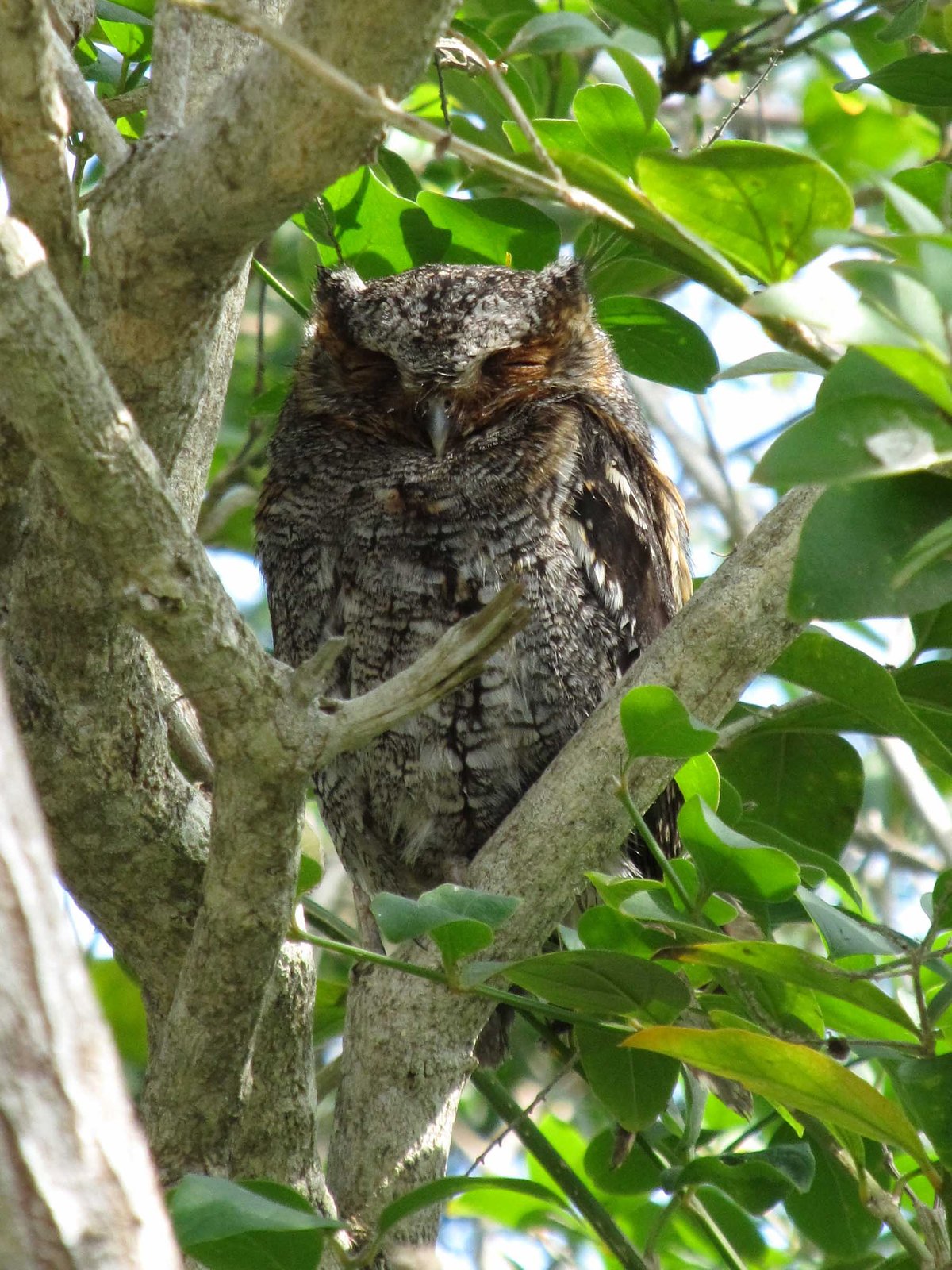
The Flammulated Owl is a small, insect-eating owl of dry conifer and pine-oak forest in the mountains of western North America and Mexico. It is the only owl in the guide area with dark eyes and short ear tufts. Most birds migrate: they breed from western Canada to central Mexico and winter in southern Mexico and northern Central America. Its secretive habits and soft call mean it is little noticed.
Voice
A low, soft hoop, repeated at intervals of a few seconds, often preceded by one or two even softer notes, hoo-hoop. For such a small owl the call is strikingly low and seems to come from farther away than it does. The female calls higher and more whining. Heard mainly from April to July, throughout the night.
Recording: Edgardo Orozco Díaz (Birding Guide) Contact: birdergtexpeditions@gmail.com — CC BY-NC-SA 4.0 · converted to mono · xeno-canto
Identification
15–17 cm, small, with short ear tufts that are often held flat, dark brown eyes and long wings that reach the tail tip. The plumage is grey with fine black streaks and vermiculation; a row of rufous or buff spots runs across the scapulars and the facial disc is grey with a rufous rim. There are grey and more reddish birds. Male and female are alike.
Confusion species
Screech owls (Megascops), such as Whiskered Screech Owl Megascops trichopsis and Western Screech Owl Megascops kennicottii, are larger, with yellow eyes, longer ear tufts and shorter wings. Elf Owl Micrathene whitneyi is smaller, with yellow eyes, white eyebrows and no ear tufts. Pygmy owls (Glaucidium) have yellow eyes, no ear tufts and a longer tail.
Habitat
Open, dry montane forest of pine, oak and fir, especially pine-oak forest and pine forest with an open shrub understorey, mostly between about 1500 and 3000 metres; in winter also lower oak woodland and cloud forest. It nests in old woodpecker holes in trees. At night it hunts moths, beetles, crickets and spiders in the canopy and from branches.
Where the bird is most at home, classified by the vegetation units of Mexico and Central America.




Range and movements
A summer visitor in the mountains of northern and central Mexico: the Sierra Madre Occidental in Sonora, Chihuahua, Durango and Sinaloa, the Sierra Madre Oriental in Coahuila, Nuevo León and Tamaulipas, and south to the volcanic belt of central Mexico. Some birds in southern Mexico are probably present year-round. A winter visitor in the mountains of Oaxaca, Guerrero and Chiapas, and in western Guatemala and El Salvador. Outside the guide area it breeds from southern British Columbia through the western United States.
- Summer visitor (c. Apr–Sep)
- dark = core range, pale = thinly spread
How and when to look
In May and June the low call can be heard after dark in pine-oak forest in the mountains of Durango and Chihuahua, for example along the road between Durango and Mazatlán. The bird often calls high in a tree against the trunk and often remains unseen even with a light. In winter it is almost never heard in Mexico and Guatemala.
Conservation status
Not threatened. The population is large, but the species depends on old trees with woodpecker holes and is therefore sensitive to logging of old montane forest.
Scientific name
Psiloscops flammeolus | (Kaup, 1852)
Kaup described the species in 1852 as Scops (Megascops) flammeola; because it was later moved to another genus, the author and year stand in brackets. The genus Psiloscops was introduced in 1899 by Coues. Psiloscops is Greek, from psilos 'bare, smooth' and Scops, an old genus name for scops owls. flammeolus is Latin for 'flame-coloured, with flame-like markings', from flamma 'flame', after the rufous, flammulated plumage. The specimen the first description was based on came from Mexico (not specified).