All species › Pelicans, herons and ibises › Herons, egrets and bitterns › Boat-billed Heron
Position in the tree Birds Aves › Birds with a flexible palate Neognathae › All other modern birds Neoaves › Birds of the elements Elementaves › Tropicbirds and waterbirds Phaethoquornithes › Core waterbirds Aequornithes
Boat-billed Heron | Cochlearius cochlearius
Schuitbekreiger | Garza cucharón
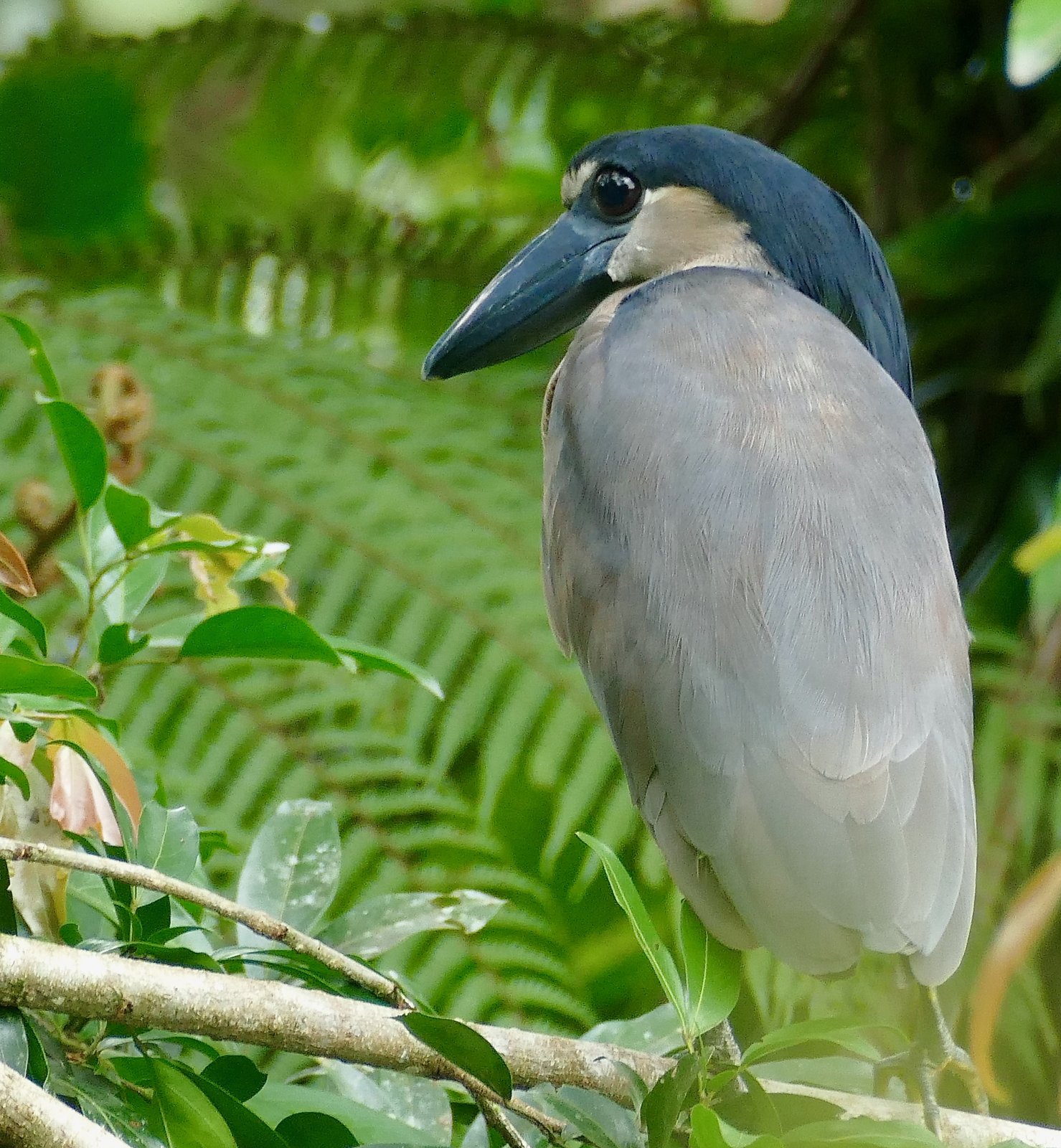
The Boat-billed Heron is a stocky night heron with an exceptionally broad, boat-shaped bill and large, dark eyes. By day it roosts in small groups in dense trees over water and only starts foraging at dusk. In the guide area it is resident in mangroves, swamp forest and riverbanks in the lowlands, from north-western and north-eastern Mexico to Panama.
Voice
A deep, croaking kwok or kwa and a series of fast, high croaking notes; at the nest bill-clattering and soft cooing sounds. Heard mainly in the evening and at night.
Recording: Leonardo Guzman Hernandez — CC BY-NC-SA 4.0 · converted to mono · xeno-canto
Identification
45–51 cm. A compact heron with a short neck, a large head and a broad, flat bill that from above resembles an upturned boat. The eyes are very large and dark. Adults have a black cap with a long, broad black crest, a white forehead and whitish face, a pale grey back, a white to buff breast and a cinnamon belly with black flanks. The bare skin under the bill is black or greenish; the legs are yellow-green. Juveniles are plain brown above and paler below, with a dark cap without a long crest. The sexes are alike.
Confusion species
Black-crowned Night Heron Nycticorax nycticorax and Yellow-crowned Night Heron Nyctanassa violacea have a narrow, pointed bill and smaller eyes; juveniles of both are brown with white spots or streaks, not plain brown. In good light the broad bill is always decisive.
Habitat
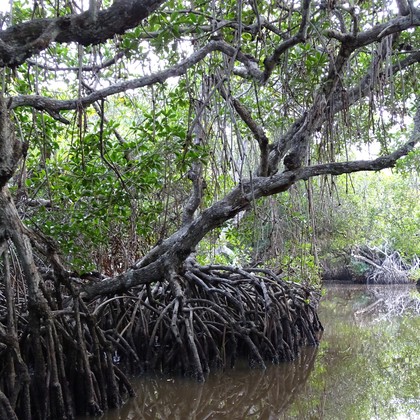
Mangroves, swamp forest, floodplain forest and dense waterside vegetation along slow-flowing rivers, lagoons and lakes, mainly in the lowlands. By day it roosts hidden in dense trees over water, often in small groups; at night it hunts standing or perched at the water's edge for fish, frogs, shrimps and crabs, using the broad bill as a scoop. It breeds alone or in small colonies, with the nest in a tree or shrub over water.
Where the bird is most at home, classified by the vegetation units of Mexico and Central America.



Range and movements
In Mexico on the Pacific side from Sinaloa south to Chiapas, and on the Gulf side from southern Tamaulipas through Veracruz and Tabasco to the Yucatán Peninsula. Further in the lowlands of all of Central America, from Belize and Guatemala to Panama. Outside the guide area through much of tropical South America, to northern Argentina.
- Resident
- dark = core range, pale = thinly spread
How and when to look
On boat trips through the mangroves around San Blas in Nayarit, in the canals of Tortuguero and at Caño Negro in Costa Rica and in the lagoons of Belize, roosting groups are often spotted among the branches over the water. At dusk the birds fly out to their feeding sites.
Conservation status
Not threatened. In the guide area locally common, but sensitive to mangrove clearance and drainage of swamp forest.
Scientific name
Cochlearius cochlearius | (Linnaeus, 1766)
Linnaeus described the species in 1766 as Cancroma Cochlearia; because it was later moved to another genus, the author and year stand in brackets. The genus Cochlearius was introduced in 1760 by Brisson. Cochlearius comes from Latin cochlear 'spoon', after the broad, scoop-shaped bill. cochlearius repeats the genus name, from Latin cochlear 'spoon', after the broad, scoop-shaped bill. The specimen the first description was based on came from the Guianas (not specified).