All species › Pelicans, herons and ibises › Herons, egrets and bitterns › Fasciated Tiger Heron
Position in the tree Birds Aves › Birds with a flexible palate Neognathae › All other modern birds Neoaves › Birds of the elements Elementaves › Tropicbirds and waterbirds Phaethoquornithes › Core waterbirds Aequornithes
Fasciated Tiger Heron | Tigrisoma fasciatum
Gestreepte tijgerroerdomp | Garza tigre barreteada
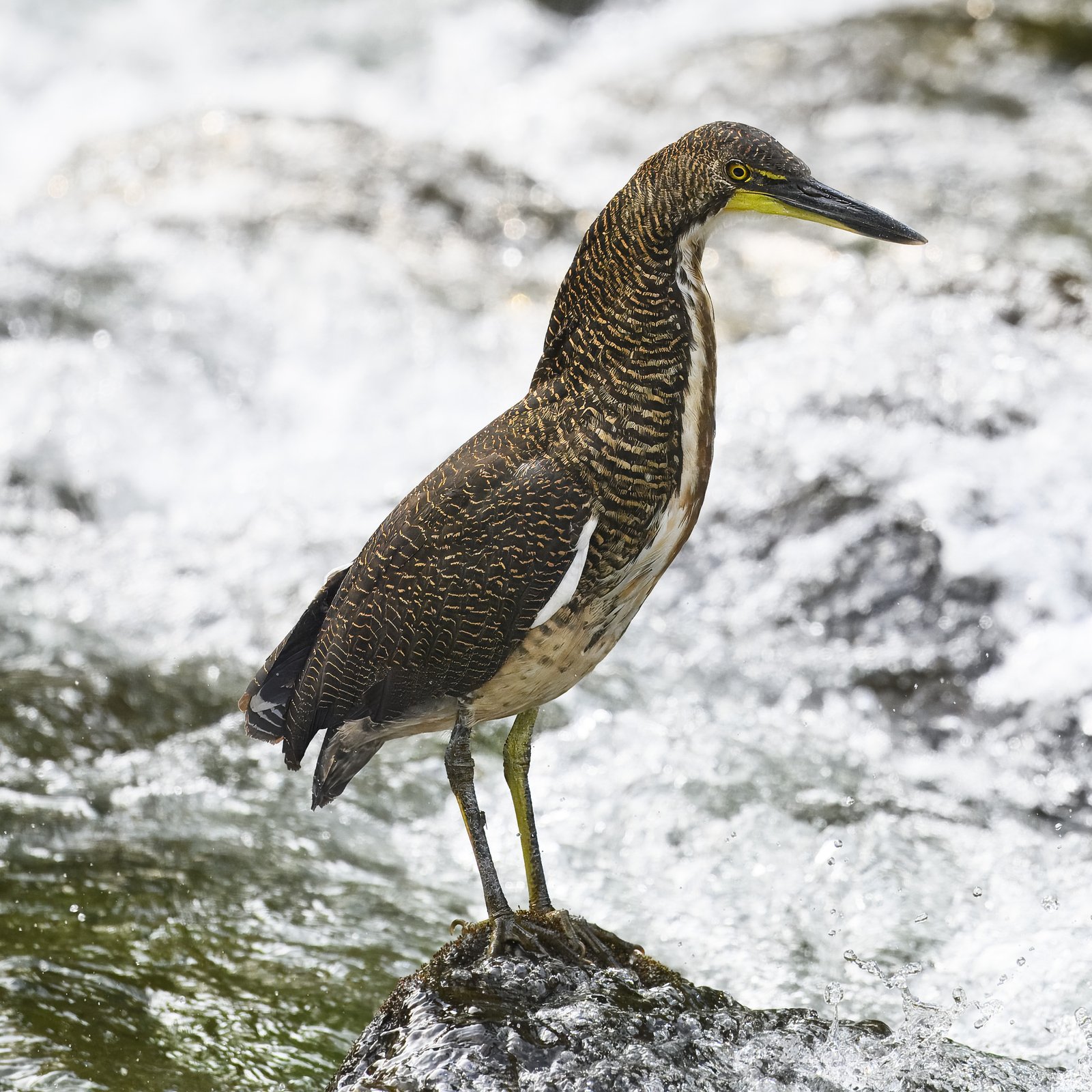
The Fasciated Tiger Heron is a dark, finely barred tiger heron of fast-flowing rivers and streams in the hills. In the guide area it is a scarce resident of Costa Rica and Panama. It often stands on rocks in the middle of the current, where its dark plumage blends in against the wet stones.
Voice
Usually silent. When disturbed a low, hoarse kwok; in the breeding season deep, growling calls.
Recording: Bernabe Lopez-Lanus — CC BY-NC-SA 4.0 · converted to mono · xeno-canto
Identification
61–71 cm. Smaller and more compact than the other tiger herons, with a strikingly short, thick bill. Adults have a black crown and a slate-grey head; the neck and upperparts are dark grey-brown with dense, fine buff barring, and the foreneck has a white central stripe. The throat is feathered and white. The belly is cinnamon, the flanks grey. Juveniles are finely and evenly barred buff and black, more finely than juveniles of the other tiger herons. The sexes are alike.
Confusion species
Bare-throated Tiger Heron Tigrisoma mexicanum is larger and paler, with a longer bill and a bare, yellow throat, and lives mainly in the lowlands. Adult Rufescent Tiger Heron Tigrisoma lineatum has a rufous-chestnut head and neck, and juveniles have coarser barring and a longer bill. Sunbittern Eurypyga helias lives along the same streams, but is slimmer, has a small head with a thin bill and shows large orange and black wing patches in flight.
Habitat
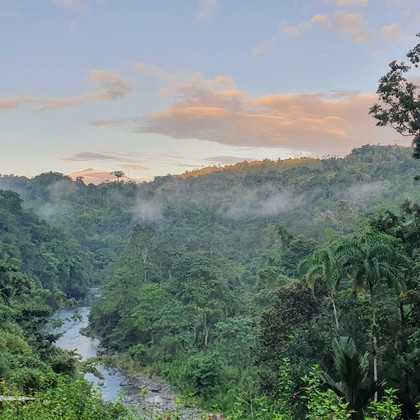
Fast-flowing, rocky rivers and streams with boulders and rapids in humid forest, mainly in the hills and foothills between about 300 and 1200 m, locally lower. It hunts fish and crustaceans from rocks or on gravel bars. The nest is a platform of sticks in a tree on the bank.
Where the bird is most at home, classified by the vegetation units of Mexico and Central America.



Range and movements
In the guide area along rivers on the Caribbean slope of Costa Rica, locally also on the Pacific side, and in Panama on both slopes, east to Darién. Outside the guide area in the Andes from Colombia to Bolivia and north-western Argentina, and in south-eastern Brazil.
- Resident
- dark = core range, pale = thinly spread
How and when to look
Rivers such as the Sarapiquí and the Tuis in Costa Rica and fast streams in the foothills of western and central Panama are the best places. Searching slowly upstream along the bank and scanning rocks in the current gives the best chance.
Conservation status
Not threatened globally. In the guide area scarce and local; sensitive to pollution and silting of rivers from logging, mining and hydroelectric dams.
Scientific name
Tigrisoma fasciatum | (Such, 1825)
Such described the species in 1825 as Ardea Fasciata; because it was later moved to another genus, the author and year stand in brackets. The genus Tigrisoma was introduced in 1827 by Swainson. Tigrisoma is Greek, from tigris 'tiger' and sōma 'body', after the barred plumage. fasciatum is Latin for 'banded', after the fine barring of the plumage. The specimen the first description was based on came from Brazil.