All species › Hedgehogs, shrews and moles › Shrews › Cretan Shrew
Cretan Shrew | Crocidura zimmermanni
Zimmermanns spitsmuis | Musaraña De Creta
The Cretan Shrew is a white-toothed shrew found only on Crete, mainly in the mountains of central and western Crete. It was described in 1953 as a subspecies of the Greater White-toothed Shrew and recognised as a separate species in 1978, on the basis of its build and its distinctive chromosomes. Genetic studies place it at the base of a North African group of Crocidura species, and it is regarded as a survivor of a species that already lived on Crete in the Pleistocene. Live animals are known only from a few upland plateaus.
No photograph of a living wild animal of this species with a suitable Creative Commons licence exists. Do you have one that meets the rules? Send it in.
Tracks
No signs are known that are specific to this species. Recent records at lower altitudes come exclusively from Barn Owl pellets, which is also the most productive method. Crocidura skulls and lower jaws are recognisable in pellets by their white teeth; separating them from Crocidura gueldenstaedtii requires skull measurements, such as rostrum length and lower-jaw shape, and experience.
Identification
The Cretan Shrew is a medium-sized Crocidura with, like all members of the genus, white teeth, ears that project above the fur and long scattered hairs on the tail. The summer coat is grey-brown on the back, greyer and less dark than in the Lesser White-toothed Shrew; the belly is paler brownish grey, with no clear dividing line between back and belly. The upper surfaces of the fore and hind feet are pale. Males are slightly larger than females. The skull resembles that of the Lesser White-toothed Shrew but has a longer rostrum and longer, slenderer lower jaws. Whether the coat changes in winter is unknown. The karyotype is 2n = 34. Head-body 6.5 to 7.8 cm, tail 3.5 to 4.2 cm, ear 7 to 13 mm, hind foot 12 to 14 mm, weight 7 to 8 g.
Similar species
Crete is also home to Güldenstädt's White-toothed Shrew (Crocidura gueldenstaedtii), formerly treated as the Lesser White-toothed Shrew and probably brought by people in prehistory. Externally the two species are hardly separable: the Cretan Shrew is somewhat greyer and less dark, but that difference is not reliable in the field. Separation rests on the skull: a longer rostrum, slenderer lower jaws, and a third upper unicuspid that is higher than the parastyle of the upper premolar. In practice altitude helps: live Cretan Shrews have only been caught in the mountains, while Crocidura gueldenstaedtii lives mainly in the lower parts of the island. Yet Cretan Shrews have turned up in pellets from 140 to 830 m, so altitude is not conclusive. Red-toothed shrews (Sorex) are absent from Crete. The Etruscan Shrew (Suncus etruscus) is much smaller, weighing only a few grams.
Habitat
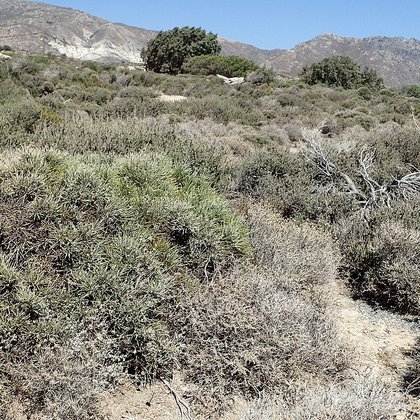
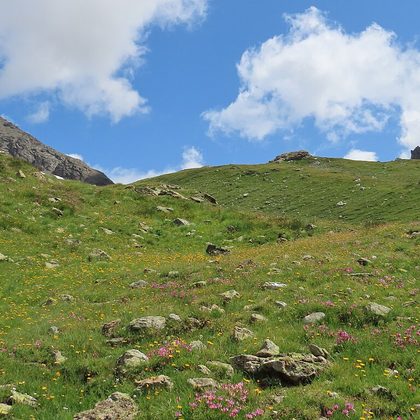
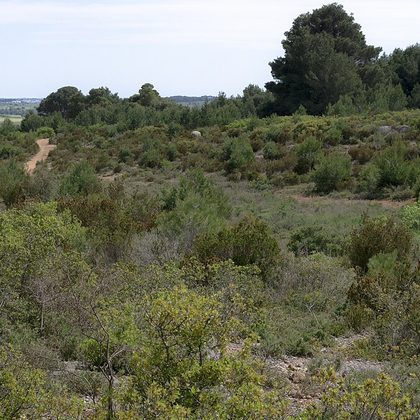
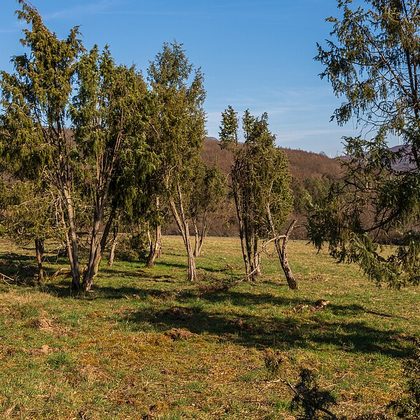
The species is known from mountain areas and their foothills from about 140 to 1,400 m, with low, spiny scrub and a harsh climate, with snow in winter and drought in summer. Within these zones the species is found mainly in damp spots with moss cushions under bushes of Cretan barberry (Berberis cretica). On the Nida and Omalos plateaus it lives in that mosaic of mountain pasture and thorny scrub. What habitat it uses in the lowlands and on the coast is unknown; only pellet records and subfossil remains are known from there.
Where the animal is most at home, classified with EUNIS — the European standard for habitats.
Distribution
The Cretan Shrew is endemic to Crete. The species is known mainly from the island's mountain areas, including the Nida plateau in the Ida (Psiloritis) range in the centre, the type locality, and the Omalos plateau in the Lefka Ori in the west. Pellet records show that it also occurs lower down, to 140 m, and subfossil remains are known from the coast. There are indications of size differences between central and western populations. It does not occur outside Crete.
Way of life
Almost nothing has been published on its way of life: there are no data on food, breeding, range size or social organisation. It is ground-dwelling, and records in Barn Owl pellets point to activity at night or at dusk. What holds for the genus has not been tested for this species: white-toothed shrews eat small invertebrates, do not hibernate, can enter brief torpor in cold weather and seldom live longer than eighteen months. Present-day animals are larger than those from the Pleistocene.
Where and when to look
Seeing a live animal is exceptional. On the Nida and Omalos plateaus small mammals can be watched for at dusk among the barberry bushes and mossy patches, but a sight record cannot be separated from Crocidura gueldenstaedtii. The method that does produce reliable data is collecting Barn Owl pellets in villages, chapels and ruins in and around the mountains, and having them sorted by someone experienced with shrew skulls. Every record, especially at lower altitude, adds to knowledge of the range of a threatened species. Trapping or disturbing this species requires a permit.
Conservation status
Endangered (EN, 2023) on the IUCN Red List; in earlier assessments it was listed as Vulnerable. Its range is limited to a single island, the population is probably declining, and the known sites of live animals are on a few upland plateaus. The species is threatened by habitat loss and appears to be displaced at lower altitudes by Crocidura gueldenstaedtii, probably brought to Crete by people in the fourth millennium BC or earlier; that competition could eventually lead to extinction. More research on distribution, numbers and ecology is needed, as are targeted conservation measures. It is listed on Appendix III of the Bern Convention.
Scientific name
Crocidura zimmermanni | Wettstein-Westersheim, 1953
Wettstein-Westersheim described the species in 1953 and placed it straight away in the genus where it still stands. Crocidura is Greek, from krokys, genitive krokydos, 'flock of wool, nap', and oura, 'tail', after the long loose hairs standing out among the short ones on the tail. zimmermanni honours the German zoologist Klaus Zimmermann (1912–1976) of the Berlin Museum für Naturkunde, a student of rodents and insectivores. The specimen the first description was based on came from Greece, Crete.