All species › Hedgehogs, shrews and moles › Shrews › Savi’s pygmy shrew
Savi’s pygmy shrew | Suncus etruscus
Wimperspitsmuis | Musarañita
Savi's Pygmy Shrew weighs 1.2 to 2.7 g and is among the lightest mammals known. It lives in the dry, open landscape around the Mediterranean: olive groves, vineyards, maquis and old terraces with dry-stone walls. Because an animal of two grams loses heat rapidly, it eats about twice its own weight each day and can let its body temperature drop for a few hours when food is short. It is seldom seen in the field; almost everything known about its distribution comes from owl pellets.
No photograph of a living wild animal of this species with a suitable Creative Commons licence exists. Do you have one that meets the rules? Send it in.
Tracks
In the field Savi's Pygmy Shrew leaves few usable signs. The prints are so small, the forefoot about 5 mm long and the hind foot 7 by 4 mm, that they show only in fine dust or silt and cannot be told reliably from those of young Crocidura. The droppings are minute and rarely found. The species is recorded almost exclusively in owl pellets of the barn owl and, less often, of the little owl and other raptors: the tiny skulls and lower jaws are readily recognised by their size and by the four unicuspid teeth. In Bulgaria, of seventeen new localities most came from barn owl pellets and only five from dead animals. A dead animal on a path or brought in by a cat is the other usual source.
Identification
A tiny white-toothed shrew with a proportionately large head, a long, pointed snout and large, prominent ears. The fur is greyish-brown with a reddish tinge on the back and paler grey below, without a sharp boundary. The tail is about half the length of head and body, thick at the base, and carries long, projecting bristle-hairs among the short fur; these occur in all white-toothed shrews but stand out in so small a species. The teeth are white. The diagnostic character in the hand is the dentition: the upper jaw has four small unicuspid teeth behind the incisor, against three in the Crocidura shrews. Head-body 3.5 to 5.3 cm, tail 2.1 to 3.0 cm, hind foot 5.7 to 7.9 mm, weight 1.2 to 2.7 g. The heart can beat more than 1500 times a minute.
Similar species
The main risk of confusion lies with young white-toothed shrews of the genus Crocidura, such as the Greater White-toothed Shrew (C. russula) and the Lesser White-toothed Shrew (C. suaveolens), which live in the same landscapes and are small when young. Adult Crocidura weigh four to fifteen grams or more, so an animal under three grams is almost certainly Savi's Pygmy Shrew; in case of doubt the teeth decide, with four rather than three small unicuspids in the upper jaw, together with the proportionately larger head and ears. The Pygmy Shrew (Sorex minutus) is also small but heavier, with red-brown tooth tips, small ears hidden in the fur and a tail without projecting bristles; it lives in damper, cooler ground and overlaps in southern Europe only locally in the mountains. Mice are not shrews: blunt muzzle, large eyes, gnawing teeth.
Habitat
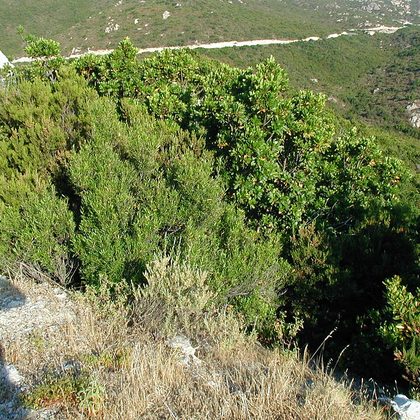
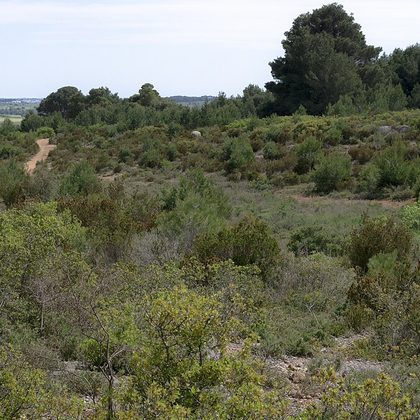
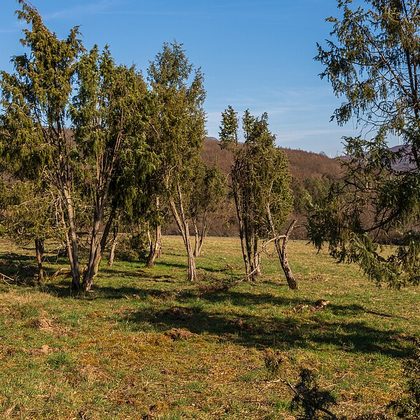
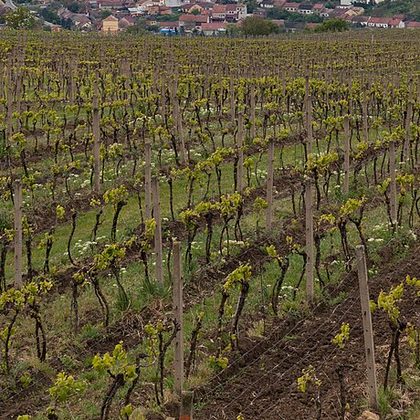
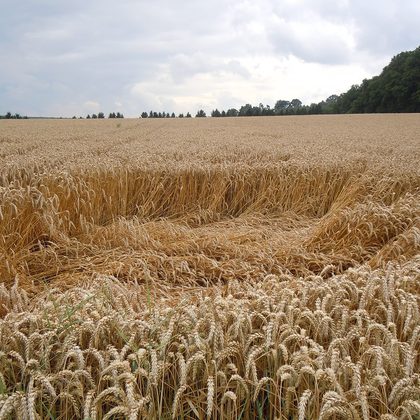
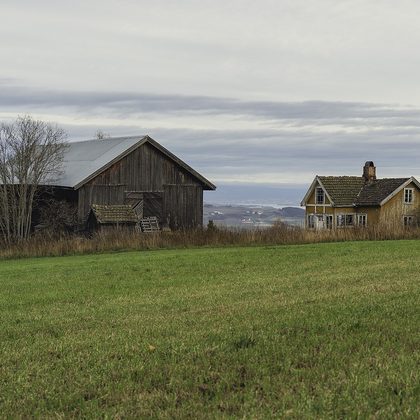
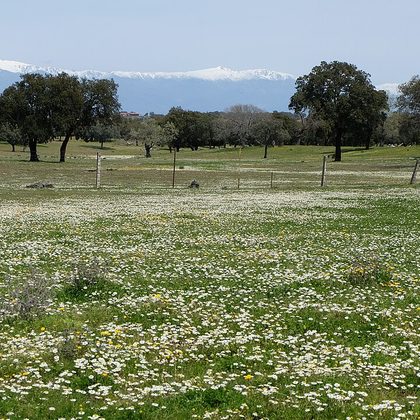
Open, dry and warm Mediterranean ground: olive groves, vineyards, almond and other orchards on dry soil, maquis, garrigue, fallow fields, wood pasture and open woodland. Typical are dry-stone walls, stone heaps and agricultural terraces, where crevices provide shelter, an even temperature and plenty of insects. It usually occurs below 1000 m, in areas with an annual rainfall below 1000 mm and a mean temperature above about 5 °C. It is also found around farmyards, barns and old rural buildings.
Where the animal is most at home, classified with EUNIS — the European standard for habitats.
Distribution
Circum-Mediterranean and onwards through south-west and central Asia to southern and south-east Asia. In Europe its range covers most of the Iberian Peninsula except Galicia, Cantabria and the high mountains, Mediterranean southern France, Italy with Sardinia, Corsica and Sicily, Malta, the Adriatic coast and the Balkans to Greece, Bulgaria and Cyprus, and further Turkey and North Africa from Morocco to Egypt. It is absent from the Balearics but occurs on Tenerife. The range limits are shifting: in Bulgaria it has recently been found north of the Stara Planina for the first time, and new localities have been reported elsewhere on the northern edge, such as Samos. Climate change is named as a possible cause of the expansion. It does not occur in Britain or Ireland.
- Native
- dark = core range, pale = thinly spread
Way of life
Mainly nocturnal, in many short bouts spread over the twenty-four hours. Savi's Pygmy Shrew eats about twice its own weight a day in invertebrates, chiefly grasshoppers and crickets, and also spiders, small snails, centipedes and worms, with the occasional olive or other fruit. It tackles prey two to three times its own weight. To save energy in cold weather or when food is short it can enter torpor for a few hours a day, lowering body temperature and metabolism; it does not hibernate. Breeding runs from spring to autumn: after a gestation of 27 to 30 days two to five young are born, on average just over three, and a female usually has three litters a year. The young are suckled for about three weeks. Outside the breeding season the species is probably solitary.
Where and when to look
The chance of seeing a live Savi's Pygmy Shrew is small but not zero. When stones are turned or dry-stone walls in olive groves and terraces are searched at dusk with a torch, an animal is sometimes seen moving jerkily between the crevices; the fine, high squeaking often comes before the movement. Stones should be put back in place afterwards. The most reliable method is dissecting barn owl pellets from barns, churches and abandoned farmhouses in the Mediterranean lowlands: under a lens the skulls are recognisable by their tiny size and the four unicuspid teeth. A dead animal can be weighed, measured and reported with photographs; at the northern edge of the range every new locality counts.
Conservation status
Least Concern (2017). The species has a large range and is considered locally common in suitable habitat, although reliable densities are hardly known because it is so difficult to trap. Locally it is declining with the loss of extensive farming: the clearance of dry-stone walls and terraces, the conversion of old olive groves and vineyards to intensive cultivation, the use of insecticides, and the scrubbing-over or building-up of abandoned land. At the northern edge of its range it appears instead to be expanding. Owls, above all the barn owl, are the main natural predators; small carnivores and cats also kill it.
Scientific name
Suncus etruscus | (Savi, 1822)
Savi described the species in 1822 as Sorex etruscus; because it was later moved to another genus, the author and year stand in brackets. Suncus is formed on an Indian vernacular name for the house shrew; Ehrenberg does not say which one in 1832, and the word cannot be placed with certainty. etruscus is Latin for 'Etruscan', from Etruria, the ancient country that became Tuscany; Savi described the animal from Pisa. The specimen the first description was based on came from Italy, Pisa.