All species › Bats › Vesper bats › Bechstein's bat
Bechstein's bat | Myotis bechsteinii
Bechsteins vleermuis | Murciélago Ratonero Forestal
Bechstein's bat is a medium-sized, very long-eared Myotis living in old and mature broadleaf woodland in Europe and parts of south-western Asia. It uses tree holes throughout the year, forages close to vegetation and in summer changes roost every few days. It is scarce over much of its range, locally common in central Europe, and has been listed as Near Threatened on the global Red List since 2016.
No photograph of a living wild animal of this species with a suitable Creative Commons licence exists. Do you have one that meets the rules? Send it in.
Tracks
Roosts are mainly in tree holes: woodpecker holes, rot holes and cracks in trunks, from just above the ground to about 20 m, and in bat and bird boxes in woodland; sometimes in buildings. Because a maternity colony changes tree about every two to three days, few signs are left: at most a few droppings below the entrance. Hibernation takes place in caves, mines, cellars and tunnels, but also in trees; in underground hibernacula usually single bats are found. From late August the bats can be caught at swarming sites in front of caves.
Identification
A medium-sized bat: forearm 39 to 47 mm, weight 7 to 14 g. The key feature is the long ears, 20 to 26 mm, set wide apart, not joined at the base and with nine to eleven transverse folds on the outer margin; the tragus is long and lance-shaped, reaching about half the ear length. The fur is fairly long and shaggy, brown to reddish brown on the back and clearly paler below; juveniles are pale to greyish. The muzzle is long, the face bare and pink. The wings are dark, short and broad, suited to flight among vegetation. Echolocation consists of long, broadband frequency-modulated calls between about 35 and 100 kHz, which without a sighting are almost impossible to separate from those of other Myotis species.
Similar species
Ear length separates the species from most Myotis species: in Natterer's bat (M. nattereri) and the related recently split species the ears are shorter, with fewer folds, and the edge of the tail membrane carries a fringe of stiff hairs with an S-shaped calcar. The long-eared bats (Plecotus) have ears nearly as long as the body, joined at the base above the head; at rest they fold the ears under the wings, leaving the tragus projecting. The greater and lesser mouse-eared bats (M. myotis, M. blythii) also have long ears but are much larger (forearm over 50 mm). On a bat detector Bechstein's bat cannot be reliably identified.
Habitat
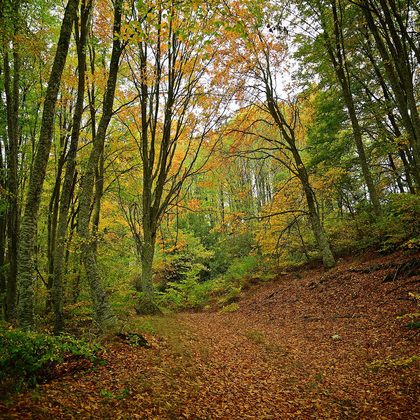
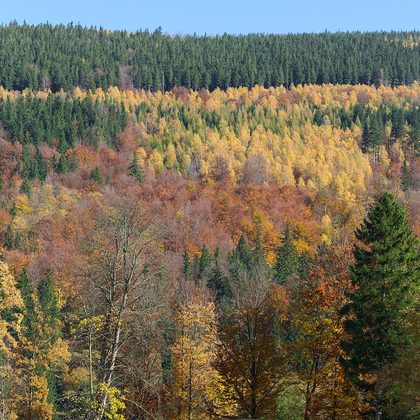
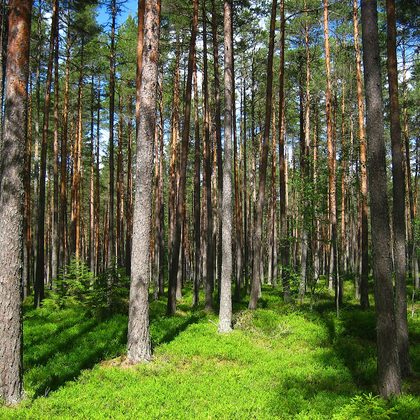
Exclusively old or mature woodland of the temperate zone, preferably beech and oak forest, from sea level to about 1500 m; maternity colonies are usually below 800 m. The species depends heavily on natural tree holes and a continuous tree layer; it is rarely found in farmland, gardens or plantations. Foraging takes place within the woodland itself, 1 to 5 m above the ground and along the foliage.
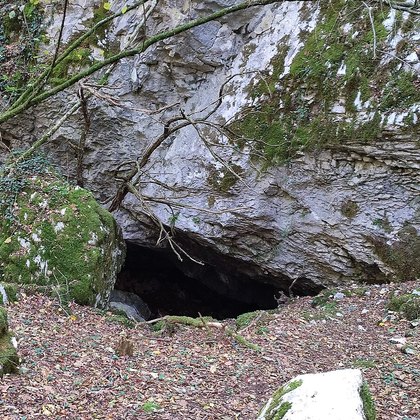
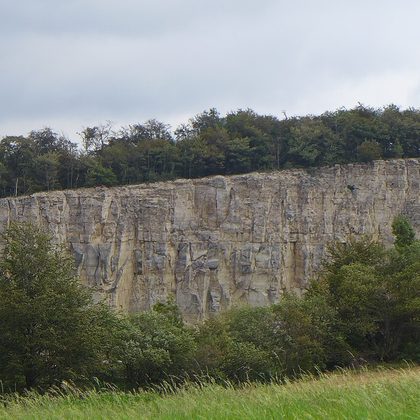
Where the animal is most at home, classified with EUNIS — the European standard for habitats.
Distribution
Europe, from southern Sweden, southern Britain and the Iberian Peninsula to Ukraine, Greece and Thrace, including Corsica and Sicily, with isolated areas in south-western Asia including Anatolia and the Caucasus. In the south of the range the species is scarce; populations are strongly fragmented. In European fossil assemblages it is one of the most frequently found bat species.
- Native
- dark = core range, pale = thinly spread
Way of life
Bechstein's bat hunts slowly and with great manoeuvrability close to the ground and foliage, and can hover; prey is partly located by ear, from the sounds it makes. The diet consists mainly of moths, supplemented by beetles, flies, lacewings and other invertebrates taken from the ground and from leaves. The foraging area of a maternity colony usually does not exceed 250 ha, 1 to 10 km from the roosts; some individuals use up to 700 ha in continuous forest. The bats emerge about twenty minutes after sunset. Maternity colonies number 10 to 50 females, rarely up to 100, and form in April; males are usually solitary. Young are born between early June and early July. In late August the bats disperse and mate at swarming sites. The maximum known age in the wild is 21 years.
Where and when to look
Bechstein's bat is rarely seen in the field: it flies low among the trees, emerges after sunset and cannot be separated from other Myotis species on a bat detector. In many countries the species is mainly recorded through box checks and licensed trapping studies. A tree with a colony can be recognised from outside by bats emerging at dusk. Boxes and tree holes with bats are not opened during the maternity period.
Conservation status
Near Threatened (NT, 2016). The species is scarce over much of its range and tied to old woodland; it is locally common only in parts of central Europe. Populations are fragmented as a result of past forest exploitation, and colonisation of new habitat is rarely recorded. The species is listed in Annexes II and IV of the Habitats Directive, which requires the designation of Special Areas of Conservation for it, and is covered by the Bern Convention and the EUROBATS Agreement.
Scientific name
Myotis bechsteinii | (Kuhl, 1817)
Kuhl described the species in 1817 as Vespertilio Bechsteinii; because it was later moved to another genus, the author and year stand in brackets. Myotis is Greek, from mys, genitive myos, 'mouse', and ous, genitive ōtos, 'ear': 'mouse-ear'. bechsteinii honours the German forester and naturalist Johann Matthäus Bechstein (1757–1822), author of the first sound account of Germany's mammals. The specimen the first description was based on came from Germany, Hesse.