All species › Bats › Vesper bats › Lesser mouse-eared myotis
Lesser mouse-eared myotis | Myotis blythii
Kleine vale vleermuis | Murciélago Ratonero Mediano
The lesser mouse-eared bat is a large Myotis of steppe, grassland and karst in southern and south-eastern Europe and much of south-western and central Asia. It closely resembles the greater mouse-eared bat, shares caves and maternity colonies with it, and hybrids have been documented where both occur. It hunts low over grassland, mainly for bush-crickets and other large insects taken from the vegetation.
No photograph of a living wild animal of this species with a suitable Creative Commons licence exists. Do you have one that meets the rules? Send it in.
Tracks
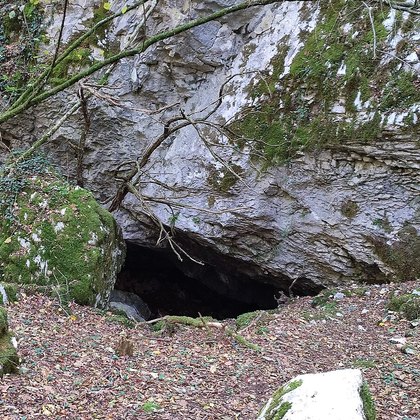
In the north of the range maternity colonies are in attics, old buildings and churches; in the south mainly in caves, tunnels and mines, often in mixed clusters with the greater mouse-eared bat, Schreibers's long-fingered bat and horseshoe bats. Beneath the roosting spots droppings lie in heaps. In the swarming season, from August, males hold fixed sites on cave ceilings, in crevices of bridges or old buildings and in walls, where they display in flight or while hanging and defend the site against other males.
Identification
A large bat: forearm 50.5 to 62 mm, weight 19 to 29.5 g. The back is brownish, the underside pale grey, whitish or beige. The ears are long (21 to 24 mm) and triangular, with a pointed, pale tragus without a dark tip. The muzzle is relatively short; the distance from the canine to the last upper molar is 8.1 to 9.5 mm. Some individuals have a pale spot on the crown, but it is absent or barely visible in many and is therefore not diagnostic. Echolocation consists of strongly modulated calls of about 2 to 10 ms starting at 120 to 170 kHz and ending at 26 to 29 kHz, usually with peak energy around 35 kHz; they closely resemble those of the greater mouse-eared bat.
Similar species
The greater mouse-eared bat (M. myotis) is the sister species and differs mainly in averages: it is on average larger, with a longer muzzle and longer ears, and its tragus often has a dark tip. The distributions overlap, the two share caves and maternity colonies and viable hybrids have been documented; without measurements, and in some cases even with them, an individual cannot be named with certainty. An observation is then recorded as Myotis myotis/blythii. The classification of this group is in flux: in North Africa and on Corsica and Sardinia lives M. punicus, formerly treated as a subspecies of the lesser or greater mouse-eared bat and now recognised as a separate species on genetic evidence; within the lesser mouse-eared bat itself several forms, including oxygnathus, have been suggested as possibly distinct species. For certain assignment in borderline cases DNA is needed. Other large species, such as the serotine (Cnephaeus serotinus) with a dark face and short, rounded ears, and Schreibers's long-fingered bat with small ears and a domed head, can be separated externally.
Habitat
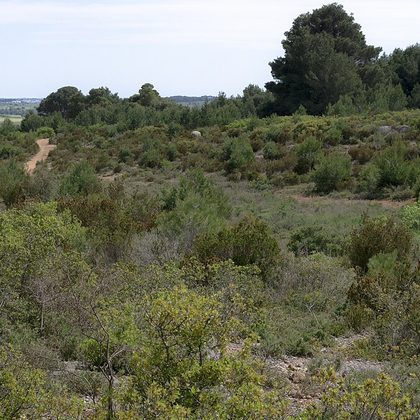
Mainly scrub and grassland: steppe, pastures and meadows, karst and farmland, from sea level to about 2100 m. The species selects open spaces for foraging, and also woodland edges where insects are abundant. The encroachment of abandoned farmland by shrubs and young woodland strongly reduces suitable foraging habitat. Roosts are in caves, tunnels, mines and buildings; hibernating groups of several hundred are known from underground sites with a stable temperature of 6 to 12 °C.
Where the animal is most at home, classified with EUNIS — the European standard for habitats.





Distribution
Southern Europe and the southern part of central Europe, including Sicily, Cyprus, Crete and smaller Mediterranean islands; in Asia from Asia Minor, the Caucasus, Palestine and northern Jordan to Kashmir, the Altai, Nepal, northern India and northern and central China. The species is absent from North Africa, Corsica and Sardinia, where the related M. punicus lives. Large colonies are known from Bulgaria, with up to 8000 bats.
- Native
- dark = core range, pale = thinly spread
Way of life
The lesser mouse-eared bat usually forages 1 to 2 m above the ground, continuously scanning the surface; it takes prey from vegetation or the ground, by landing on top of it, or in flight. The diet consists mainly of bush-crickets, chafers, grasshoppers, crane flies, ground beetles and mole crickets, and in the Mediterranean also mantises and caterpillars. The bats emerge well after sunset, after pipistrelles and Schreibers's long-fingered bats, and return before dawn. Maternity colonies consist mainly of adult females with young and usually number 50 to 500; males hang alone or in small groups nearby. The young, usually one, are born between late May and mid-June, depending on food availability, and fly at five to six weeks. Maternity and hibernation roosts are usually about 15 km apart; regular long-distance migration has not been documented, and the longest known movement is about 488 km. Little is known about hibernation.
Where and when to look
The species is best seen at emergence from a known cave or attic, which begins well after sunset. In the field it cannot be separated from the greater mouse-eared bat, nor with a bat detector; record the observation as Myotis myotis/blythii. Caves with colonies are not entered during the maternity period or in winter; shining strong lights on a cluster also causes disturbance.
Conservation status
Least Concern (LC, 2016). In the north of the range, in Asia and in Turkey populations are described as stable and abundant. In Spain and Portugal they are declining; in Romania one of the largest colonies almost disappeared within a short time. Reported causes are disturbance in caves by caving, tourism and herders, and loss of foraging habitat as abandoned farmland becomes overgrown. The species is listed in Annexes II and IV of the Habitats Directive, which requires the designation of Special Areas of Conservation for it, and is covered by the Bern Convention and the EUROBATS Agreement.
Scientific name
Myotis blythii | (Tomes, 1857)
Tomes described the species in 1857 as Vespertilio Blythii; because it was later moved to another genus, the author and year stand in brackets. Myotis is Greek, from mys, genitive myos, 'mouse', and ous, genitive ōtos, 'ear': 'mouse-ear'. blythii honours the English zoologist Edward Blyth (1810–1873), curator of the Asiatic Society's museum in Calcutta, who supplied Tomes with Indian material. The specimen the first description was based on came from India.