All species › Pigeons and doves › Doves and pigeons › Zenaida Dove
Position in the tree Birds Aves › Birds with a flexible palate Neognathae › All other modern birds Neoaves › Doves, turacos and allies Columbaves › Doves and sandgrouse Columbimorphae
Zenaida Dove | Zenaida aurita
Antilliaanse treurduif | Paloma aurita
The Zenaida Dove is the typical dove of the West Indian coast: a stocky, warm brown dove of coastal scrub, gardens and hotel grounds. On the mainland of the guide area it lives only along the north coast of the Yucatán Peninsula and on the islands off it, including Cozumel. There it is a coastal bird that rarely ventures far inland.
Voice
A soft, mournful coo-OO-oo, oo, oo, very like the call of Mourning Dove but faster and often with one note fewer. Heard mainly in the morning. On take-off the wings clap.
Recording: Garrett Yocklin — CC BY-NC-SA 4.0 · converted to mono · xeno-canto
Identification
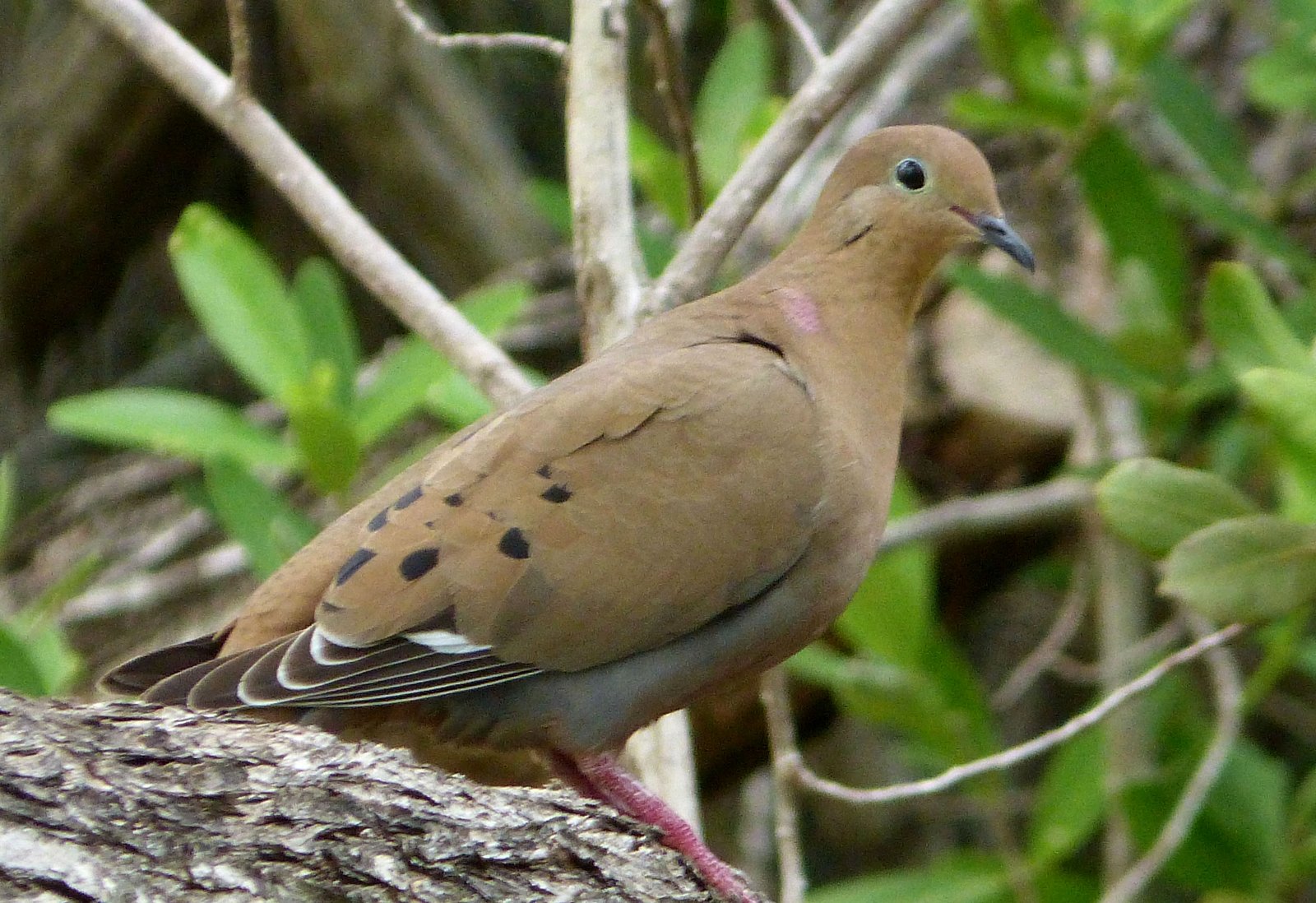
25–28 cm, stocky, with a fairly short, rounded tail. The upperparts are warm brown, with a few black spots on the coverts and a narrow white trailing edge to the secondaries, visible in flight and often also on the closed wing. The head and underparts are pinkish cinnamon. Two small black streaks below the eye and on the ear coverts; a purple-golden gloss on the sides of the neck. The tail is grey with a black band and pale grey tips. The legs are red. The female is duller than the male.
Confusion species
White-winged Dove Zenaida asiatica, which occurs in the same places, is greyer, with a broad white wing band, white tail corners and bare blue skin around the eye. Mourning Dove Zenaida macroura is slimmer and paler, with a long, pointed tail and no white wing edge. Caribbean Dove Leptotila jamaicensis has a white face and a white belly and walks mainly in woodland.
Habitat
Open and semi-open country close to the coast: coastal scrub and dune vegetation, low coastal forest, mangrove edges, and further gardens, parks and hotel grounds. Searches for seeds and fallen fruit on the ground, often on paths and lawns. The nest is a flimsy platform of twigs in a tree or shrub, sometimes on the ground.
Where the bird is most at home, classified by the vegetation units of Mexico and Central America.




Range and movements
In the guide area only along the north coast of the Yucatán Peninsula, in the states of Yucatán and Quintana Roo, with the islands of Holbox, Contoy, Mujeres and Cozumel (Z. a. salvadorii). A few records are known from Belize. Outside the guide area widespread in the Bahamas, the Greater Antilles, the Virgin Islands and the Lesser Antilles to Grenada.
- Resident
- dark = core range, pale = thinly spread
How and when to look
On Cozumel and Isla Mujeres and along the coast around Cancún often tame on hotel lawns, in gardens and on beach paths. When the bird flies off, the white wing edge and the pale tail tips show well.
Conservation status
Not threatened globally. Locally common in the guide area, but restricted to a narrow coastal strip. Coastal forest and scrub along the Mexican Caribbean coast are disappearing to tourist development, although the species also lives on hotel grounds.
Scientific name
Zenaida aurita | (Temminck, 1809)
Temminck described the species in 1809 as Columba Aurita; because it was later moved to another genus, the author and year stand in brackets. The genus Zenaida was introduced in 1838 by Bonaparte. Zenaida honours Zénaïde Bonaparte (1801–1854), wife of the French ornithologist Charles Lucien Bonaparte, who named the genus in 1838. aurita is Latin for 'eared', after the dark spot on the ear-coverts. The specimen the first description was based on came from Martinique.