All species › Pigeons and doves › Doves and pigeons › Tuxtla Quail-Dove
Position in the tree Birds Aves › Birds with a flexible palate Neognathae › All other modern birds Neoaves › Doves, turacos and allies Columbaves › Doves and sandgrouse Columbimorphae
Tuxtla Quail-Dove | Zentrygon carrikeri
Carrikers kwartelduif | Paloma perdiz tuxtleña
Tuxtla Quail-Dove is a large, shy ground dove found only in the mountains of Los Tuxtlas in southern Veracruz. Its range is one of the smallest of any bird in the guide area. The species was long treated as a subspecies of Purplish-backed Quail-Dove of Costa Rica and Panama, but is now regarded as a separate species.
Voice
A low, hollow call of two or three parts, the first soft and the last the longest, roughly took-wooo. The call is repeated at intervals of a few seconds from the ground or a low branch and its source can scarcely be pinpointed.
Recording: Nick Athanas — CC BY-NC-SA 3.0 · converted to mono · xeno-canto
Identification
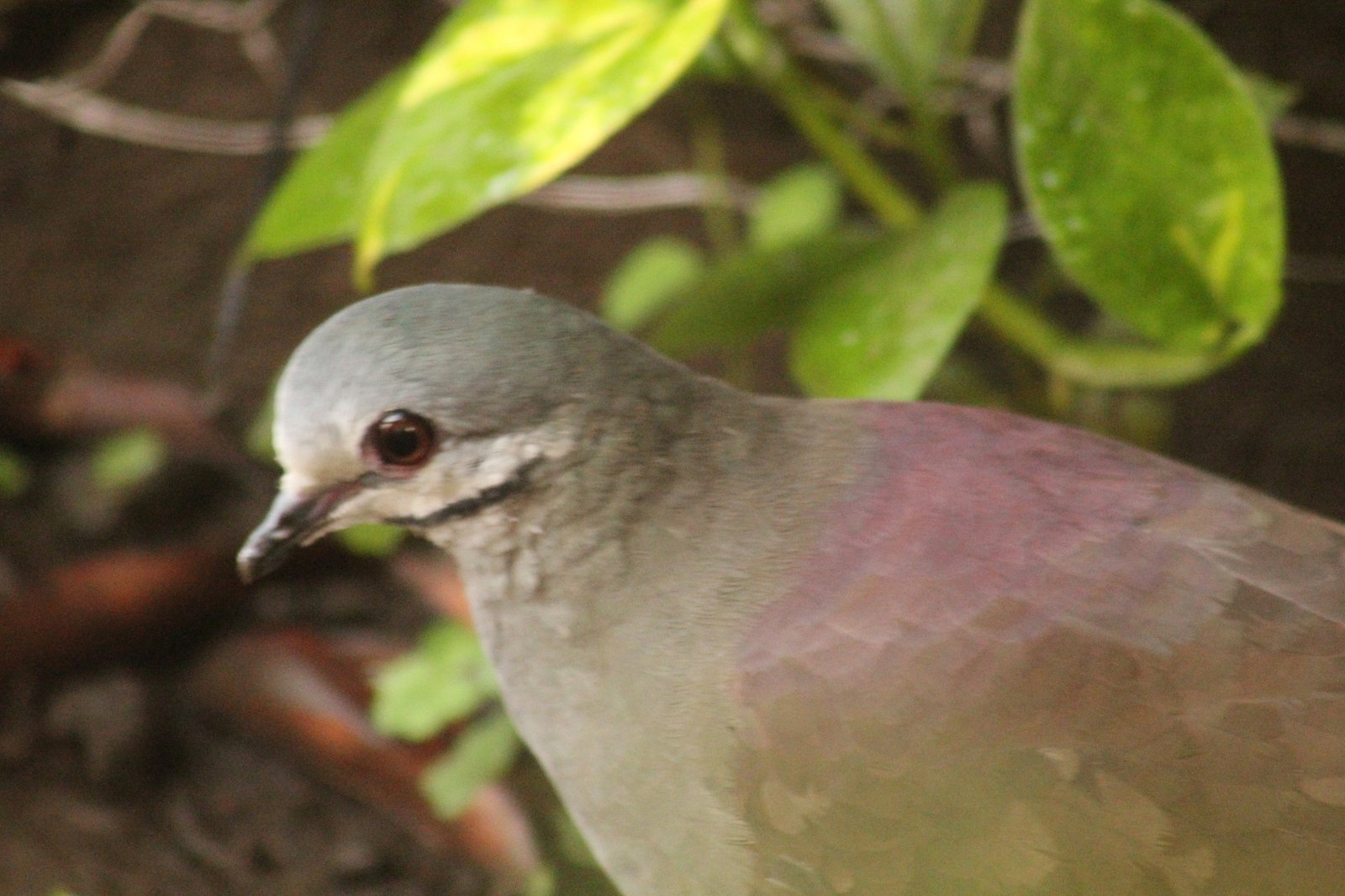
29–32 cm; a large, compact quail-dove with a short tail and fairly long, reddish legs. The forehead and face are whitish, with a narrow black moustachial stripe separating the face from the white throat. The crown and hindneck are grey, the hindneck with a greenish gloss. The mantle is purplish chestnut; the back, wings and tail are olive-brown. The breast is grey, the belly whitish and the undertail coverts pale brown. Male and female are almost alike; juveniles are duller and browner.
Confusion species
Ruddy Quail-Dove Geotrygon montana lives in the same mountains but mainly lower down; it is smaller and plain rusty brown above, without a grey crown or black moustachial stripe, and the female is olive-brown. Grey-headed Dove Leptotila plumbeiceps has a blue-grey head without facial pattern, a pink-tinged breast and white tail corners, and more often flies up into the trees. Purplish-backed Quail-Dove Zentrygon lawrencii closely resembles this species, but does not occur north of Costa Rica.
Habitat
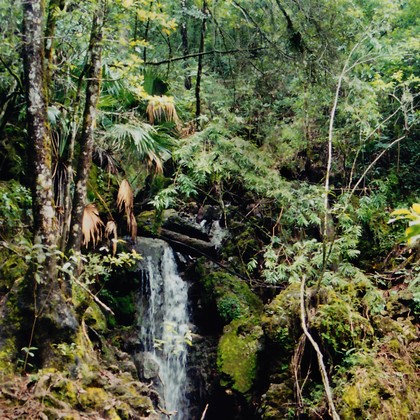
Humid montane rainforest and cloud forest on the slopes of the volcanoes of Los Tuxtlas, mainly above about 500 m, with dense undergrowth and a thick layer of leaf litter. It forages on foot on the forest floor for fallen seeds, fruit and small invertebrates. The nest is a loose platform of twigs, low in shrubs or creepers.
Where the bird is most at home, classified by the vegetation units of Mexico and Central America.

Range and movements
Only in Los Tuxtlas in southern Veracruz, on Volcán San Martín Tuxtla and in the Sierra de Santa Marta. The species does not occur elsewhere, so the guide area holds its entire range.
- Resident
- dark = core range, pale = thinly spread
How and when to look
Most records come from the forest road near Ruiz Cortines on the slopes of Volcán San Martín Tuxtla, inside the Reserva de la Biosfera Los Tuxtlas. The bird is heard far more often than seen; the best chance is early in the morning, standing quietly on a forest trail, when a bird sometimes walks across the path.
Conservation status
Endangered. Its habitat is small and badly fragmented, as much of the forest in Los Tuxtlas has been converted to pasture and farmland. The remaining montane forest lies largely within the biosphere reserve, but even there it is under pressure from clearance and hunting.
Scientific name
Zentrygon carrikeri | (Wetmore, 1941)
Wetmore described the species in 1941 as Oreopeleia lawrencii carrikeri; because it was later moved to another genus, the author and year stand in brackets. The genus Zentrygon was introduced in 2013 by Banks, Weckstein, Remsen & Johnson. Zentrygon is a blend of the genera Zenaida and Geotrygon, reflecting these quail-doves' close relationship with Zenaida. carrikeri honours the American ornithologist, entomologist and collector Melbourne Armstrong Carriker Jr. (1879–1965), who worked widely in Latin America. The specimen the first description was based on came from Volcán San Martín, Sierra de los Tuxtlas, Veracruz, Mexico.