All species › Passerines › Tyrant flycatchers and allies › Yellow-winged Flatbill
Position in the tree Birds Aves › Birds with a flexible palate Neognathae › All other modern birds Neoaves › Landbirds Telluraves › Falcons, parrots and passerines Australaves › Falcons and passerines Eufalconimorphae › Parrots and passerines Psittacopasserae
Yellow-winged Flatbill | Tolmomyias flavotectus
Geelrandbreedbektiran | Picoancho aliamarillo
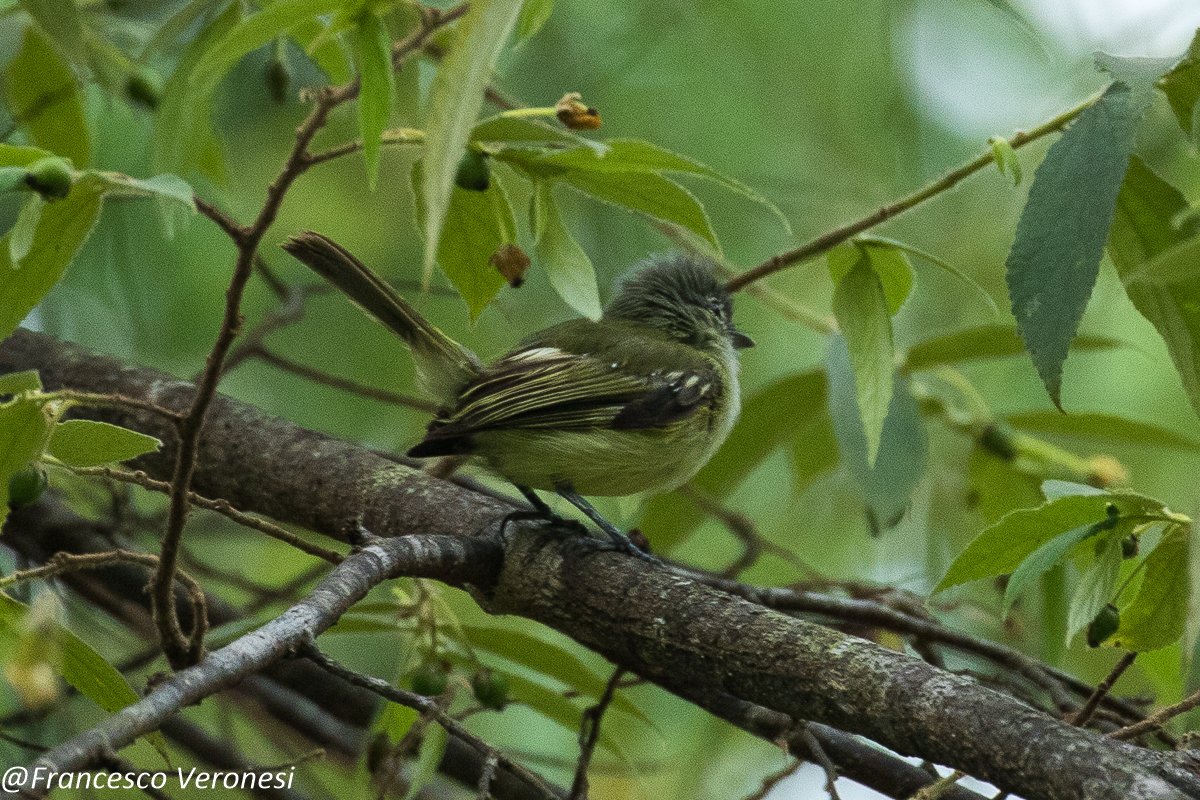
The Yellow-winged Flatbill is a small, olive-green tyrant flycatcher with a grey head, a dark eye and yellow edges to the wing-coverts. It lives in the canopy of humid lowland forest in Costa Rica and Panama and often travels with mixed flocks. It used to be treated as a subspecies of an Amazonian flatbill.
Voice
A sharp, buzzy, slightly rising call, often repeated a few times in succession.
Recording: Paul Driver — CC BY-NC-SA 4.0 · converted to mono · xeno-canto
Identification
13 cm, with a broad, flat bill, black above and pale below. Head grey with a dark iris and a narrow pale eye-ring. Back olive-green. The dark wings have broad yellow edges to the coverts, forming a yellow wing panel rather than distinct bars, and a small pale yellow spot at the base of the primaries. Throat greyish, breast olive-yellow, belly yellow. Male and female are alike.
Confusion species
Yellow-olive Flatbill Tolmomyias sulphurescens has a pale iris, a whitish supraloral line and two distinct yellow wing-bars, and lives more at forest edges and in semi-open country. Panama Tyrannulet Phylloscartes flavovirens is smaller, with a slender bill. Western Olivaceous Flatbill Rhynchocyclus aequinoctialis is larger and stockier, with an olive-green head.
Habitat
Canopy and edges of humid evergreen lowland and foothill forest, also tall secondary forest. It searches the foliage for insects and often joins mixed flocks in the canopy. Like related species, it builds a hanging nest with a downward-facing entrance.
Where the bird is most at home, classified by the vegetation units of Mexico and Central America.




Range and movements
In the guide area mainly on the Caribbean slope of Costa Rica and in Panama, where it occurs on both slopes; there are also reports from extreme south-eastern Nicaragua. Outside the guide area in western Colombia and north-western Ecuador.
- Resident
- dark = core range, pale = thinly spread
How and when to look
Regular with mixed canopy flocks along Pipeline Road (Camino del Oleoducto) in Panama. Look for the grey head, dark eye and yellow wing edgings.
Conservation status
Not threatened. Fairly common in suitable forest, but dependent on forest and therefore sensitive to deforestation.
Scientific name
Tolmomyias flavotectus | (Hartert, 1902) (GBIF: Tolmomyias assimilis)
Hartert described the species in 1902 as Rhynchocyclus megacephala flavotectus; because it was later moved to another genus, the author and year stand in brackets. The genus Tolmomyias was introduced in 1927 by Hellmayr. Tolmomyias is Greek, from tolma 'boldness' and muias 'fly' (flycatcher): 'bold flycatcher'. flavotectus is Latin, from flavus 'yellow' and tectus 'covered', after the yellow-edged wing coverts. The specimen the first description was based on came from San Javier, Hacienda Paramba, northwestern Ecuador.