All species › Passerines › Tyrant flycatchers and allies › Yellow-olive Flatbill
Position in the tree Birds Aves › Birds with a flexible palate Neognathae › All other modern birds Neoaves › Landbirds Telluraves › Falcons, parrots and passerines Australaves › Falcons and passerines Eufalconimorphae › Parrots and passerines Psittacopasserae
Yellow-olive Flatbill | Tolmomyias sulphurescens
Groenkapbreedbektiran | Mosquero ojo blanco
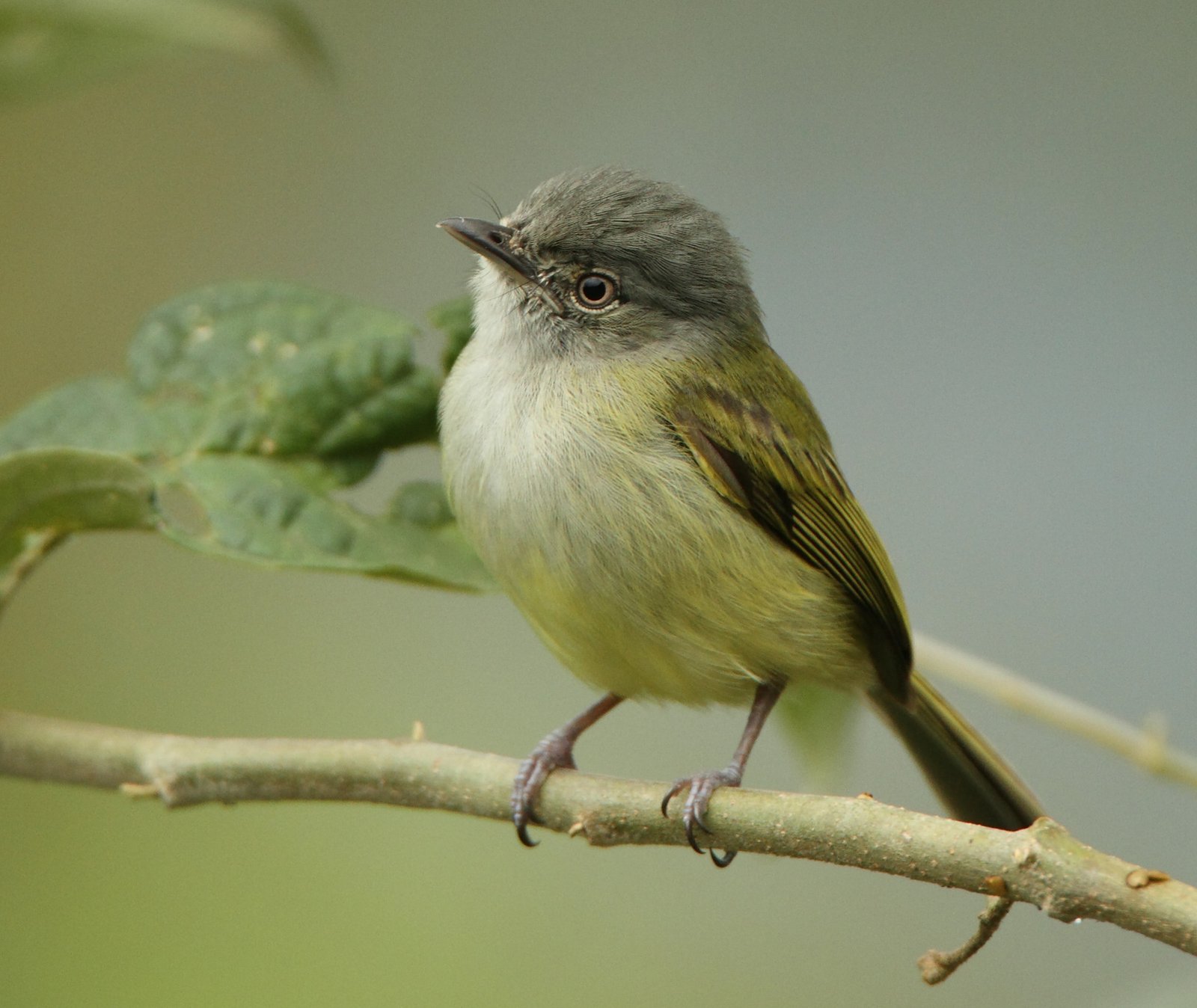
The Yellow-olive Flatbill is a small, olive-green tyrant flycatcher with a grey crown, a broad, flat bill and, in adults, a pale iris. It lives at forest edges, in secondary forest and in semi-open country with trees, and builds a conspicuous hanging nest. In the guide area it occurs from southern Mexico to Panama.
Voice
A thin, sibilant or buzzy call, tszeep, often repeated in a short series of two or three notes.
Recording: Mateus Gonçalves Santos — CC BY-NC-SA 4.0 · shortened to the first 60 s, mono · xeno-canto
Identification
13–14 cm. Crown and hindneck grey, back olive-green. A narrow whitish line above the lores and a thin pale ring around the eye. Adults have a pale grey to whitish iris. The dark wings have two yellow wing-bars and yellow edges to the flight feathers. Throat pale grey, breast greyish-olive, belly yellow. Bill broad and flat, black above and pale below. Male and female are alike.
Confusion species
Yellow-winged Flatbill Tolmomyias flavotectus (Costa Rica and Panama) has a dark iris, no whitish supraloral line, yellow edges to the wing-coverts instead of distinct wing-bars, and lives mainly in the canopy of humid forest. Eye-ringed Flatbill Rhynchocyclus brevirostris is larger and stockier, with a broad white eye-ring and a dark iris. Yellow-bellied Elaenia Elaenia flavogaster has a crest and a slender bill.
Habitat
Edges and clearings in humid and dry forest, secondary forest, gallery forest, shade coffee and other semi-open country with tall trees, from the lowlands to about 1500 m. It forages in the middle and upper levels for insects, which it takes from leaves with a short sally. It builds a pear-shaped hanging nest with a downward-pointing entrance tube, often on a thin branch and regularly near a wasp nest.
Where the bird is most at home, classified by the vegetation units of Mexico and Central America.







Range and movements
From southern Mexico (from Oaxaca and Veracruz, also the Yucatán Peninsula) through Belize, Guatemala, El Salvador, Honduras, Nicaragua and Costa Rica to Panama. Outside the guide area over much of South America, to northern Argentina, and on Trinidad.
- Resident
- dark = core range, pale = thinly spread
How and when to look
The hanging, pear-shaped nest with an entrance tube at the bottom is often noticed before the bird itself. The pale iris is a good feature at close range.
Conservation status
Not threatened. Widespread and fairly common; tolerates semi-open and man-made landscapes as long as tall trees remain.
Scientific name
Tolmomyias sulphurescens | (Spix, 1825)
Spix described the species in 1825 as Platyrhynchus sulphurescens; because it was later moved to another genus, the author and year stand in brackets. The genus Tolmomyias was introduced in 1927 by Hellmayr. Tolmomyias is Greek, from tolma 'boldness' and muias 'fly' (flycatcher): 'bold flycatcher'. sulphurescens is Modern Latin for 'sulphur-tinged', from sulphur 'sulphur', after the yellow underparts. The specimen the first description was based on came from Rio de Janeiro, Brazil.