All species › Passerines › Tyrant flycatchers and allies › Brownish Twistwing
Position in the tree Birds Aves › Birds with a flexible palate Neognathae › All other modern birds Neoaves › Landbirds Telluraves › Falcons, parrots and passerines Australaves › Falcons and passerines Eufalconimorphae › Parrots and passerines Psittacopasserae
Brownish Twistwing | Cnipodectes subbrunneus
Schroefvleugeltiran | Alitorcido pardo
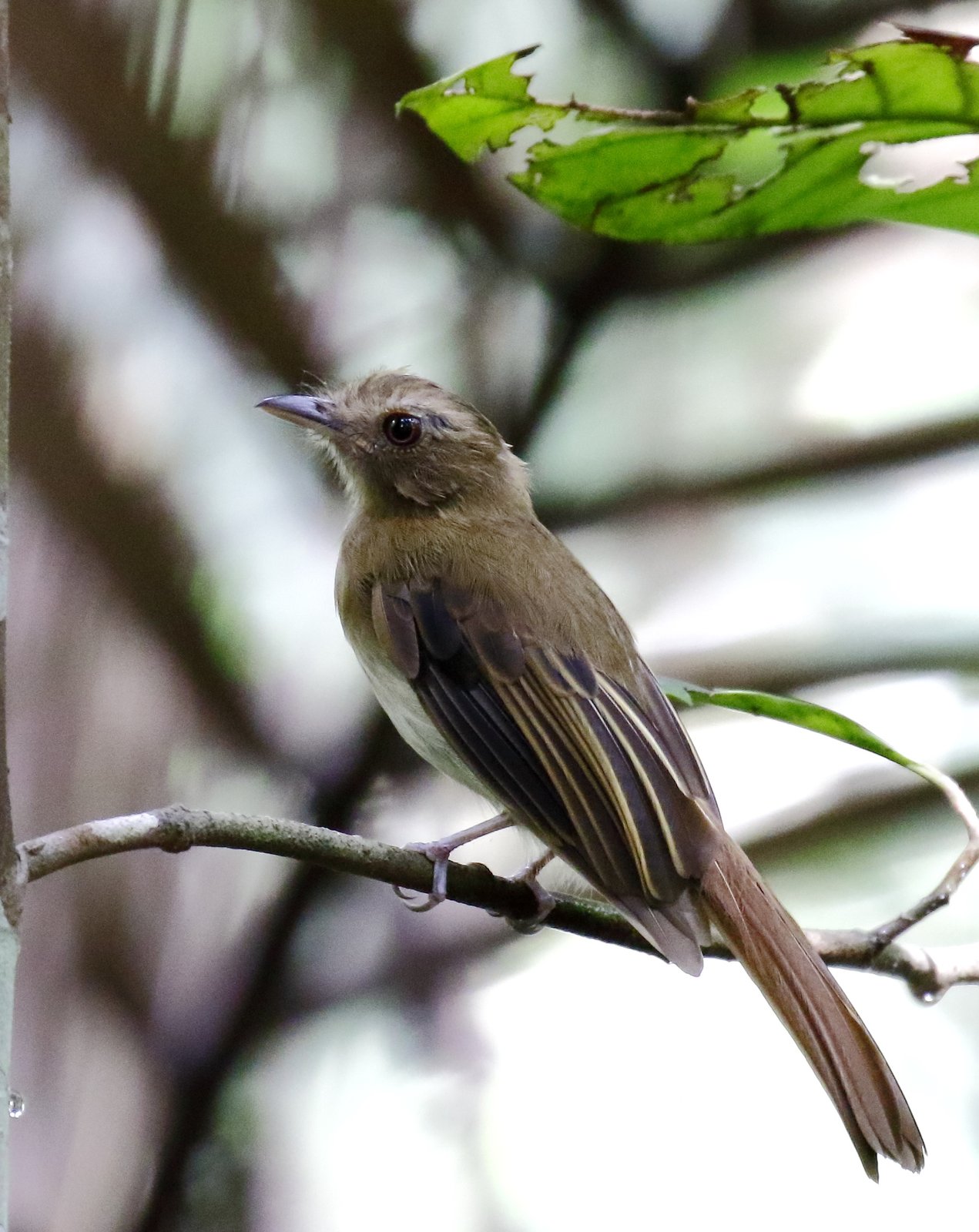
The Brownish Twistwing is a fairly large, brownish tyrant flycatcher of the understorey of humid lowland forest. Like the Mionectes flycatchers it repeatedly lifts one wing at a time above its back. In the male the outer primaries are stiff and twisted, which gives the species its name. In the guide area it lives only in Panama.
Voice
A loud, emphatic two-syllabled whistle, often repeated several times; also sharp calls. More often heard than seen.
Recording: Jacob Wijpkema — CC BY-NC-SA 4.0 · converted to mono · xeno-canto
Identification
15–17 cm; the male is distinctly larger than the female. Upperparts olive-brown, rump and tail more rufous-brown; the tail is fairly long. Wings dark with cinnamon-buff edges to the coverts, forming two faint wing-bars. Throat greyish, breast brownish-olive, belly pale yellowish. Bill fairly broad and dark. The twisted primaries of the male can hardly be seen in the field.
Confusion species
Ochre-bellied Flycatcher Mionectes oleagineus also lifts one wing at a time, but is smaller and greener, with a greyish head and a bright ochre belly. Western Olivaceous Flatbill Rhynchocyclus aequinoctialis is greener, with a broader, flatter bill and a shorter tail. Rufous Mourner Rhytipterna holerythra is larger and uniformly rufous-brown.
Habitat
Understorey and middle levels of humid lowland forest, mature secondary forest and forest edges, often near streams and in dense growth with vines; mainly in the lowlands. It perches quietly and takes insects with short sallies to leaves.
Where the bird is most at home, classified by the vegetation units of Mexico and Central America.




Range and movements
In the guide area only in Panama, mainly in the central and eastern parts of the country, east to Darién. Outside the guide area in northern and western Colombia, western Ecuador and, as a separate population, in western Amazonia.
- Resident
- dark = core range, pale = thinly spread
How and when to look
Worth looking for along Pipeline Road (Camino del Oleoducto) in Panama. Watch for a medium-sized brown flycatcher in the understorey that lifts one wing and then the other, and listen for the loud, repeated whistle.
Conservation status
Not threatened. Not rare in suitable forest but inconspicuous; dependent on forest and disappears where it is cleared completely.
Scientific name
Cnipodectes subbrunneus | (Sclater, 1860)
Sclater described the species in 1860 as Cyclorhynchus subbrunneus; because it was later moved to another genus, the author and year stand in brackets. The genus Cnipodectes was introduced in 1873 by Sclater & Salvin. Cnipodectes is Greek, from knips, knipos 'insect' and dēktēs 'biter': 'insect-biter'. subbrunneus is Latin, from sub 'somewhat' and brunneus 'brown': 'brownish', after the brown plumage. The specimen the first description was based on came from Babahoyo, Los Ríos, Ecuador.