All species › Pigeons and doves › Doves and pigeons › White-tipped Dove
Position in the tree Birds Aves › Birds with a flexible palate Neognathae › All other modern birds Neoaves › Doves, turacos and allies Columbaves › Doves and sandgrouse Columbimorphae
White-tipped Dove | Leptotila verreauxi
Verreaux' duif | Paloma arroyera
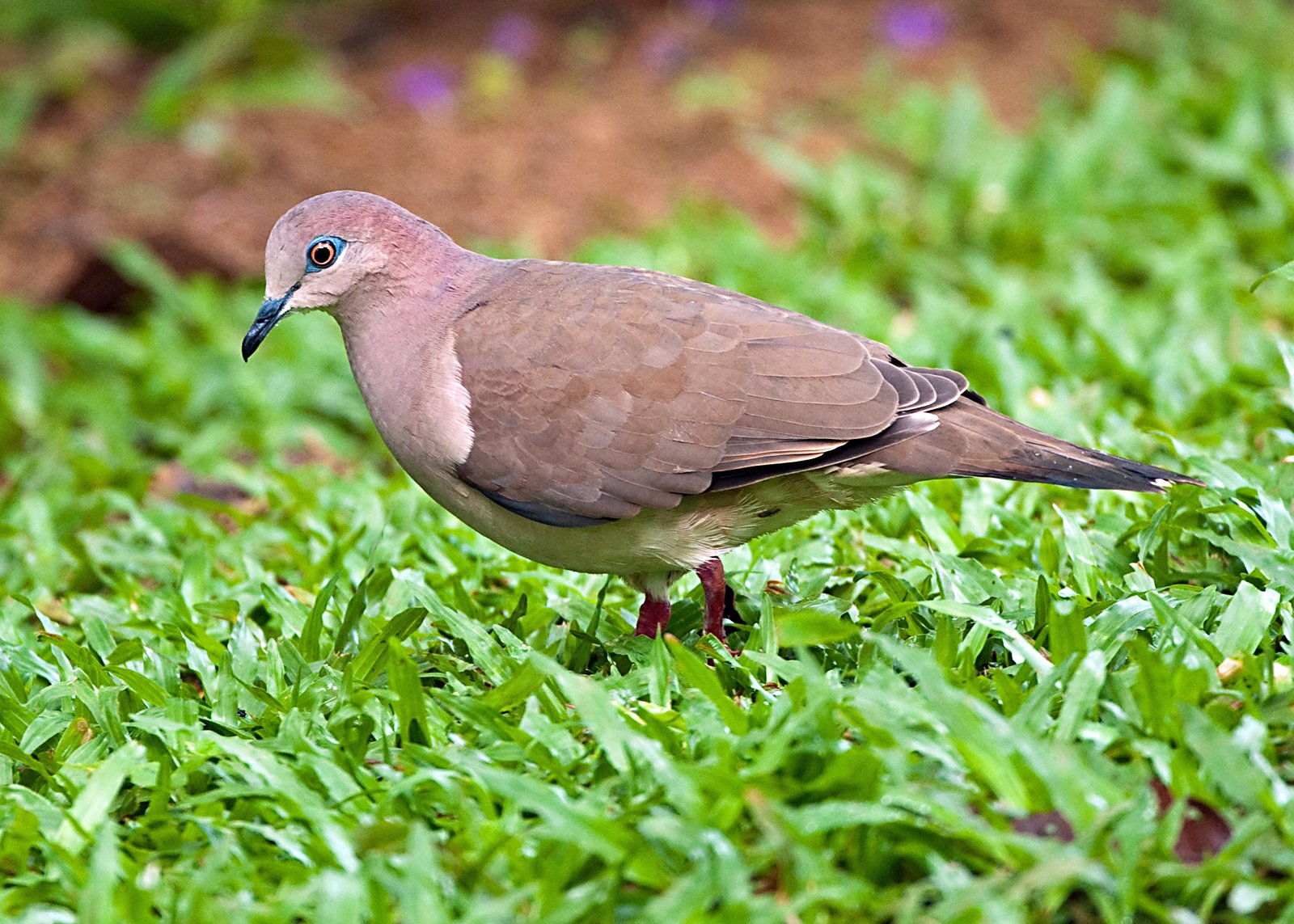
The White-tipped Dove is the most widespread ground dove in the guide area: a medium-sized, brown dove with pale underparts and white tail corners, found from southern Texas to Argentina. It usually walks unobtrusively on the ground in scrub and along forest edges and is heard more often than seen. In the guide area it is absent only from Baja California, the arid interior of northern Mexico and the highest mountains.
Voice
A low, hollow, far-carrying coo, like blowing across the neck of a bottle: a short grace note followed by a long note that swells and fades, oo-whooooo. The call is repeated at long intervals, also in the middle of the day. On take-off the wings make a soft whistling sound.
Recording: Étienne Leroy — CC BY-NC-SA 4.0 · converted to mono · xeno-canto
Identification
25–29 cm. A fairly stocky dove with a medium-length, rounded tail. The upperparts are plain grey-brown to olive-brown, the crown greyish, the forehead and throat pale, almost white. The breast is pale pinkish buff, the belly white; the hindneck has a faint purplish gloss. The eye is pale yellow, surrounded by a ring of bare, usually blue skin; the legs are red. The tail is dark with narrow white tips to the outer feathers, visible mainly on take-off and landing. The underwing is rufous. The sexes are alike; juveniles have pale feather fringes on the upperparts.
Confusion species
Grey-headed Dove Leptotila plumbeiceps has a blue-grey crown and nape contrasting sharply with the brown back, and lives in humid forest. Grey-chested Dove Leptotila cassinii is darker, with a grey breast and less white in the tail, and lives in humid lowland forest on the Caribbean side. Caribbean Dove Leptotila jamaicensis has a whiter face and a pinkish-purple gloss on the neck and mantle, and occurs only along the coast of the Yucatán Peninsula and on offshore islands. Ruddy Quail-Dove Geotrygon montana is rufous-brown, with a pale stripe below the eye and no white tail corners. Mourning Dove Zenaida macroura is slimmer, with a long, pointed tail and black spots on the wing.
Habitat
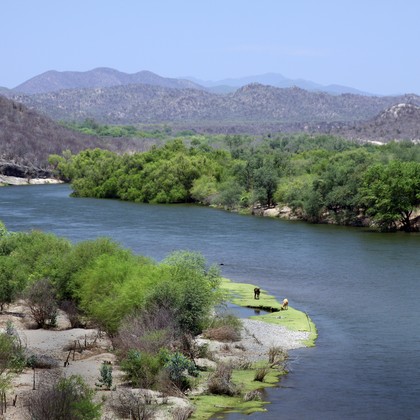
Dry and semi-humid forest, thorn scrub, gallery forest, second growth and forest edges, thickets, plantations and gardens with dense cover; absent from the interior of closed rainforest. From sea level to about 2500 m, mainly below 1500 m. Forages alone or in pairs, walking on the ground for seeds, fallen fruit and small invertebrates. The nest is a platform of twigs in a shrub or low tree.
Where the bird is most at home, classified by the vegetation units of Mexico and Central America.





Range and movements
In Mexico on the Pacific side from southern Sonora and on the Gulf coast from Nuevo León and Tamaulipas southwards, including the whole Yucatán Peninsula and the Islas Marías (L. v. capitalis). Further throughout Guatemala, Belize, El Salvador, Honduras, Nicaragua, Costa Rica and Panama. Outside the guide area from southern Texas far into South America, south to Argentina, and on Aruba, Curaçao, Bonaire, Trinidad and Tobago.
- Resident
- dark = core range, pale = thinly spread
How and when to look
Early in the morning birds walk on quiet dirt roads and tracks along scrub, where they flush on approach and show the white tail corners. At feeding stations of lodges, for example in Costa Rica and on the Yucatán Peninsula, they are often tame. The hollow cooing usually gives the species away before it is seen.
Conservation status
Not threatened. Common and widespread throughout the guide area. The species benefits from forest edges and second growth and copes well with a human-altered landscape.
Scientific name
Leptotila verreauxi | Bonaparte, 1855
Bonaparte described the species in 1855 and placed it straight away in the genus where it still stands. The genus Leptotila was introduced in 1837 by Swainson. Leptotila is Greek, from leptos 'slender' and ptilon 'feather', after the abruptly narrowed outermost primary. verreauxi honours the French naturalist and natural-history dealer Jules Verreaux (1807–1873). The specimen the first description was based on came from Colombia.