All species › Pigeons and doves › Doves and pigeons › Caribbean Dove
Position in the tree Birds Aves › Birds with a flexible palate Neognathae › All other modern birds Neoaves › Doves, turacos and allies Columbaves › Doves and sandgrouse Columbimorphae
Caribbean Dove | Leptotila jamaicensis
Witbuikduif | Paloma caribeña
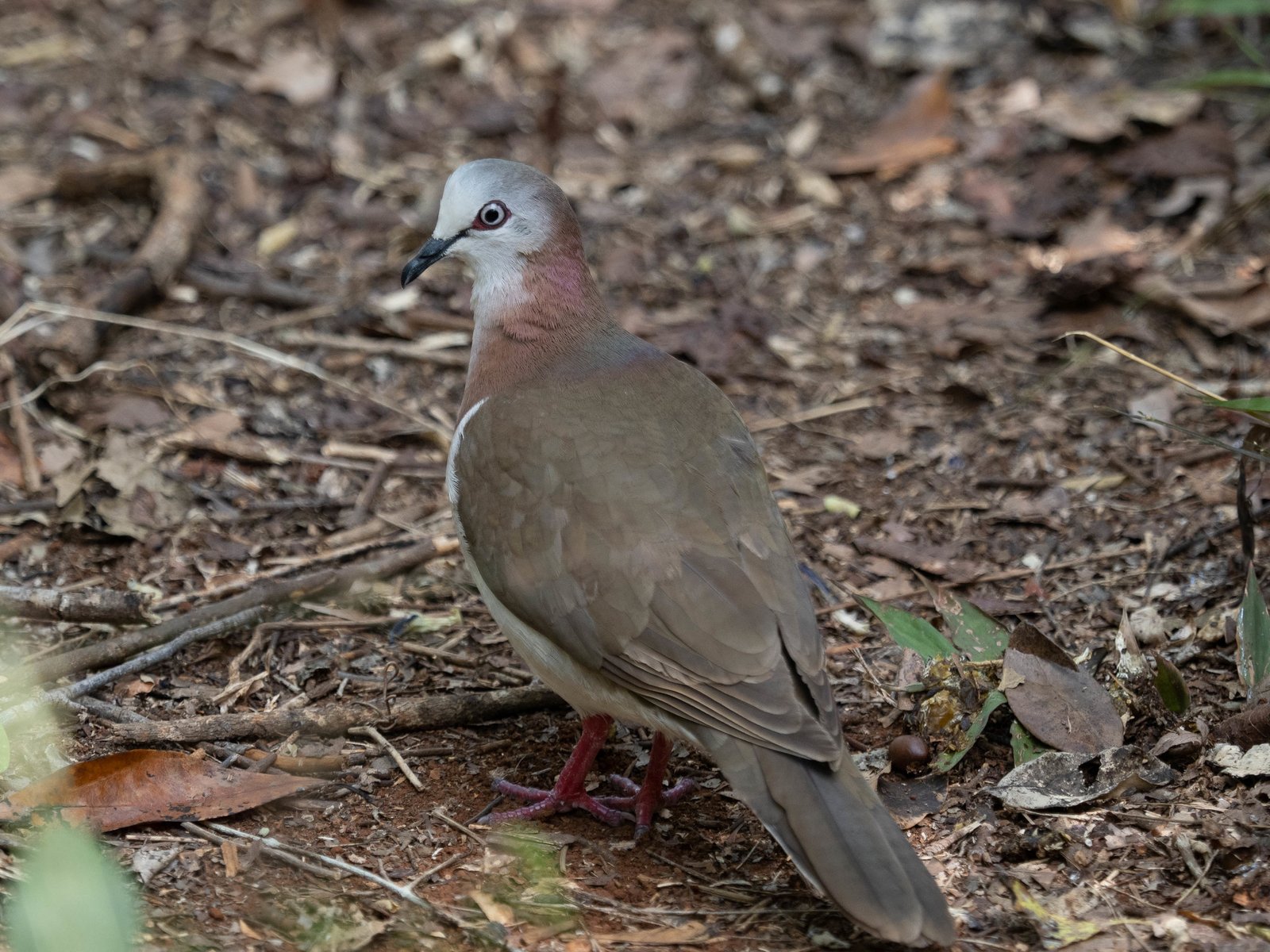
The Caribbean Dove is a large ground dove of the western Caribbean, closely related to the White-tipped Dove. In the guide area it lives only in the north of the Yucatán Peninsula, on the islands off it and on the Bay Islands of Honduras. The pale face, the glossy neck and the white belly separate it from the other ground doves.
Voice
A rhythmic series of usually four low, mournful notes, stressed on the last: hoo-hoo-hoo-hooo. Clearly different from the single hollow bottle note of White-tipped Dove. The call is repeated at intervals, often from dense cover and mainly early in the morning.
Recording: Eric Antonio Martinez — CC BY-NC-SA 4.0 · converted to mono · xeno-canto
Identification
29–33 cm, a heavy dove with a fairly long, rounded tail. The forehead, face and throat are white, the hindcrown grey. The neck, mantle and sides of the neck are pink to wine-red with a green or purple gloss; the back and wings are plain olive-brown. The breast is pale pink, the belly white. The eye is pale, surrounded by bare reddish to purple skin; the legs are red. The tail is dark with broad white corners, the underwing rufous. The sexes are alike; juveniles are duller and lack the gloss.
Confusion species
White-tipped Dove Leptotila verreauxi is slightly smaller, with a less white face and little gloss on the neck and mantle; the two species occur side by side on the Yucatán Peninsula, White-tipped Dove mainly further inland. White-winged Dove Zenaida asiatica has a broad white stripe along the folded wing and blue skin around the eye. Zenaida Dove Zenaida aurita is smaller and warmer brown, with black spots on the wing and a white trailing edge to the secondaries.
Habitat
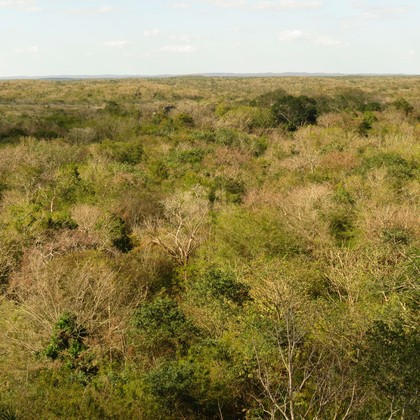
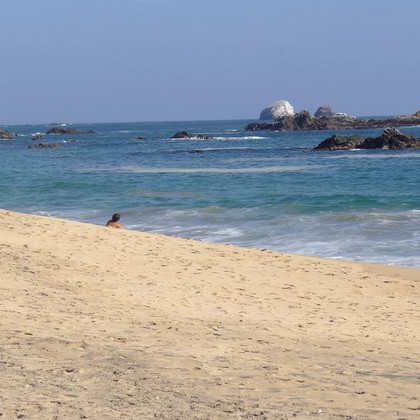
Dry and semi-evergreen coastal forest, coastal scrub on sand and limestone, mangrove edges, and gardens, hotel grounds and yards with shrubs; mainly close to the coast and on islands, from sea level to a few tens of metres. Forages by walking on the ground for seeds, fallen fruit and small invertebrates. The nest is a loose platform of twigs in a shrub or low tree.
Where the bird is most at home, classified by the vegetation units of Mexico and Central America.


Range and movements
In Mexico in the north of the Yucatán Peninsula, in the states of Yucatán and Quintana Roo, with the islands of Holbox, Mujeres and Cozumel, and on the Bay Islands of Honduras (L. j. gaumeri). Also reported from Belize. Outside the guide area on Jamaica, the Cayman Islands and the Colombian island of San Andrés; introduced on New Providence (Bahamas).
- Resident
- dark = core range, pale = thinly spread
How and when to look
On Cozumel and Isla Mujeres and along the coast of Quintana Roo, for example around Cancún, birds walk early in the morning on paths in coastal forest and on the lawns of hotel grounds. The four-note call is the best clue.
Conservation status
Not threatened. Locally common in the north of the Yucatán Peninsula and on Cozumel. Coastal forest and scrub along the Mexican Caribbean coast are disappearing to hotel and housing development, but the species also occurs in gardens and hotel grounds.
Scientific name
Leptotila jamaicensis | (Linnaeus, 1766)
Linnaeus described the species in 1766 as Columba jamaicensis; because it was later moved to another genus, the author and year stand in brackets. The genus Leptotila was introduced in 1837 by Swainson. Leptotila is Greek, from leptos 'slender' and ptilon 'feather', after the abruptly narrowed outermost primary. jamaicensis is Latin for 'of Jamaica', the island from which the species was described. The specimen the first description was based on came from Jamaica.