All species › Gamebirds › Partridges, pheasants, grouse and allies › Ocellated Turkey
Position in the tree Birds Aves › Birds with a flexible palate Neognathae › Fowl Galloanserae
Ocellated Turkey | Meleagris ocellata
Pauwkalkoen | Guajolote ocelado
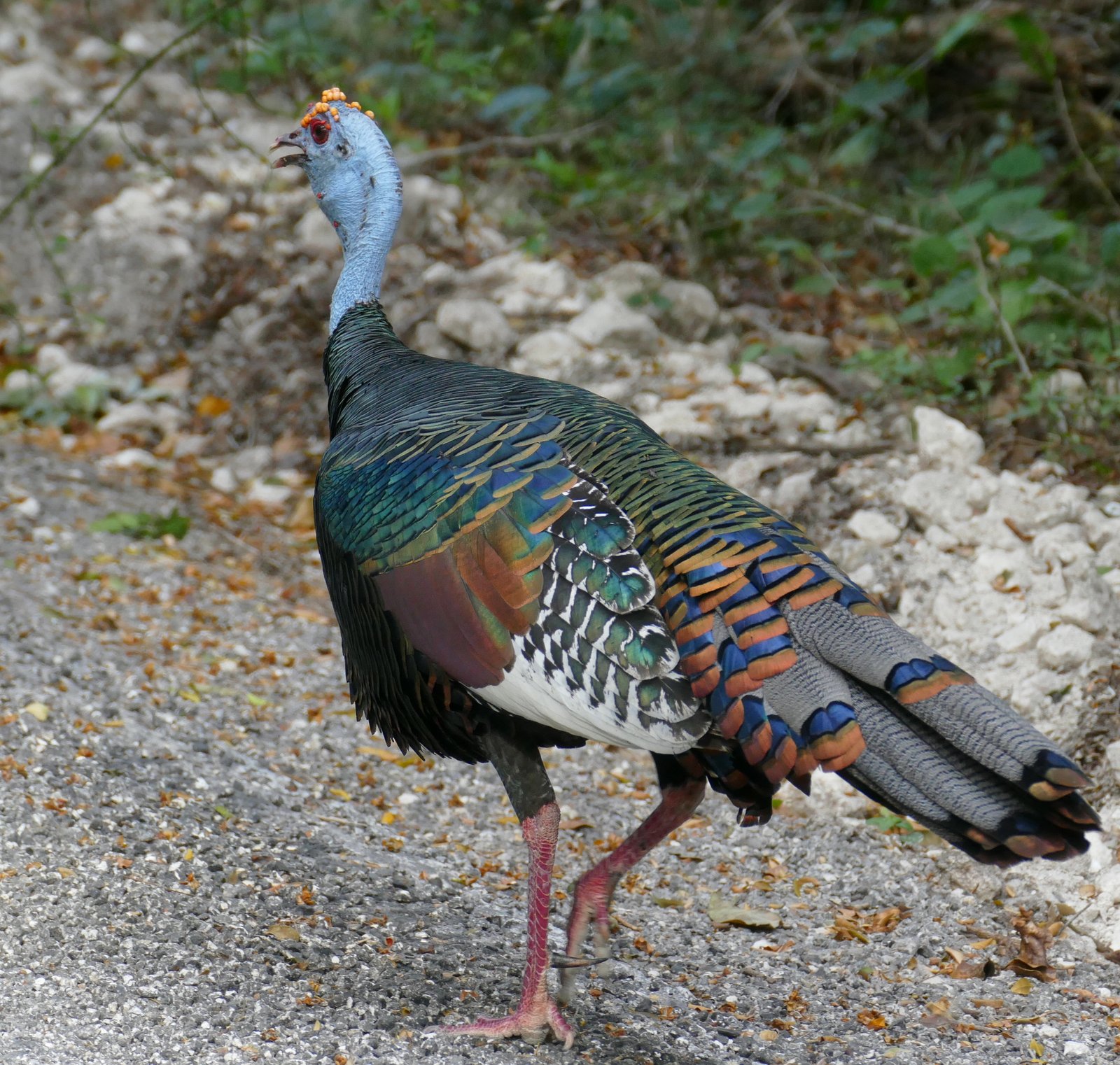
The Ocellated Turkey is a turkey of the Yucatán Peninsula and the adjacent lowlands and does not occur outside the guide area. It is smaller and slimmer than the Wild Turkey, with a blue head covered in orange warts and a tail with eyespots that recall a peafowl. In protected areas without hunting, such as around the Maya ruins of Tikal and Calakmul, it is often fairly tame.
Voice
In display the male gives a series of low, hollow notes that speed up and run into a high, bubbling gobble, poom-poom-poom-pom-pom-pidi-gloglo, softer and higher than the gobble of Wild Turkey. The female gives a soft, clucking tok.
Recording: GABRIEL LEITE — CC BY-NC-SA 4.0 · converted to mono · xeno-canto
Identification
70–100 cm; the male is clearly larger than the female. The body plumage is glossy bronze-green, with black and copper bars on the back and breast that give a scaly look. The bare head and neck are bright blue with orange-red warts around the eye and on the crown; the male has a fleshy blue knob on top of the head with yellow-orange warts, which swells in display. The greater wing coverts are coppery bronze and the secondaries white-edged, giving a white patch on the closed wing. The tail is blue-grey with large blue-and-bronze eyespots and a golden edge. The legs are pink to red; the male has long spurs. There is no breast beard of hair-like feathers as in Wild Turkey.
Confusion species
Domestic turkeys, descended from Wild Turkey Meleagris gallopavo, roam villages in the same area; they are heavier, with a red wattle, a breast beard and no eyespots on the tail. Great Curassow Crax rubra is plain black or rufous with a curly crest. Crested Guan Penelope purpurascens is olive-brown with a red dewlap and lives mainly in the trees.
Habitat
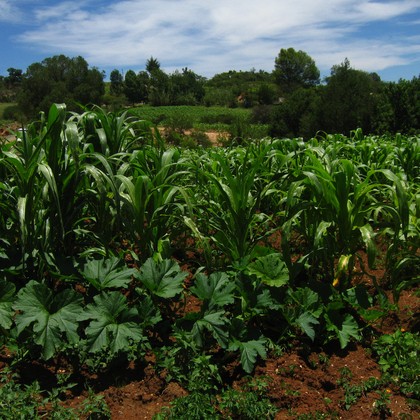
Semi-evergreen and seasonal lowland forest, forest edges, clearings and abandoned fields within forest, from sea level to about 300 m. It forages in small groups on the ground for seeds, fruit, leaves and insects, also in milpas and grassy patches at the forest edge, and roosts high in trees. The nest is a scrape on the forest floor with 8 to 15 eggs; the breeding season runs from March to June.
Where the bird is most at home, classified by the vegetation units of Mexico and Central America.



Range and movements
The Yucatán Peninsula in the Mexican states of Campeche, Yucatán and Quintana Roo, further eastern Tabasco and north-eastern Chiapas, northern Guatemala (mainly Petén) and Belize. The species occurs only in this part of the guide area.
- Resident
- dark = core range, pale = thinly spread
How and when to look
At the ruins of Tikal in Guatemala and Calakmul in Campeche small groups often walk openly across lawns and trails and can be seen at close range, especially early in the morning and late in the afternoon. In the display season, February to April, males there fan their tails.
Conservation status
Near Threatened. The species is declining through hunting for meat and the clearance of forest for farming and cattle ranching. In large protected areas such as Calakmul, the Maya Biosphere Reserve in Petén and Rio Bravo in Belize numbers are stable to fairly high.
Scientific name
Meleagris ocellata | Cuvier, GLCFD, 1820
Cuvier, GLCFD described the species in 1820 and placed it straight away in the genus where it still stands. The genus Meleagris was introduced in 1758 by Linnaeus. Meleagris is the Greek word for 'guineafowl', transferred by Linnaeus to the turkey. ocellata is Latin for 'with eye-spots', from ocellus 'little eye', after the blue-bronze eyespots on the tail. The specimen the first description was based on came from Gulf of Honduras.