All species › Passerines › Antbirds › Spotted Antbird
Position in the tree Birds Aves › Birds with a flexible palate Neognathae › All other modern birds Neoaves › Landbirds Telluraves › Falcons, parrots and passerines Australaves › Falcons and passerines Eufalconimorphae › Parrots and passerines Psittacopasserae
Spotted Antbird | Hylophylax naevioides
Vlekborstmiervogel | Hormiguero moteado
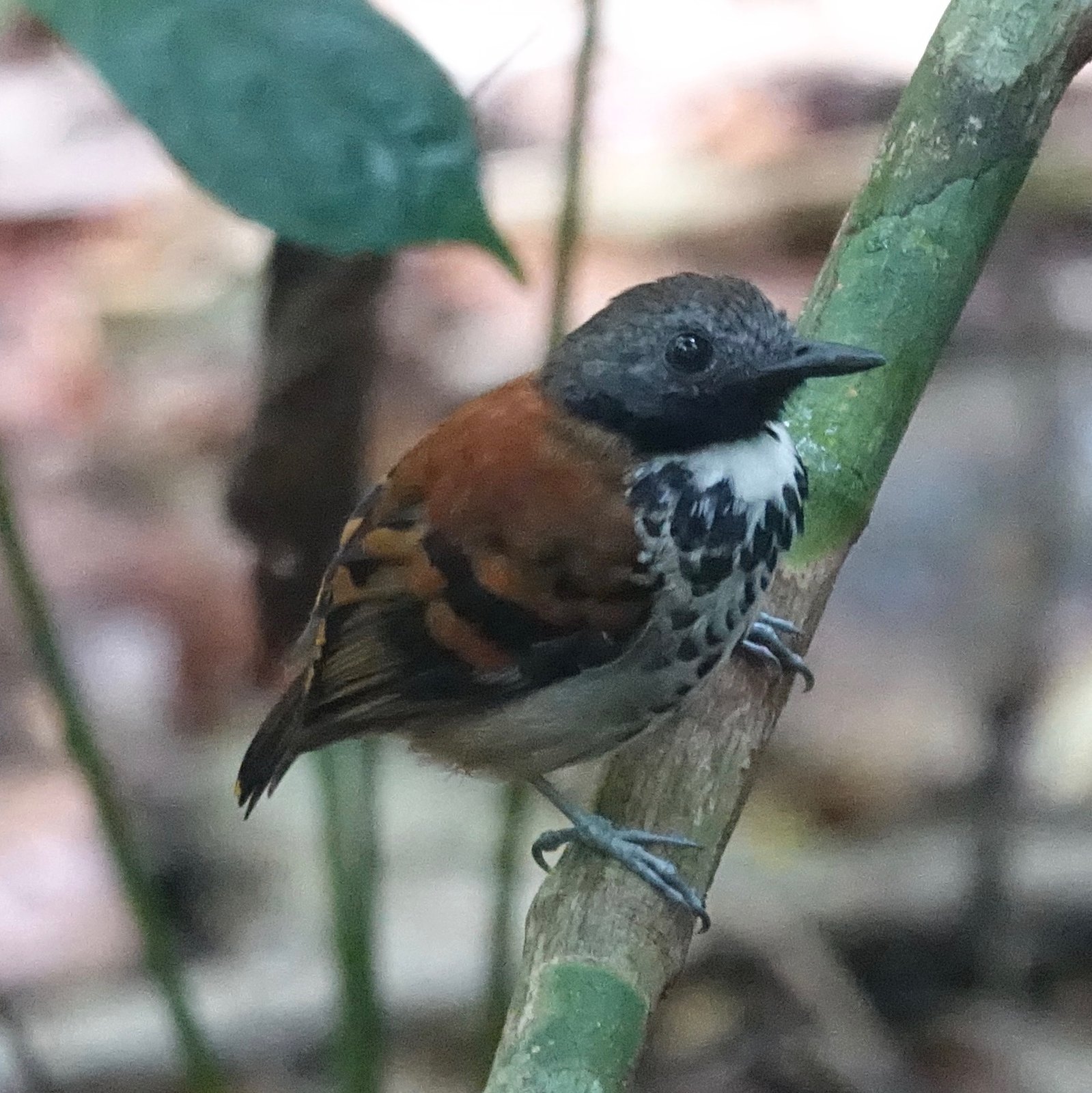
The Spotted Antbird is a small antbird with a white breast covered in black spots. It is a regular follower of army-ant swarms, where it catches the insects that flee ahead of the ants. In the guide area it lives from Honduras to Panama.
Voice
A series of high, thin, two-syllabled whistles, roughly pee-tee pee-tee pee-tee, fading towards the end. Also short, rasping calls.
Recording: Rainforest Connection — CC BY-NC-SA 4.0 · converted to mono · xeno-canto
Identification
11 cm. The male has a grey head, a black throat and white underparts with a broad band of large black spots across the breast. Back rufous-brown, wings blackish with two buff wing bars; tail grey with a black band and a pale tip. The female is duller brown, with a paler throat and brown rather than black spots on a buffy breast.
Confusion species
Bicolored Antbird Gymnopithys bicolor, often at the same ant swarms, is larger and has unspotted white underparts, a brown head and blue skin around the eye. Ocellated Antbird Phaenostictus mcleannani is much larger, with scaly plumage and a long tail. Wing-banded Antbird Myrmornis torquata is stockier and lacks the spotted breast.
Habitat
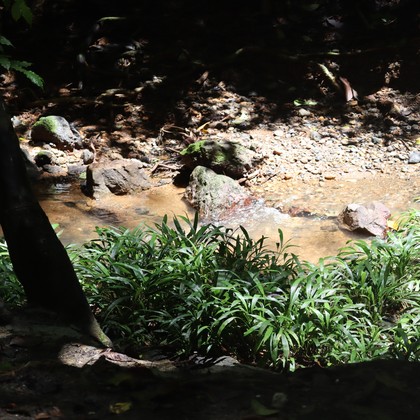
Undergrowth of humid lowland and foothill forest, including mature secondary forest; from sea level to about 900 m. It usually forages at army-ant swarms, but also alone in the undergrowth; it likes to perch crosswise on vertical stems just above the ground.
Where the bird is most at home, classified by the vegetation units of Mexico and Central America.



Range and movements
Caribbean slope of Honduras and Nicaragua to Costa Rica, where it also occurs on the southern Pacific slope; in Panama on both slopes. Outside the guide area in western Colombia and Ecuador.
- Resident
- dark = core range, pale = thinly spread
How and when to look
At an army-ant swarm in the lowland forest of Panama or Costa Rica it is often one of the first birds noticed, along with Bicolored and Ocellated Antbirds. Pipeline Road in Panama is a well-known site.
Conservation status
Not threatened. Fairly common in humid forest; as an army-ant follower it depends on larger tracts of continuous forest.
Scientific name
Hylophylax naevioides | (de Lafresnaye, 1847)
De Lafresnaye described the species in 1847 as Conopophaga naevioïdes; because it was later moved to another genus, the author and year stand in brackets. The genus Hylophylax was introduced in 1909 by Ridgway. Hylophylax is Greek, from hulē 'woodland' and phulax 'guardian': 'forest watchman'. naevioides means 'resembling naevius', from Latin naevius 'spotted' and Greek -oidēs 'resembling', after the related Spot-backed Antbird (Hylophylax naevius). The specimen the first description was based on came from Panama (designated later; no original locality).