All species › Passerines › Antbirds › White-bellied Antbird
Position in the tree Birds Aves › Birds with a flexible palate Neognathae › All other modern birds Neoaves › Landbirds Telluraves › Falcons, parrots and passerines Australaves › Falcons and passerines Eufalconimorphae › Parrots and passerines Psittacopasserae
White-bellied Antbird | Myrmeciza longipes
Witbuikmiervogel | Hormiguero ventriblanco
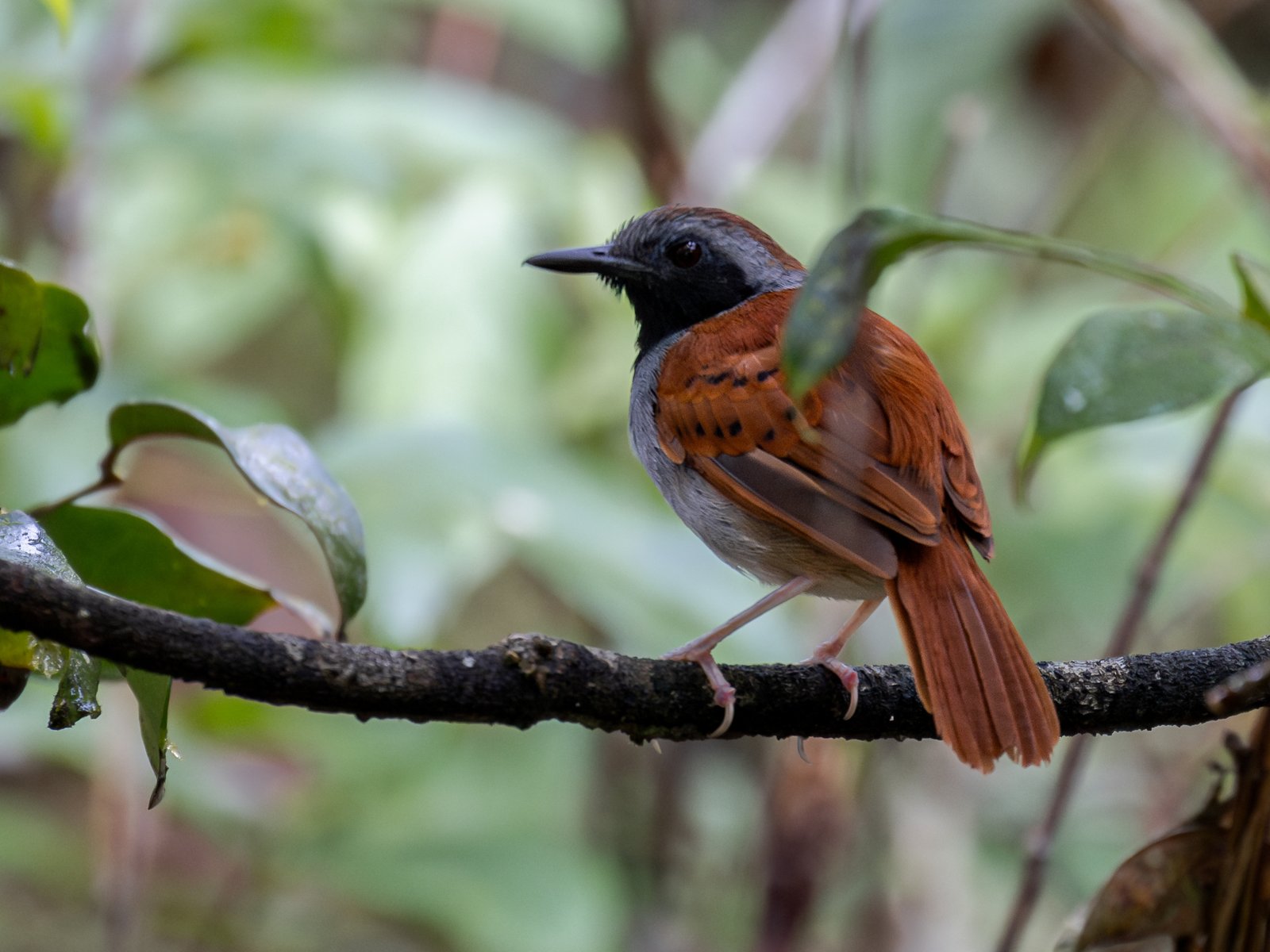
The White-bellied Antbird is a rufous antbird with long pink legs that searches for food while walking on the forest floor. It lives in thickets and the undergrowth of drier forest. In the guide area it occurs only in central and eastern Panama.
Voice
A loud, fast series of clear notes that accelerates and falls in pitch, often slowing at the end. Also sharp, short calls.
Recording: Johan Chaves — CC BY-NC-SA 4.0 · converted to mono · xeno-canto
Identification
15 cm. Legs long and flesh-pink. The male has rufous upperparts, grey cheeks and sides of the head, a black throat and breast and a white belly with buff-brown flanks. The female lacks the black: the throat is whitish, the breast buff and the belly white; the sides of the head are grey.
Confusion species
Chestnut-backed Antbird Poliocrania exsul has dark underparts without a white belly and blue skin around the eye, and lives in more humid forest. Female Bare-crowned Antbird Gymnocichla nudiceps has entirely rufous underparts and bare blue skin around the eye.
Habitat
Dense thickets and undergrowth of dry and semi-humid forest, secondary forest, gallery forest and forest edges in the lowlands. It walks on the ground and among dead leaves in search of insects; usually keeps low and hidden.
Where the bird is most at home, classified by the vegetation units of Mexico and Central America.



Range and movements
Central and eastern Panama, from the Canal Area east to Darién. Outside the guide area in northern Colombia, Venezuela, Trinidad, the Guianas and northern Brazil.
- Resident
- dark = core range, pale = thinly spread
How and when to look
Look in drier forest and thickets in the Canal Area of Panama. The loud, descending song is usually the first sign; the bird may then appear briefly on the forest floor.
Conservation status
Not threatened. Fairly common in suitable thickets and drier forest; tolerates secondary growth well.
Scientific name
Myrmeciza longipes | (Swainson, 1825)
Swainson described the species in 1825 as Drymophila longipes; because it was later moved to another genus, the author and year stand in brackets. The genus Myrmeciza was introduced in 1841 by Gray. Myrmeciza is Greek, from murmēx 'ant'; the second element is variously explained as 'to sit' or 'to lie in ambush', after antbirds foraging at army-ant swarms. longipes is Latin, from longus 'long' and pes 'foot', after the fairly long legs. The specimen the first description was based on came from Trinidad (designated; originally 'somewhere in Brazil').