All species › Passerines › Antbirds › Dull-mantled Antbird
Position in the tree Birds Aves › Birds with a flexible palate Neognathae › All other modern birds Neoaves › Landbirds Telluraves › Falcons, parrots and passerines Australaves › Falcons and passerines Eufalconimorphae › Parrots and passerines Psittacopasserae
Dull-mantled Antbird | Sipia laemosticta
Grijskruinmiervogel | Hormiguero alimaculado
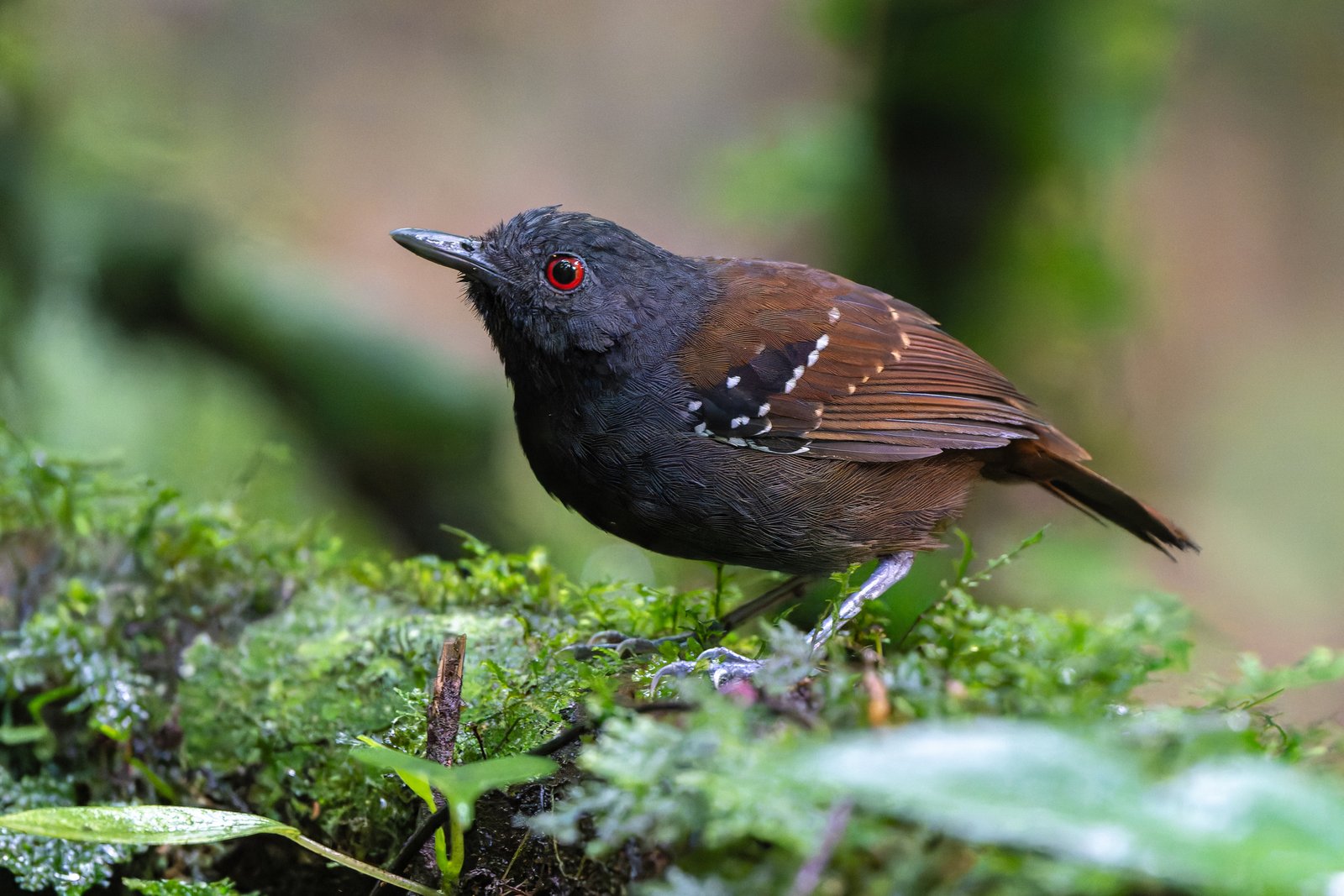
The Dull-mantled Antbird is a dark, short-tailed antbird with a red eye that lives mainly in shady ravines and along streams in the foothills. It keeps on or just above the ground. In the guide area it occurs in Costa Rica and Panama.
Voice
A short series of high, clear whistled notes. Also short, sharp calls.
Recording: Sue Riffe — CC BY-NC-SA 4.0 · converted to mono · xeno-canto
Identification
13–14 cm. Eye red. The male has a slate-grey head and underparts with a black throat, a dark chestnut-brown back and blackish wing coverts with small white spots. The female resembles the male but has white flecks in the black throat and a browner belly and flanks. Tail short and blackish.
Confusion species
Chestnut-backed Antbird Poliocrania exsul has a dark eye with bare blue skin around it, a brighter chestnut back and usually no white wing spots; it more often lives lower down in the lowlands. Dusky Antbird Cercomacroides tyrannina is slimmer and longer-tailed and keeps higher in the shrub layer.
Habitat
Undergrowth of humid foothill forest and lower mountain slopes, especially on steep slopes, in ravines and along streams with dense growth. It searches for insects on or just above the ground, usually in pairs.
Where the bird is most at home, classified by the vegetation units of Mexico and Central America.



Range and movements
Caribbean slope of Costa Rica; in Panama in the foothills on both slopes, east to Darién. Outside the guide area in north-western Colombia.
- Resident
- dark = core range, pale = thinly spread
How and when to look
Look along streams and in ravines in foothill forest in Costa Rica and Panama. Watch for the red eyes in the gloom of the undergrowth.
Conservation status
Not threatened. Locally fairly common, but patchily distributed because it is tied to foothill forest; sensitive to deforestation.
Scientific name
Sipia laemosticta | (Salvin, 1865)
Salvin described the species in 1865 as Myrmeciza laemosticta; because it was later moved to another genus, the author and year stand in brackets. The genus Sipia was introduced in 1924 by Hellmayr. Sipia is named after Sipí in the Chocó (western Colombia), the type locality of the type species. laemosticta is Greek, from laimos 'throat' and stiktos 'spotted', after the white-spotted black throat. The specimen the first description was based on came from Tucurrique, Costa Rica.