All species › Woodpeckers and allies › New World barbets › Spot-crowned Barbet
Position in the tree Birds Aves › Birds with a flexible palate Neognathae › All other modern birds Neoaves › Landbirds Telluraves › Raptors, owls, kingfishers and woodpeckers Afroaves › Mousebirds, rollers and woodpeckers Coraciimorphae › Trogons and cavity nesters Cavitaves › Hornbills, kingfishers and woodpeckers Picocoraciae › Kingfishers, bee-eaters and woodpeckers Picodynastornithes
Spot-crowned Barbet | Capito maculicoronatus
Roodflankbaardvogel | Cabezón pechiblanco
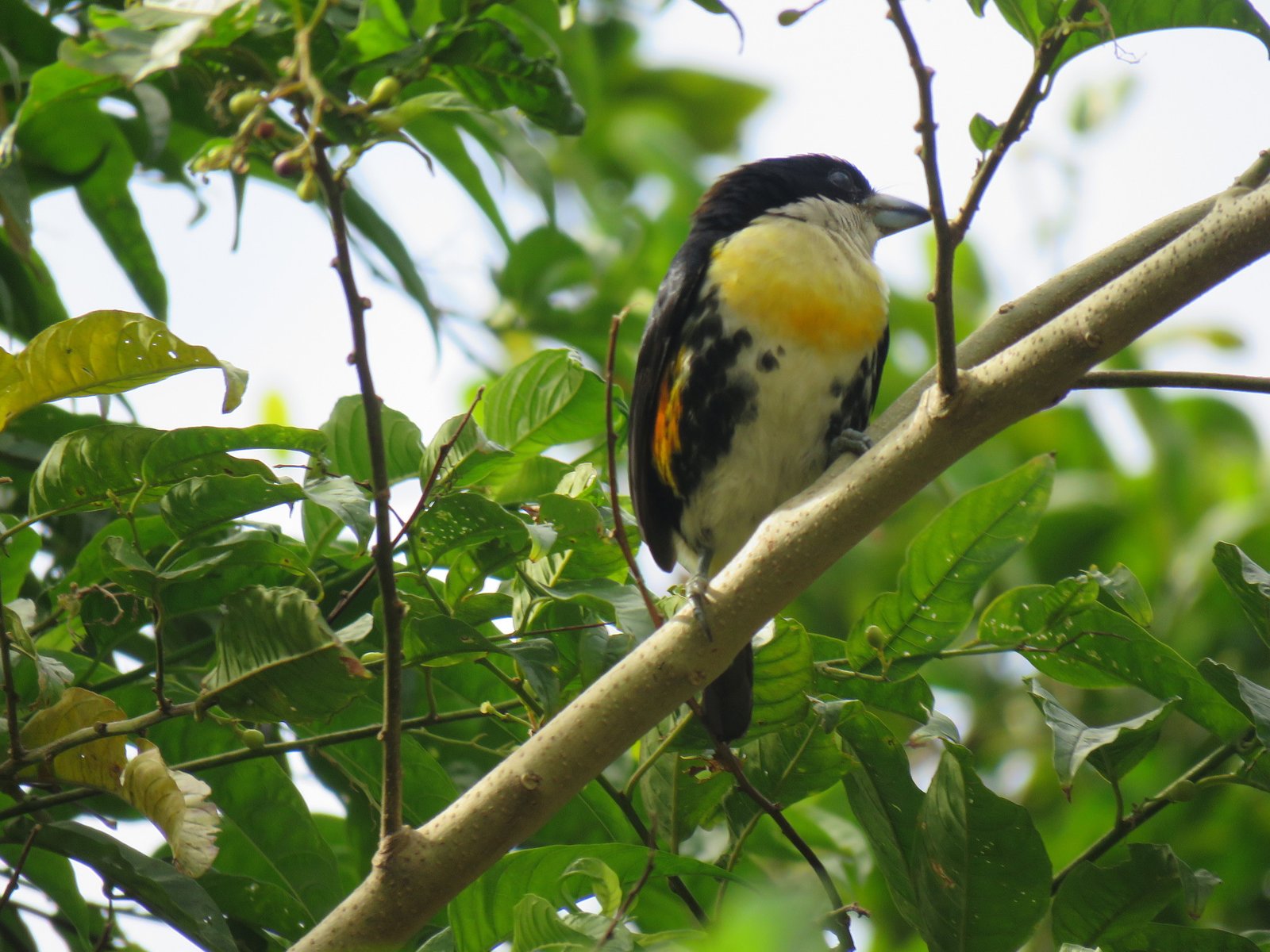
The Spot-crowned Barbet is a stocky black-and-white barbet with an orange-yellow breast patch and red on the flanks. It moves through the canopy in pairs or small groups, often with mixed flocks. In the guide area it lives only in Panama.
Voice
Harsh, croaking calls, krrrek or kwaak, and a low, rattling series, often from small groups together.
Recording: Jerome Fischer — CC BY-NC-SA 4.0 · converted to mono · xeno-canto
Identification
18–19 cm. Bill thick and greyish with a dark tip. Upperparts glossy black, the crown finely spotted pale; a white stripe behind the eye. Male: throat and breast white, with an orange-yellow patch in the centre of the breast; flanks streaked black and orange-red. Female: like the male, but with a broad black band across the throat and breast.
Confusion species
Red-headed Barbet Eubucco bourcierii is smaller, green above and lacks black and white. Collared Aracari Pteroglossus torquatus also has a black head and a yellow belly with red, but is much larger, with a long tail and a large two-toned bill.
Habitat
Canopy and edges of humid lowland and foothill forest up to about 1000 m, also tall secondary forest and fruiting trees in clearings. It eats fruit and insects and, like other barbets, also searches clusters of dead leaves. It nests in a cavity in a dead tree.
Where the bird is most at home, classified by the vegetation units of Mexico and Central America.




Range and movements
Within the guide area only in Panama, from eastern Veraguas and Coclé (mainly on the Caribbean side) east through Colón, Panamá province and Guna Yala to Darién. Outside the guide area only in north-western Colombia.
- Resident
- dark = core range, pale = thinly spread
How and when to look
Regularly seen around El Valle de Antón in Coclé, along Pipeline Road (Camino del Oleoducto) and in Darién in Panama. It pays to search fruiting trees and mixed flocks in the canopy.
Conservation status
Not threatened. Fairly common in most of its small range.
Scientific name
Capito maculicoronatus | Lawrence, 1861
Lawrence described the species in 1861 and placed it straight away in the genus where it still stands. The genus Capito was introduced in 1816 by Vieillot. Capito is Latin for 'big-headed', from caput 'head', after the large head and heavy bill. maculicoronatus is Latin, from macula 'spot' and coronatus 'crowned', after the spotted crown. The specimen the first description was based on came from Atlantic side of the Isthmus of Panama.