All species › Woodpeckers and allies › New World barbets › Red-headed Barbet
Position in the tree Birds Aves › Birds with a flexible palate Neognathae › All other modern birds Neoaves › Landbirds Telluraves › Raptors, owls, kingfishers and woodpeckers Afroaves › Mousebirds, rollers and woodpeckers Coraciimorphae › Trogons and cavity nesters Cavitaves › Hornbills, kingfishers and woodpeckers Picocoraciae › Kingfishers, bee-eaters and woodpeckers Picodynastornithes
Red-headed Barbet | Eubucco bourcierii
Roodkopbaardvogel | Barbudo cabecirrojo
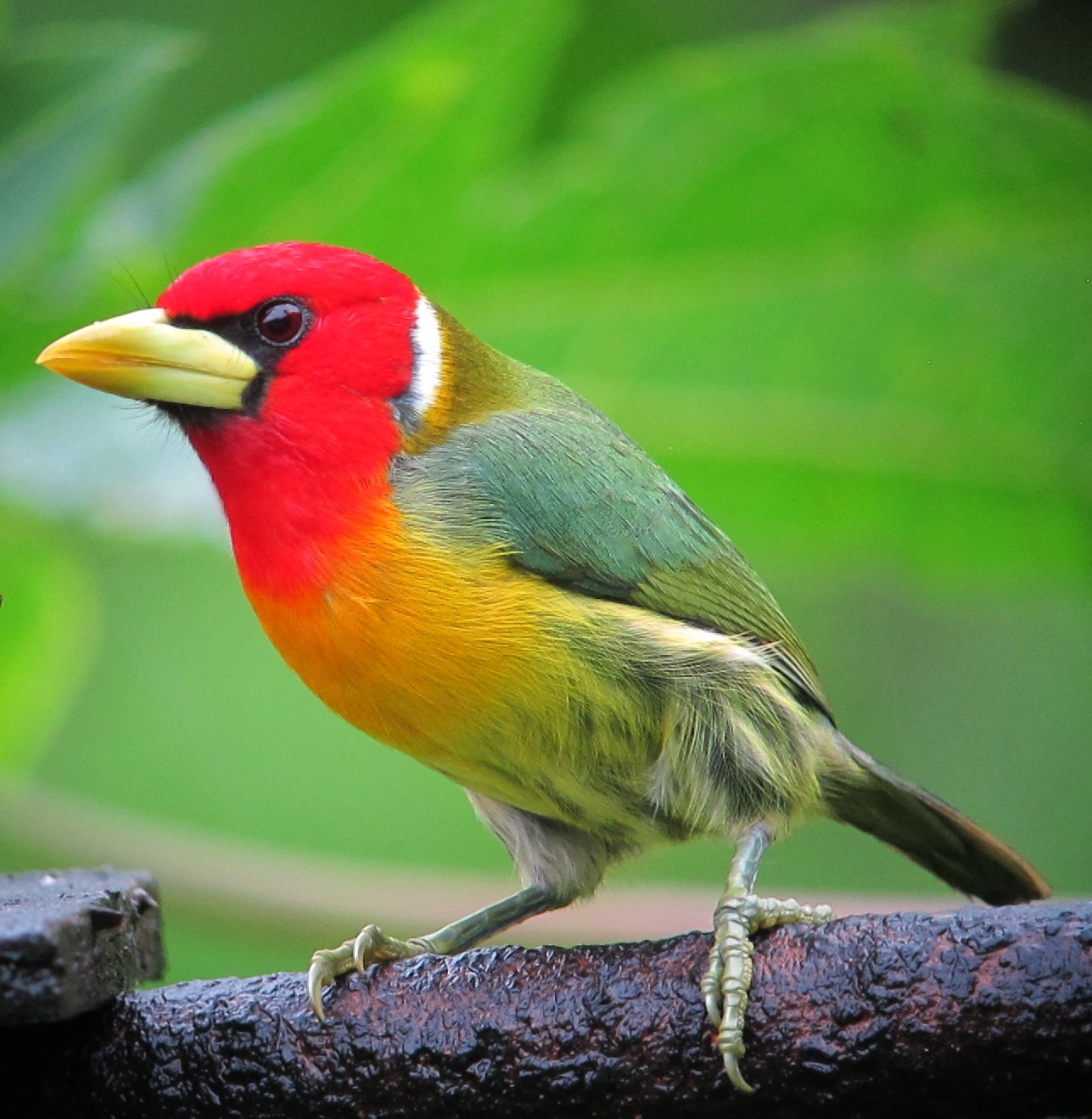
The Red-headed Barbet is a small, stocky barbet with a thick, pale bill. The male has a bright red head, the female a black forehead and blue-grey cheeks. In the guide area it lives in the foothills and lower mountains of Costa Rica and Panama.
Voice
Not very vocal. A low, rapid, frog-like trill, trrrrrr, and a soft, hoarse chek.
Recording: Mauricio Cuellar Ramirez (@Birding.travel) — CC BY-NC-SA 4.0 · converted to mono · xeno-canto
Identification
15–16 cm. Bill short, thick and yellowish-green to horn-coloured. Male: head and throat red, with a narrow bluish band on the nape; upperparts green; breast orange to yellow; belly yellowish with green streaks on the flanks. Female: forehead and lores black, cheeks blue-grey, crown olive-yellow, throat and breast yellow-orange, otherwise green and yellow like the male.
Confusion species
Bay-headed Tanager Tangara gyrola also has a rufous head and green body, but is slimmer, with a fine dark bill, a narrow yellow collar and a blue to green belly without streaks. Prong-billed Barbet Semnornis frantzii (higher in the mountains) is olive-brown and tawny, without red or green.
Habitat
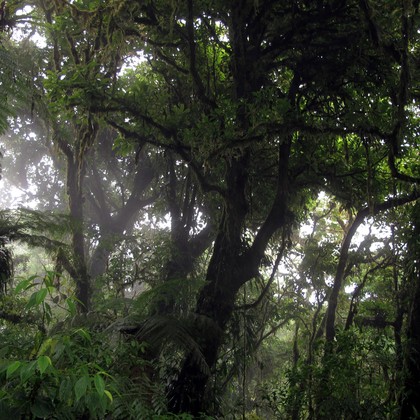
Humid foothill and lower montane forest, mainly between about 400 and 1500 m, also forest edges and tall secondary forest. It often forages with mixed flocks in the middle layer and systematically searches hanging clusters of dead leaves for insects; it also eats fruit. It nests in a cavity it excavates in rotten wood.
Where the bird is most at home, classified by the vegetation units of Mexico and Central America.


Range and movements
In Costa Rica on the slopes of the mountain ranges, mainly on the Caribbean side, and in western Panama (Chiriquí, Bocas del Toro, Ngäbe-Buglé and Veraguas); in eastern Panama in the mountains of Darién, such as Cerro Pirre. Outside the guide area from Colombia and western Venezuela to Ecuador and northern Peru.
- Resident
- dark = core range, pale = thinly spread
How and when to look
Regularly seen at Cinchona and Virgen del Socorro, in Braulio Carrillo (Quebrada González) and at Rancho Naturalista in Costa Rica and in the Fortuna area of western Panama. With mixed flocks it pays to watch for a bird hanging in a cluster of dead leaves.
Conservation status
Not threatened. Fairly scarce but widespread in mid-elevation forest.
Scientific name
Eubucco bourcierii | (de Lafresnaye, 1845)
De Lafresnaye described the species in 1845 as Micropogon Bourcierii; because it was later moved to another genus, the author and year stand in brackets. The genus Eubucco was introduced in 1850 by Bonaparte. Eubucco combines Greek eu 'good, true' with the genus Bucco (Latin bucca 'cheek'): 'true Bucco'. bourcierii honours the French naturalist and hummingbird specialist Jules Bourcier (1797–1873), consul in Ecuador. The specimen the first description was based on came from Bogotá, Colombia.