All species › Woodpeckers and allies › Toucan-barbets › Prong-billed Barbet
Position in the tree Birds Aves › Birds with a flexible palate Neognathae › All other modern birds Neoaves › Landbirds Telluraves › Raptors, owls, kingfishers and woodpeckers Afroaves › Mousebirds, rollers and woodpeckers Coraciimorphae › Trogons and cavity nesters Cavitaves › Hornbills, kingfishers and woodpeckers Picocoraciae › Kingfishers, bee-eaters and woodpeckers Picodynastornithes
Prong-billed Barbet | Semnornis frantzii
Tandsnavelbaardvogel | Barbudo cocora
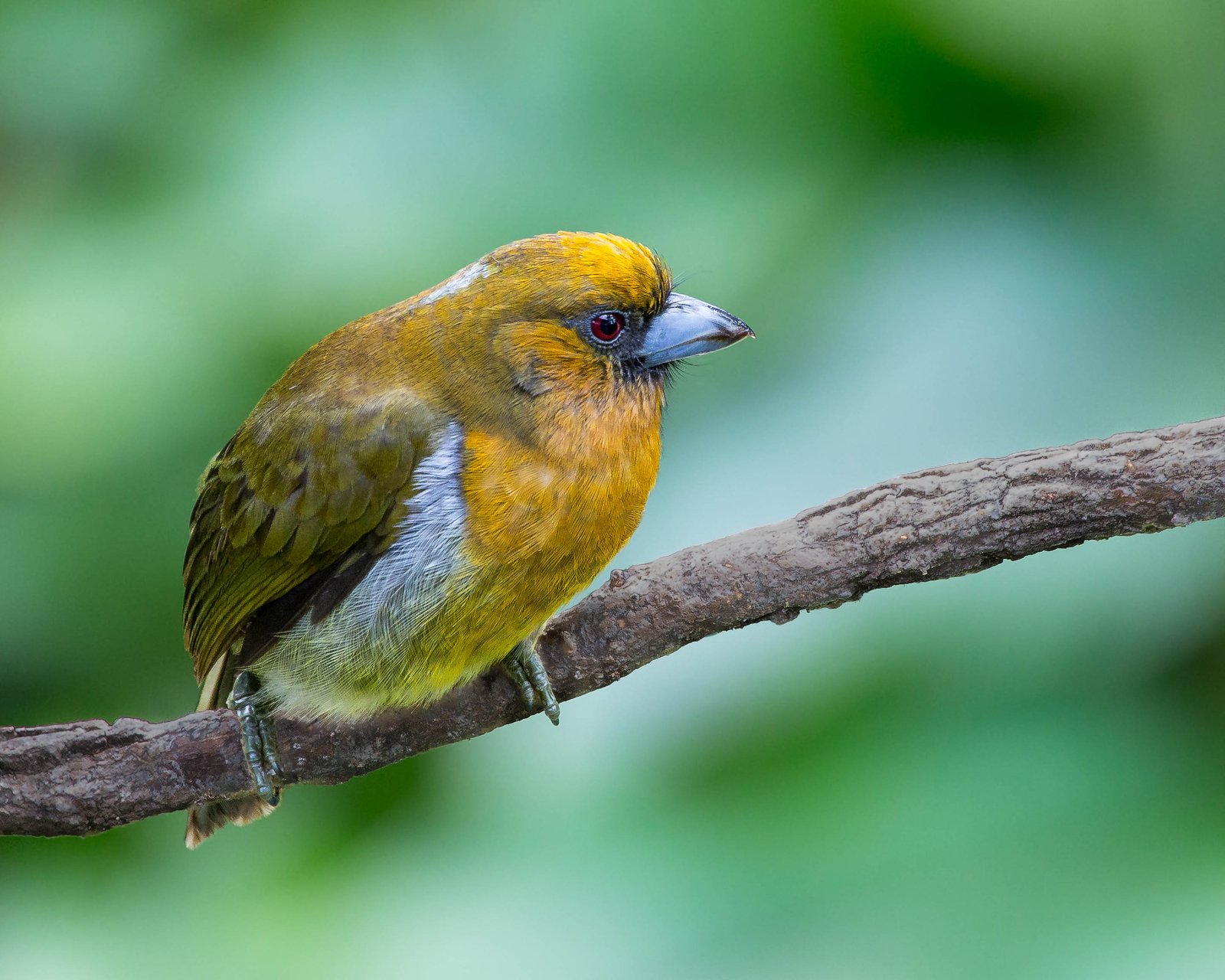
The Prong-billed Barbet is a stocky, olive-brown barbet with a tawny-orange face and a thick, silvery-grey bill with a forked tip. Small groups give a loud, hollow duet in the early morning. It occurs only in the mountains of Costa Rica and western Panama.
Voice
A loud, hollow, repeated duet, kwa-a-a kwa-a-a, mainly in the early morning, with pairs and groups answering each other; also low, croaking calls.
Recording: GABRIEL LEITE — CC BY-NC-SA 4.0 · converted to mono · xeno-canto
Identification
17–18 cm. Head, throat and breast tawny-orange, with black around the base of the bill. Upperparts olive-brown, belly yellowish olive-grey. The bill is thick and silvery-grey, and the upper mandible ends in two points that overlap the lower mandible. The male has a short, glossy black tuft on the hindcrown, which the female lacks.
Confusion species
Red-headed Barbet Eubucco bourcierii lives mainly lower down, is smaller and green above, and the male has a red head. No other bird of montane forest combines a tawny-orange face with a thick grey bill.
Habitat
Humid montane forest and cloud forest, mainly between about 1000 and 2400 m, also forest edges and clearings with fruiting trees. It lives in pairs or small groups and eats mainly fruit and berries, supplemented with insects. Outside the breeding season groups roost together in a tree cavity.
Where the bird is most at home, classified by the vegetation units of Mexico and Central America.



Range and movements
Only in the mountains of Costa Rica (Cordillera de Guanacaste, Cordillera de Tilarán, Cordillera Central and Cordillera de Talamanca) and western Panama (Chiriquí, Bocas del Toro, Ngäbe-Buglé and western Veraguas). It does not occur outside the guide area.
- Resident
- dark = core range, pale = thinly spread
How and when to look
Regularly seen at Monteverde, on the slopes of Poás, at Tapantí and at San Gerardo de Dota in Costa Rica and around Boquete and Cerro Punta in Panama. The early-morning duet helps in finding a group.
Conservation status
Not threatened. Common in montane forest within its small range.
Scientific name
Semnornis frantzii | (Sclater, 1864)
Sclater described the species in 1864 as Tetragonops frantzii; because it was later moved to another genus, the author and year stand in brackets. The genus Semnornis was introduced in 1900 by Richmond. Semnornis is Greek, from semnos 'solemn, noble' and ornis 'bird': 'noble bird'. frantzii honours the German physician and naturalist Alexander von Frantzius (1821–1877), resident in Costa Rica from 1853 to 1868. The specimen the first description was based on came from near San José, Costa Rica.