All species › Passerines › New World blackbirds, troupials and allies › Spot-breasted Oriole
Position in the tree Birds Aves › Birds with a flexible palate Neognathae › All other modern birds Neoaves › Landbirds Telluraves › Falcons, parrots and passerines Australaves › Falcons and passerines Eufalconimorphae › Parrots and passerines Psittacopasserae
Spot-breasted Oriole | Icterus pectoralis
Vlekborsttroepiaal | Bolsero pecho manchado
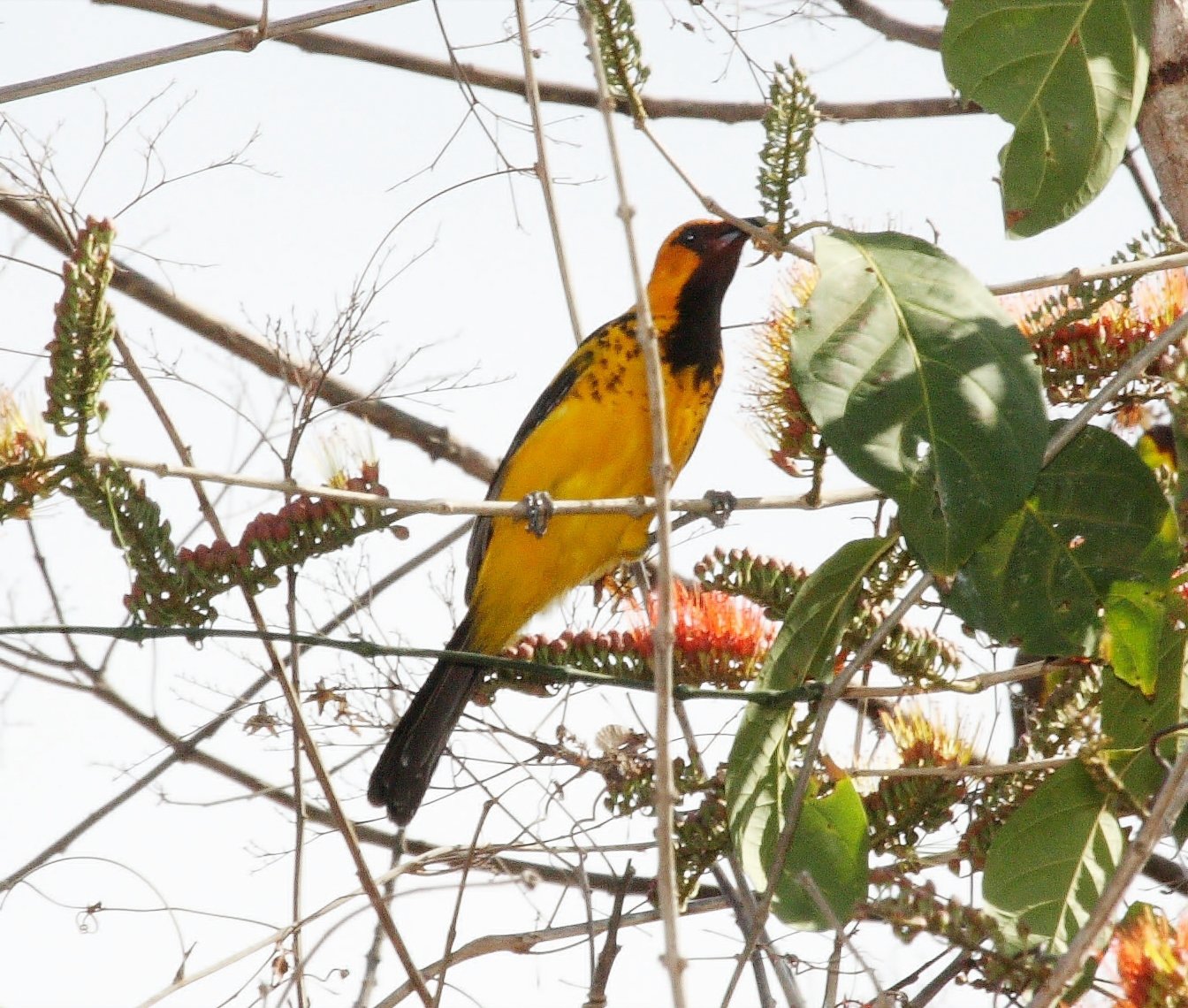
Spot-breasted Oriole is a large orange oriole of dry forest and open country on the Pacific side of Central America, from southern Mexico to north-western Costa Rica. It is named after the black spots on the sides of the breast. It has been introduced to south-eastern Florida and has become established there.
Voice
The song is a long, clear series of whistles, often with repeated phrases, and is sung by both sexes. The call is a nasal nyek and a dry rattle.
Recording: Alfonso Auerbach — CC BY-NC-SA 4.0 · converted to mono · xeno-canto
Identification
21–24 cm. Large oriole with a straight, pointed bill. The sexes are nearly alike. Head and underparts are orange to yellow-orange, with a black mask between eye and bill and a black throat patch that extends onto the upper breast; the sides of the breast bear black spots. The back is black, the shoulders orange. The wing is black with a white patch at the base of the primaries and white edges to the tertials; the tail is black. Young birds are olive-yellow with little or no black and without spots.
Confusion species
Altamira Oriole Icterus gularis is bulkier, with a thicker bill, a white wing bar and no spots on the breast. Hooded Oriole Icterus cucullatus and Streak-backed Oriole Icterus pustulatus are smaller and have white wing bars; Streak-backed Oriole also has a streaked back. Young birds without spots resemble young Altamira Orioles; the white patch at the base of the primaries is then the best feature.
Habitat
Dry forest, thorn scrub, riparian woodland, forest edges and open country with trees, also pastureland, gardens and villages, from sea level to about 1500 m. It searches for insects and fruit and drinks nectar from flowering trees.
Where the bird is most at home, classified by the vegetation units of Mexico and Central America.






Range and movements
On the Pacific side from southern Mexico (Oaxaca and Chiapas) through Guatemala, El Salvador, Honduras and Nicaragua to north-western Costa Rica; in Honduras also in dry interior valleys on the Caribbean side. Introduced to south-eastern Florida.
- Resident
- dark = core range, pale = thinly spread
How and when to look
Best found in dry, semi-open country along the Pacific coast, often in pairs; the long, whistled song carries far.
Conservation status
Not threatened (LC). Fairly common within its range. Locally trapped for the cage-bird trade.
Scientific name
Icterus pectoralis | (Wagler, 1829)
Wagler described the species in 1829 as Ps[arocolius] pectoralis; because it was later moved to another genus, the author and year stand in brackets. The genus Icterus was introduced in 1760 by Brisson. Icterus is from Ancient Greek ikteros, a yellow bird usually taken to be the golden oriole, the sight of which was thought to cure jaundice. pectoralis is Latin for 'of the breast', after the black spots on the sides of the breast. The specimen the first description was based on came from Totulapa, Oaxaca (Mexico).