All species › Passerines › New World blackbirds, troupials and allies › Altamira Oriole
Position in the tree Birds Aves › Birds with a flexible palate Neognathae › All other modern birds Neoaves › Landbirds Telluraves › Falcons, parrots and passerines Australaves › Falcons and passerines Eufalconimorphae › Parrots and passerines Psittacopasserae
Altamira Oriole | Icterus gularis
Altamiratroepiaal | Bolsero de Altamira
Altamira Oriole is the largest oriole in the guide area. It is named after the town of Altamira in Tamaulipas and lives in open woodland and forest edges in the lowlands, from the far south of Texas to Nicaragua. Its hanging nest is longer than that of other orioles in the area.
Voice
The song consists of separate, clear whistled notes with pauses between them. The call is a dry, grating rattle and a nasal ike.
Recording: Étienne Leroy — CC BY-NC-SA 4.0 · shortened to the first 60 s, mono · xeno-canto
Identification
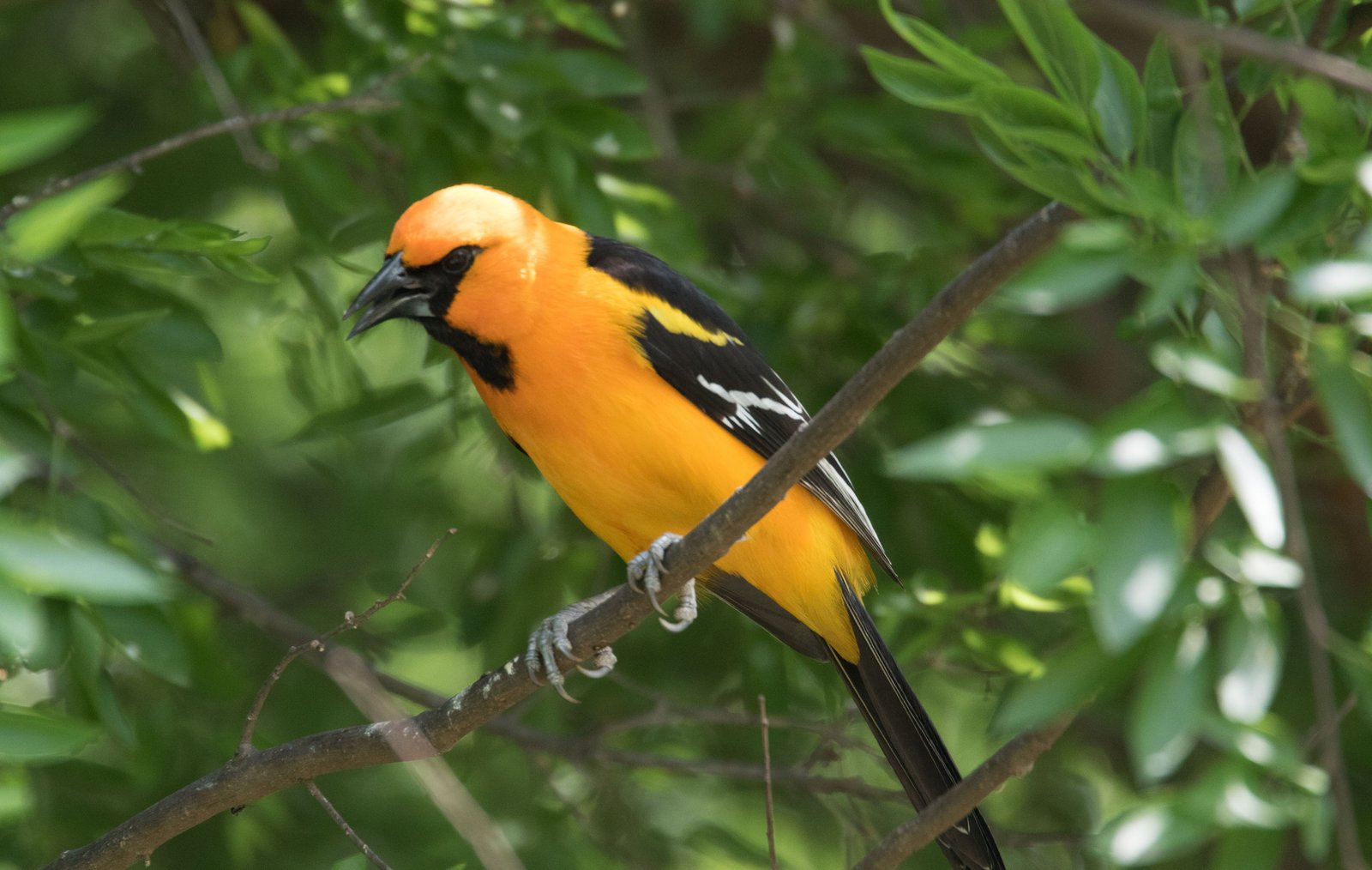
23–25 cm. Large, stocky oriole with a thick, straight bill. The sexes are nearly alike. Head and underparts are bright orange to yellow-orange, with a black mask between eye and bill and a black throat patch. The back is black. The wing is black with an orange or yellow upper wing bar on the lesser coverts, a white lower wing bar and white edges to the flight feathers; the tail is black. Young birds are duller yellow with an olive back.
Confusion species
Hooded Oriole Icterus cucullatus is smaller and slimmer, with a thin, slightly curved bill and two white wing bars. Streak-backed Oriole Icterus pustulatus has a streaked or spotted back. Spot-breasted Oriole Icterus pectoralis has black spots on the sides of the breast and a white patch at the base of the primaries. Orange Oriole Icterus auratus has an orange back.
Habitat
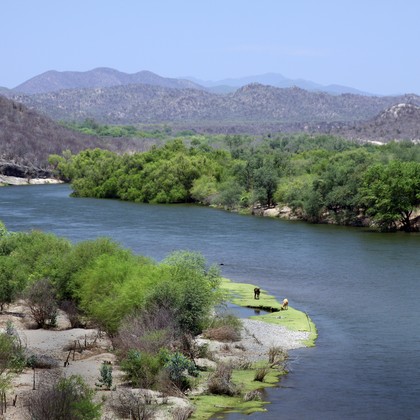
Dry and semi-humid forest, thorn scrub, gallery forest and riparian woodland, forest edges and open country with scattered large trees, also villages and pastureland, mainly in the lowlands up to about 1500 m. It eats insects, spiders and fruit. The nest is a hanging pouch up to about 60 cm long on an outer branch, often above a road or clearing.
Where the bird is most at home, classified by the vegetation units of Mexico and Central America.






Range and movements
On the Atlantic side from the far south of Texas through Nuevo León, Tamaulipas and Veracruz to the Yucatán Peninsula, Belize and northern Guatemala. On the Pacific side from south-western Mexico through Chiapas, Guatemala, El Salvador and Honduras to Nicaragua.
- Resident
- dark = core range, pale = thinly spread
How and when to look
The long, hanging nests show well in the dry season and reveal the presence of the species; the birds themselves often sit high in large, scattered trees.
Conservation status
Not threatened (LC). Common and widespread. It benefits in part from open, partly cleared country; in Texas it is confined to the last remnants of riparian woodland.
Scientific name
Icterus gularis | (Wagler, 1829)
Wagler described the species in 1829 as Ps[arocolius] gularis; because it was later moved to another genus, the author and year stand in brackets. The genus Icterus was introduced in 1760 by Brisson. Icterus is from Ancient Greek ikteros, a yellow bird usually taken to be the golden oriole, the sight of which was thought to cure jaundice. gularis is Latin for 'of the throat', after the black throat patch. The specimen the first description was based on came from Tehuantepec, Oaxaca (Mexico).