All species › Passerines › New World blackbirds, troupials and allies › Orange Oriole
Position in the tree Birds Aves › Birds with a flexible palate Neognathae › All other modern birds Neoaves › Landbirds Telluraves › Falcons, parrots and passerines Australaves › Falcons and passerines Eufalconimorphae › Parrots and passerines Psittacopasserae
Orange Oriole | Icterus auratus
Yucatántroepiaal | Bolsero yucateco
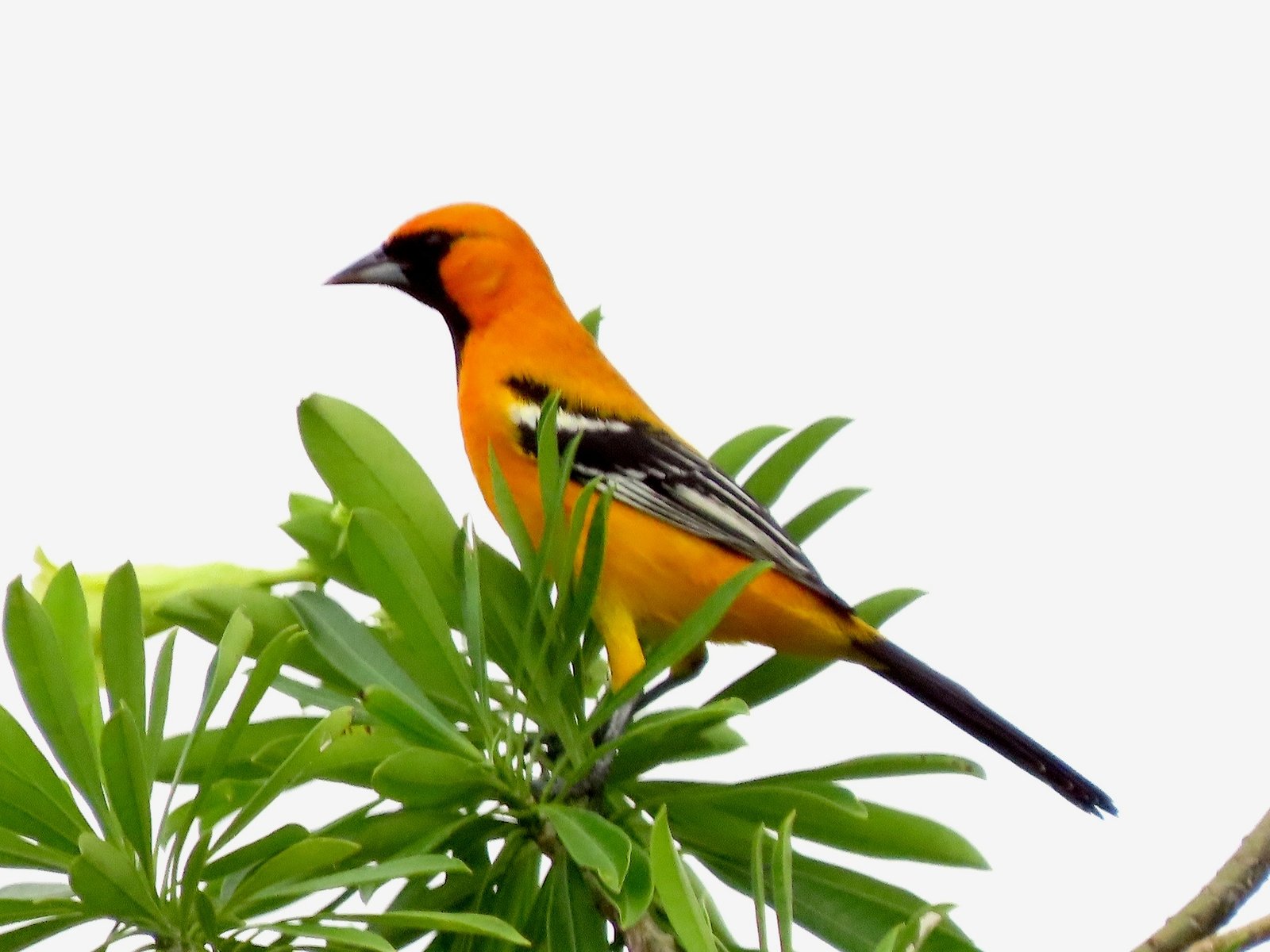
Orange Oriole is an orange oriole found only on the Yucatán Peninsula. Unlike most orioles in the guide area, the male has an orange rather than a black back. It lives in dry forest, scrub and villages.
Voice
The song is a varied series of clear whistles. The call is a nasal nyek and a short rattle.
Recording: GABRIEL LEITE — CC BY-NC-SA 4.0 · converted to mono · xeno-canto
Identification
18–20 cm. Medium-sized oriole with a straight, pointed bill. The male is entirely orange on head, back and underparts, with a small black patch between eye and bill and a black throat patch. The wing is black with orange lesser coverts and white edges to the greater coverts and flight feathers; the tail is black. The female is duller, more yellow-orange, with an olive tinge to the back. Young birds are olive-yellow with little black.
Confusion species
The male Hooded Oriole Icterus cucullatus, which also occurs on the peninsula, has a black back, a larger black throat patch and a thin, slightly curved bill. Altamira Oriole Icterus gularis is larger and bulkier and has a black back. Females and young birds are more alike: in Orange Oriole look for the straight bill and the warmer, more orange tone.
Habitat
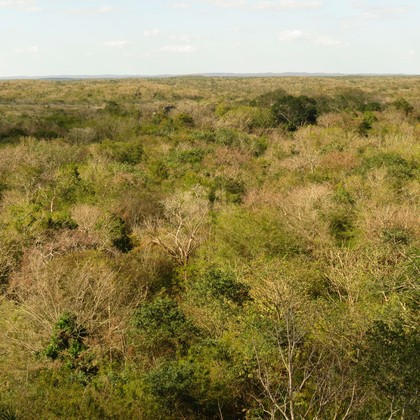
Dry and semi-evergreen seasonal forest, scrub, forest edges, mangrove margins, and villages and gardens with trees, in the lowlands. It eats insects, fruit and nectar.
Where the bird is most at home, classified by the vegetation units of Mexico and Central America.



Range and movements
Endemic to the Yucatán Peninsula: the Mexican states of Yucatán, Campeche and Quintana Roo and the far north of Belize.
- Resident
- dark = core range, pale = thinly spread
How and when to look
Often seen in villages and along roads in the north of the peninsula, in flowering trees and shrubs; check for the orange back to separate it from Hooded Oriole.
Conservation status
Not threatened (LC). Fairly common within its small range. Locally trapped for the cage-bird trade.
Scientific name
Icterus auratus | Bonaparte, 1850
Bonaparte described the species in 1850 and placed it straight away in the genus where it still stands. The genus Icterus was introduced in 1760 by Brisson. Icterus is from Ancient Greek ikteros, a yellow bird usually taken to be the golden oriole, the sight of which was thought to cure jaundice. auratus is Latin for 'gilded', after the fiery orange-yellow plumage. The specimen the first description was based on came from Yucatán (Mexico).