All species › Parrots › African and New World parrots › Spectacled Parrotlet
Position in the tree Birds Aves › Birds with a flexible palate Neognathae › All other modern birds Neoaves › Landbirds Telluraves › Falcons, parrots and passerines Australaves › Falcons and passerines Eufalconimorphae › Parrots and passerines Psittacopasserae
Spectacled Parrotlet | Forpus conspicillatus
Gebrilde muspapegaai | Periquito de anteojos
The Spectacled Parrotlet is the smallest parrot in the guide area: a green parrotlet with a short, pointed tail that occurs only in eastern Panama. It lives in semi-open country with scattered trees, forest edges and pastures, and is slowly spreading westward with deforestation in Darién and Panamá province.
Voice
A high, fine, chirping cheet or chee-chee; in flocks a continuous twittering, somewhat softer than that of Orange-chinned Parakeet.
Recording: Yair Guillermo Molina Martínez. — CC BY-NC-SA 4.0 · converted to mono · xeno-canto
Identification
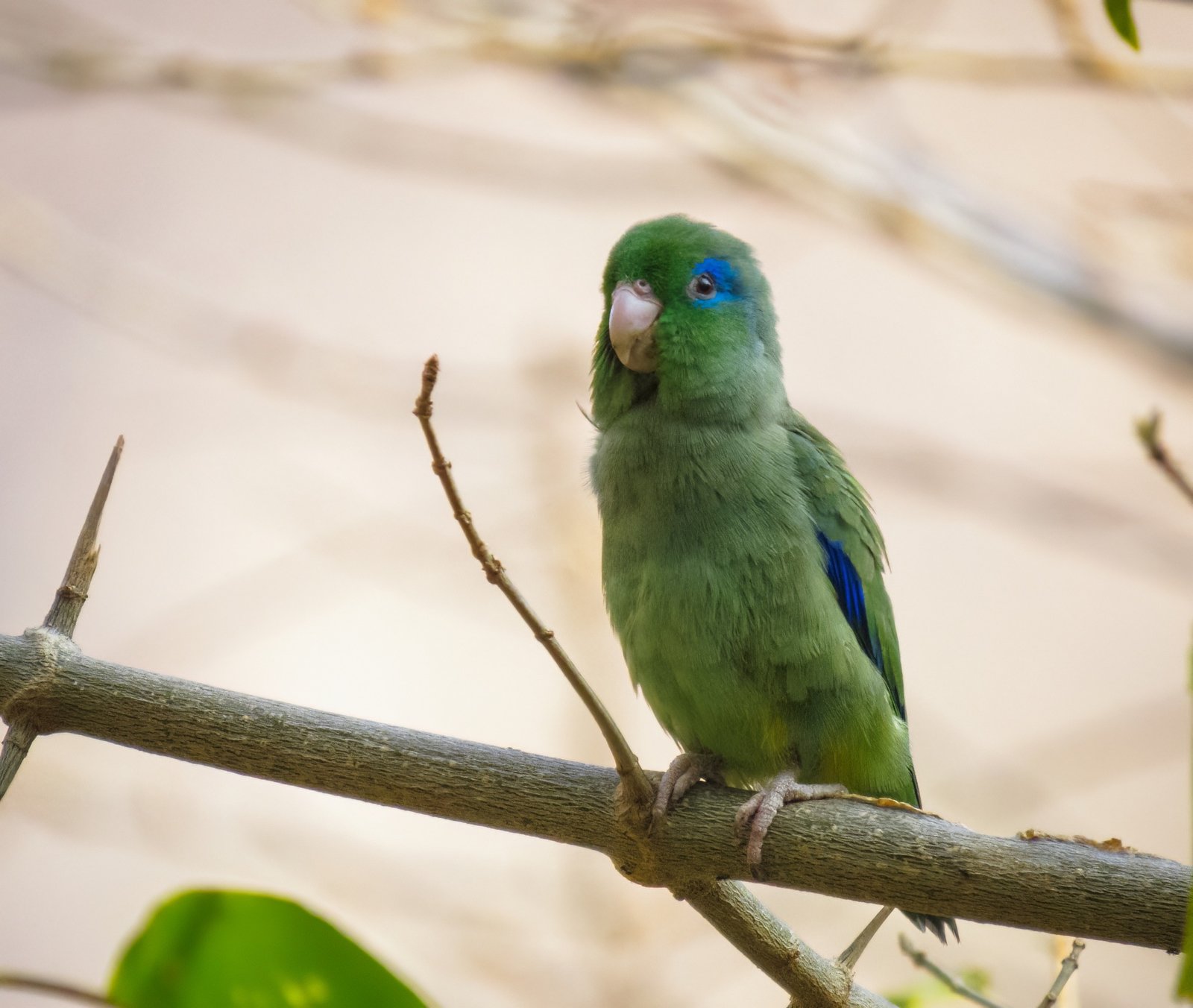
12–13 cm. Small and compact, with a short, wedge-shaped tail and a pale horn bill. The male is green, with a bright blue ring around the eye, a blue rump and blue greater coverts, secondaries and underwing coverts, clearly visible in flight. The female lacks the blue and has a narrow emerald-green eye-ring and a yellowish-green rump.
Confusion species
No other parrotlet occurs in Panama. Orange-chinned Parakeet Brotogeris jugularis is larger, with a longer tail, an orange chin spot and brown shoulders. Blue-fronted Parrotlet Touit dilectissimus has a square tail, a blue forehead and red on the head and wing, and lives in forest on the slopes.
Habitat
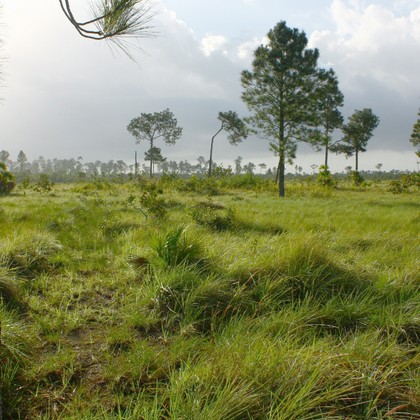
Pasture with scattered trees, forest edges, secondary forest, scrub, gallery forest along rivers and open savanna-like country, also gardens and yards in villages; in the lowlands. It eats seeds of grasses and herbs, berries and fruit, often on or just above the ground. It nests in a tree cavity, a hollow in a termite nest or a hole in a post.
Where the bird is most at home, classified by the vegetation units of Mexico and Central America.




Range and movements
In eastern Panama: Darién, Emberá and eastern Panamá province (for example around Lake Bayano and near Chepo), with scattered records further west to the area of the Panama Canal. It is spreading with deforestation. Outside the guide area in Colombia and western Venezuela.
- Resident
- dark = core range, pale = thinly spread
How and when to look
Along the Pan-American Highway in Darién and eastern Panamá province small groups sit in pastures and on wires, often together with Orange-chinned Parakeets. In flight the blue wings of the male are clearly visible.
Conservation status
Not threatened. In eastern Panama it benefits from the conversion of forest to pasture.
Scientific name
Forpus conspicillatus | (de Lafresnaye, 1848)
De Lafresnaye described the species in 1848 as Psittacula conspicillata; because it was later moved to another genus, the author and year stand in brackets. The genus Forpus was introduced in 1858 by Boie. The derivation of Forpus is unknown. conspicillatus is Modern Latin for 'spectacled' (conspicillum 'lookout'), after the male's blue eye-ring. The specimen the first description was based on came from Honda, upper Magdalena River, Colombia.