All species › Waders, gulls and terns › Jaegers and skuas › South Polar Skua
Position in the tree Birds Aves › Birds with a flexible palate Neognathae › All other modern birds Neoaves › Birds of the elements Elementaves › Cranes and waders Gruimorphae
South Polar Skua | Stercorarius maccormicki
Zuidpooljager | Págalo polar
The South Polar Skua is a large, heavy skua that breeds along the coasts of Antarctica and after the breeding season makes a long migration across the oceans, far into the northern hemisphere. In the guide area it is a scarce and irregular visitor on the open sea, mainly off the Pacific coast of Mexico, in the months of the southern-hemisphere winter. There are pale, intermediate and dark birds, with every gradation between them.
Voice
Almost always silent at sea. On the breeding grounds a harsh, laughing gah-gah-gah and hoarse alarm calls.
Recording: steve — CC BY-SA 4.0 · converted to mono · xeno-canto
Identification
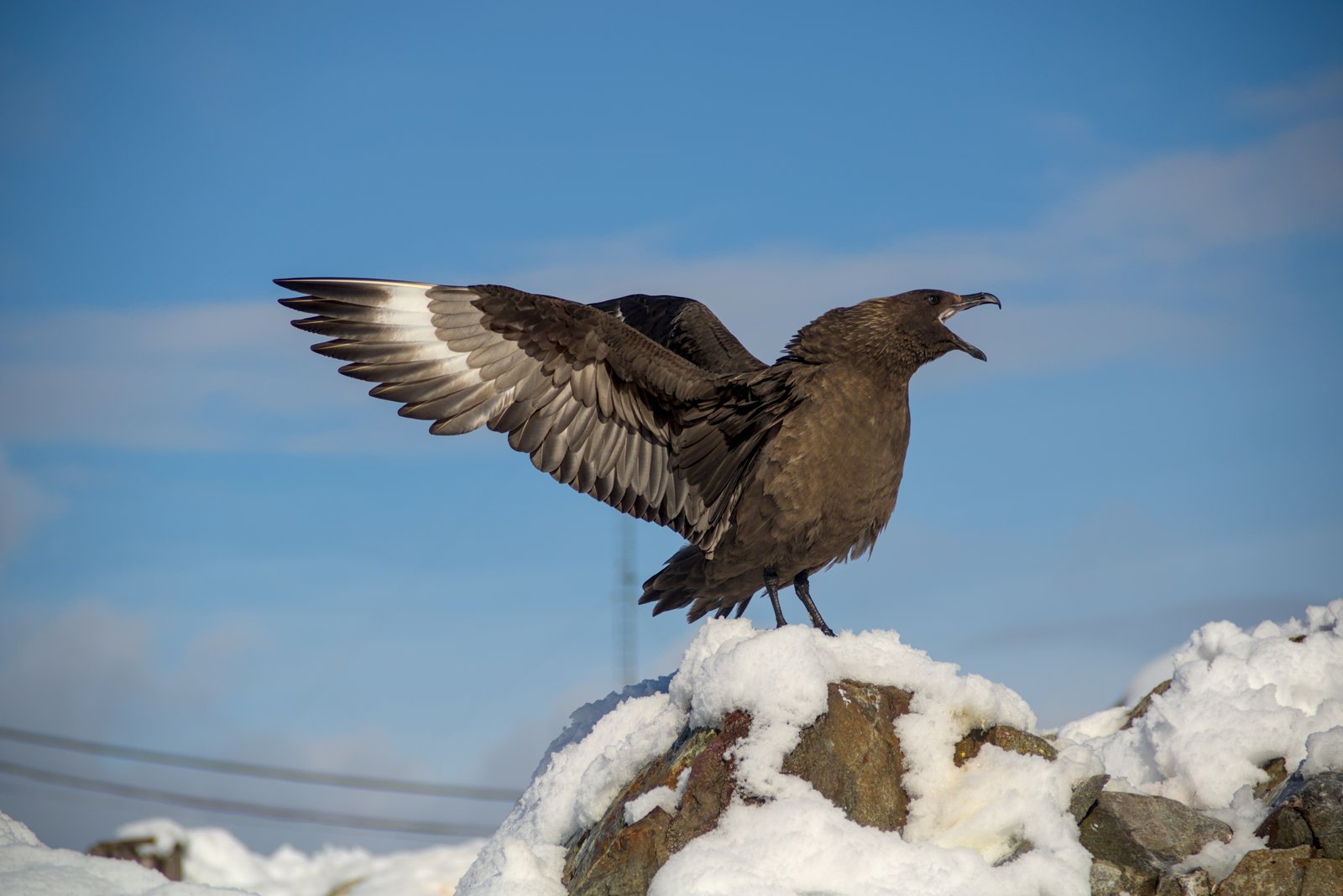
50–55 cm. A stocky, gull-like skua with broad wings, a short, wedge-shaped tail without elongated central feathers and a heavy, blackish bill. All morphs show a conspicuous white patch at the base of the primaries, on both the upperwing and the underwing. Pale birds have a pale greyish-buff head, neck and underparts that contrast sharply with the almost black-brown wings and back; fine pale streaks are often visible on the nape. Dark birds are uniformly cold dark brown. Juveniles are more uniformly grey-brown, with a grey base to the bill.
Confusion species
The dark morph of Pomarine Skua Stercorarius pomarinus is smaller and slimmer, with narrower wings, a smaller white primary patch and, in adults, twisted, spoon-shaped central tail feathers. Large skuas of the Atlantic and the coast of South America, such as Chilean Skua Stercorarius chilensis, are warmer brown or cinnamon and often have a dark cap; they are not or hardly known from the guide area.
Habitat
Outside the breeding season on the open sea, usually far offshore over deep water. It flies low and purposefully over the water and sits on the sea surface for long periods. It chases gulls, shearwaters and other seabirds to steal their food, and also eats fish.
Where the bird is most at home, classified by the vegetation units of Mexico and Central America.

Range and movements
In the guide area mainly recorded at sea off the Pacific coast of Mexico, including off Baja California and further south. Off the Pacific coast of Central America scarce and irregular. Very rare on the Gulf of Mexico and Caribbean side. Outside the guide area the species breeds along the coasts of Antarctica and in the austral winter migrates north into the North Pacific and North Atlantic.
- Passage (Mar–Apr, Oct–Nov)
- dark = core range, pale = thinly spread
How and when to look
Pelagic trips far off the Pacific coast between May and October offer the best chance. A heavy, dark or cold grey-brown skua with large white wing patches and no tail streamers is probably this species.
Conservation status
Not threatened (LC). The world population is relatively small but appears stable. In the guide area a scarce visitor with no breeding population, whose true numbers are poorly known because few observers go to sea.
Scientific name
Stercorarius maccormicki | (Saunders, 1893)
Saunders described the species in 1893 as Megalestris maccormicki; because it was later moved to another genus, the author and year stand in brackets. The genus Stercorarius was introduced in 1760 by Brisson. Stercorarius is Latin for 'of dung', from stercus 'dung': the food disgorged by seabirds when pursued by skuas was once taken for excrement. maccormicki honours the British naval surgeon and naturalist Robert McCormick (1800–1890), who sailed to Antarctica with James Clark Ross. The specimen the first description was based on came from Possession Island, Victoria Land, Antarctica.