All species › Waders, gulls and terns › Jaegers and skuas › Long-tailed Jaeger
Position in the tree Birds Aves › Birds with a flexible palate Neognathae › All other modern birds Neoaves › Birds of the elements Elementaves › Cranes and waders Gruimorphae
Long-tailed Jaeger | Stercorarius longicaudus
Kleinste jager | Págalo rabero
The Long-tailed Jaeger is the slimmest and most lightly built of the jaegers, with a buoyant, tern-like flight. It breeds on the high Arctic tundra, where it feeds mainly on lemmings, and passes through the guide area on its way to wintering grounds in the southern hemisphere. Its migration takes place largely far offshore, so the species is seen mainly from boats.
Voice
Almost always silent at sea. On the breeding grounds a long series of shrill notes and a sharp, nasal barking when disturbed.
Recording: Stanislas Wroza — CC BY-NC-SA 4.0 · converted to mono · xeno-canto
Identification
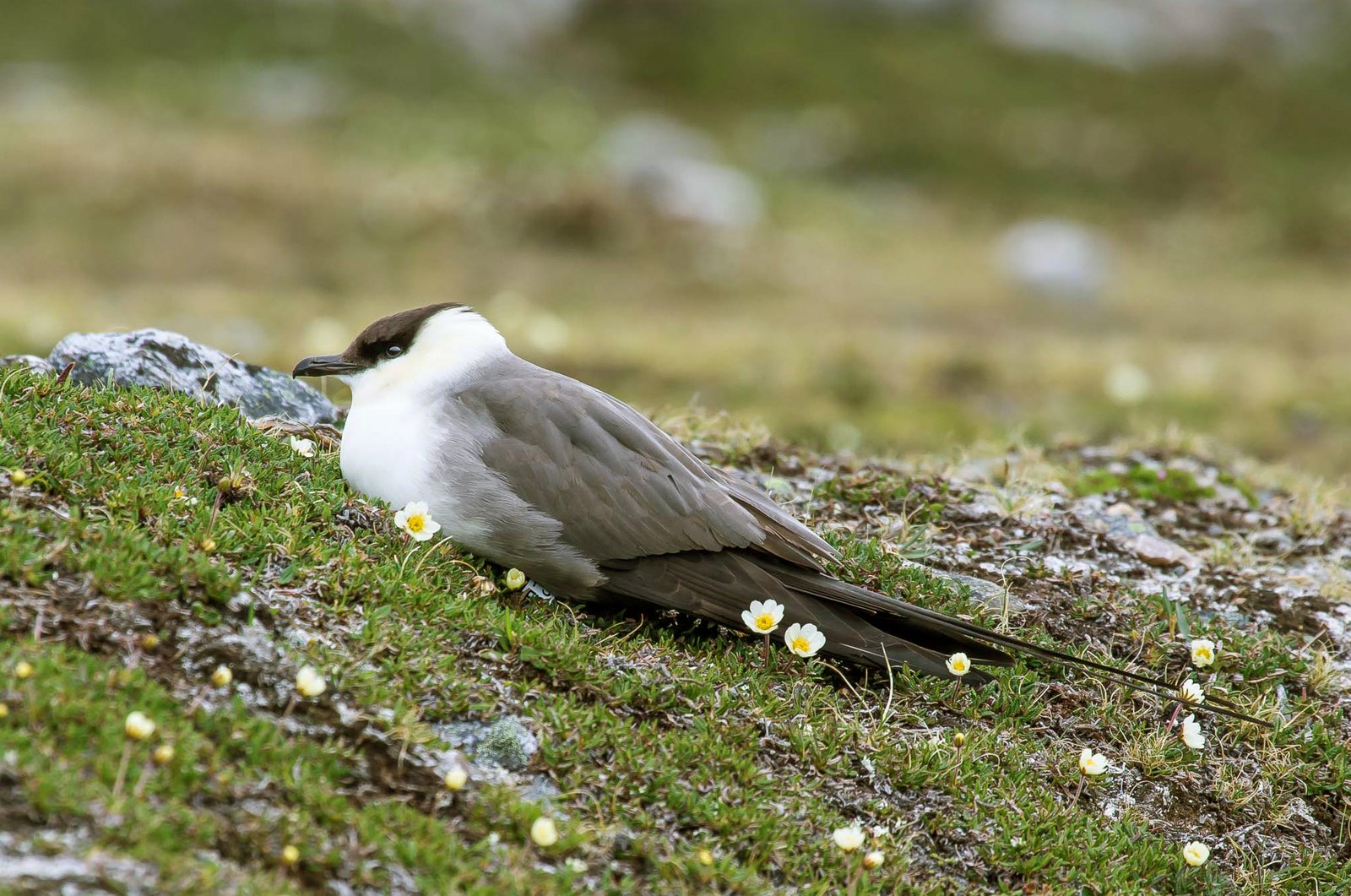
35–41 cm excluding the elongated tail feathers; in adults the two thin, flexible central tail feathers project a further 15 to 25 cm beyond the tail. Slim, with long, narrow wings and a small bill. The adult is cold grey-brown above, with a sharply defined black cap, a white breast that merges into grey on the belly and usually no breast band; the dark trailing edge of the wing contrasts with the paler coverts. Only two white shafts in the primaries, so the wing shows hardly any pale flash. A dark morph is extremely rare. Juveniles vary from pale greyish to dark, are cold grey-brown and coarsely barred, with short, blunt central tail feathers.
Confusion species
Parasitic Jaeger Stercorarius parasiticus is bulkier and warmer brown, with more white in the primaries, often a breast band and shorter, pointed tail feathers. Pomarine Jaeger Stercorarius pomarinus is much heavier, with broad wings, a thick bill and, in adults, twisted, spoon-shaped tail feathers. Terns such as Arctic Tern Sterna paradisaea are paler, with a white body and a forked tail.
Habitat
In the guide area on the open sea, over the edge of the continental shelf and beyond, along fronts and upwelling zones; it rarely comes close inshore. It picks fish and invertebrates from the surface and sometimes robs terns.
Where the bird is most at home, classified by the vegetation units of Mexico and Central America.


Range and movements
Passage migrant off the Pacific coast of the whole guide area, from Baja California to Panama, mainly far offshore; scarce on the Gulf of Mexico and Caribbean side. A small number remain in the guide area in winter. Outside the guide area the species breeds around the North Pole, in Alaska, Arctic Canada, Greenland, northern Scandinavia and Siberia, and winters at sea in the southern hemisphere, mainly off the coasts of South America and southern Africa.
- Passage (Mar–Apr, Oct–Nov)
- dark = core range, pale = thinly spread
How and when to look
Pelagic boat trips off the Pacific coast in August and September give the best chance; a jaeger with a light, buoyant flight and almost no white in the wing is nearly always this species.
Conservation status
Not threatened. The world population is large, but the number of breeding pairs fluctuates strongly with lemming numbers. As the species spends most of the year on the open sea, its trend is poorly known.
Scientific name
Stercorarius longicaudus | Vieillot, 1819
Vieillot described the species in 1819 and placed it straight away in the genus where it still stands. The genus Stercorarius was introduced in 1760 by Brisson. Stercorarius is Latin for 'of dung', from stercus 'dung': the food disgorged by seabirds when pursued by skuas was once taken for excrement. longicaudus is Latin, from longus 'long' and cauda 'tail', after the long central tail feathers of the adult. The specimen the first description was based on came from northern Europe.