All species › Waders, gulls and terns › Jaegers and skuas › Pomarine Jaeger
Position in the tree Birds Aves › Birds with a flexible palate Neognathae › All other modern birds Neoaves › Birds of the elements Elementaves › Cranes and waders Gruimorphae
Pomarine Jaeger | Stercorarius pomarinus
Middelste jager | Págalo pomarino
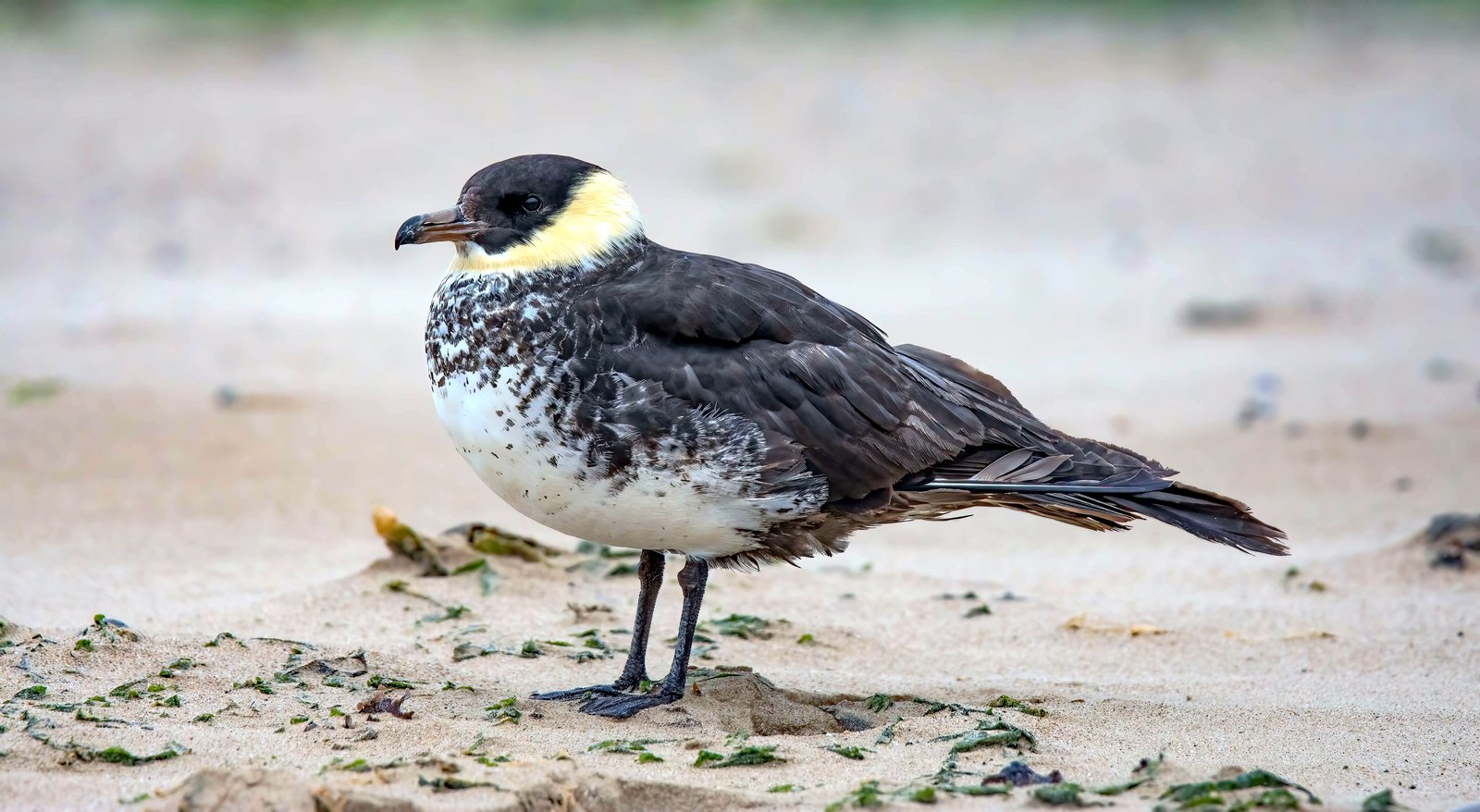
The Pomarine Jaeger is the heaviest of the three jaegers with elongated tail feathers, broad of wing and chest, with a slower, more gull-like wingbeat. It breeds on the Arctic tundra and winters in warm waters, including those of the guide area, where it is the most frequently seen jaeger at sea. In adults the central tail feathers are broadened into a twisted spoon.
Voice
Almost always silent at sea. On the breeding grounds a hard, nasal week-week and hoarse, barking calls.
Recording: Benjamin Drillat — CC BY-NC-SA 4.0 · converted to mono · xeno-canto
Identification
46–51 cm excluding the elongated tail feathers; in adults the two broad, twisted central tail feathers project a further 5 to 11 cm beyond the tail. Bulky, with a broad chest, a thick bicoloured bill and wings that are broad at the base. The pale morph has a black cap, yellow cheeks, white underparts and often a dark-mottled breast band and barred flanks; the dark morph is uniformly sooty brown and less numerous. Five to eight white shafts in the primaries, and on the underwing often a second pale patch at the base of the greater coverts. In non-breeding plumage the cap is less distinct, the rump and flanks are barred and the tail spoons are often missing. Juveniles are cold dark brown and coarsely barred, with a pale bill with a dark tip.
Confusion species
Parasitic Jaeger Stercorarius parasiticus is slimmer, flies faster and more agilely and, in adults, has pointed, unbroadened tail feathers. Long-tailed Jaeger Stercorarius longicaudus is slimmer still and colder grey, with very long, thin tail feathers. Dark young gulls lack the white primary flash and have a less powerful, direct flight.
Habitat
At sea over the continental shelf and beyond, especially in upwelling zones and around fishing boats; it comes closer inshore in onshore winds. It robs gulls, terns and shearwaters of their catch, also catches fish itself, takes offal and sometimes kills smaller seabirds.
Where the bird is most at home, classified by the vegetation units of Mexico and Central America.

Range and movements
At sea along both coasts of the guide area, from Baja California and the Gulf of California to Panama, most numerous off the Pacific coast; also in the Gulf of Mexico and the Caribbean Sea. Outside the guide area the species breeds around the North Pole, in northern Alaska, Arctic Canada and Siberia, and winters in tropical and subtropical seas on both sides of the equator.
- Winter visitor (c. Oct–Mar)
- dark = core range, pale = thinly spread
How and when to look
Boat trips on the Gulf of California or off the Pacific coast in winter often produce several birds, which may follow close behind the boat; the heavy build and twisted tail spoons are best seen from the side.
Conservation status
Not threatened. The world population is poorly counted: the breeding range is sparsely inhabited and the number of breeding pairs fluctuates strongly with lemming numbers.
Scientific name
Stercorarius pomarinus | (Temminck, 1815)
Temminck described the species in 1815 as Lestris pomarinus; because it was later moved to another genus, the author and year stand in brackets. The genus Stercorarius was introduced in 1760 by Brisson. Stercorarius is Latin for 'of dung', from stercus 'dung': the food disgorged by seabirds when pursued by skuas was once taken for excrement. pomarinus contracts Greek pōma 'lid' and rhis 'nostrils': the nostrils lie beneath the horny cere on the bill. The specimen the first description was based on came from arctic Europe.