All species › Passerines › New World sparrows › Song Sparrow
Position in the tree Birds Aves › Birds with a flexible palate Neognathae › All other modern birds Neoaves › Landbirds Telluraves › Falcons, parrots and passerines Australaves › Falcons and passerines Eufalconimorphae › Parrots and passerines Psittacopasserae
Song Sparrow | Melospiza melodia
Zanggors | Chingolo cantor
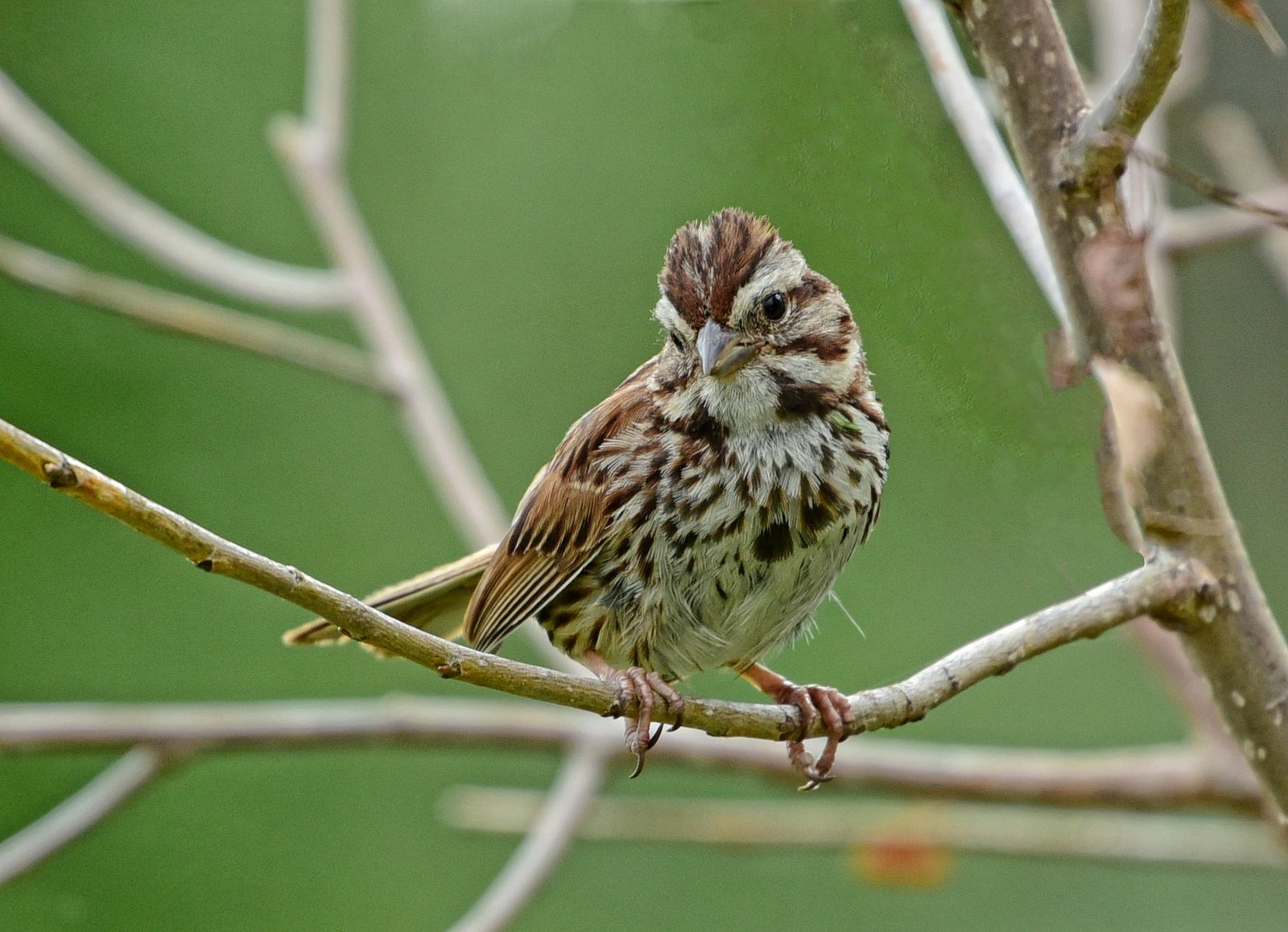
The Song Sparrow is a brown, heavily streaked sparrow of dense vegetation near water. Across its large North American range it varies greatly in size and colour, with dozens of subspecies. In the guide area residents live in north-western Mexico and on the central plateau, and northern birds join them in winter.
Voice
The song usually begins with two or three clear, repeated notes, followed by a buzzy note and a varied trill; each male has several song types. The call is a full, nasal chimp; also a thin, high tsee.
Recording: Ed Pandolfino — CC BY-NC-SA 4.0 · converted to mono · xeno-canto
Identification
13–17 cm. Head with a brown crown with a grey central stripe, a broad grey supercilium, a brown eye-stripe and a prominent broad dark malar stripe beside a white throat. Breast and flanks white with coarse brown or blackish streaks that often merge into a dark central breast spot. Upperparts brown with dark streaks. Tail long and rounded; in flight it is pumped up and down. The residents of the central plateau are smaller and darker, with coarser, blacker streaks. The sexes are alike.
Confusion species
Lincoln's Sparrow Melospiza lincolnii is smaller and finer, with fine black streaks on a buff breast band and flanks and a greyer face. Swamp Sparrow Melospiza georgiana has rusty wings and a grey, barely streaked breast. Savannah Sparrow Passerculus sandwichensis has a shorter, notched tail, often yellow lores, and lives in open grassland.
Habitat
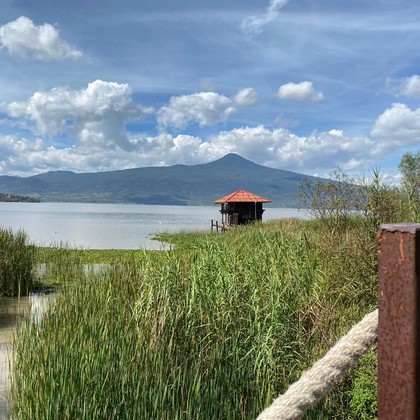
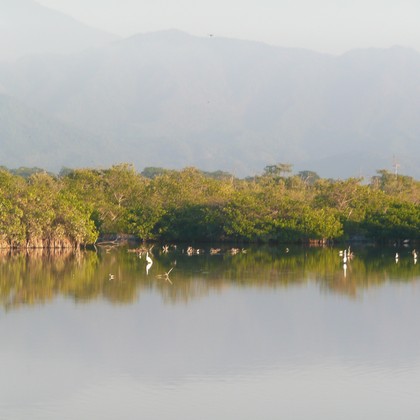
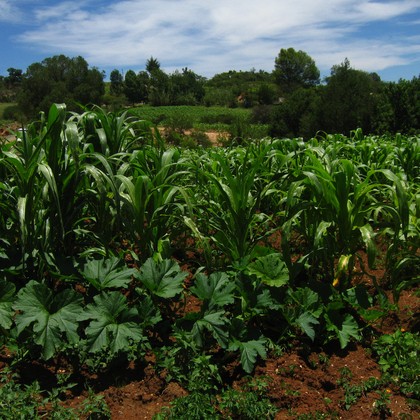
Dense, low vegetation at the edges of marshes, lakes, rivers and irrigation canals: reeds, cattails, sedges, willows and rank growth. Also in damp field margins, hedgerows and moist gardens, and in Baja California in coastal saltmarsh. It feeds on the ground on insects and seeds and sings from an exposed perch.
Where the bird is most at home, classified by the vegetation units of Mexico and Central America.


Range and movements
Breeds across much of North America, from Alaska and Canada to northern Mexico. In the guide area resident in Baja California, along rivers in Sonora and Chihuahua and on the central plateau, from Durango and Zacatecas to Jalisco, Michoacán, Guanajuato, the Valley of Mexico and Puebla. In winter northern birds reach northern Mexico, mainly Sonora, Chihuahua, Coahuila, Nuevo León and Tamaulipas.
- Resident
- Summer visitor (c. Apr–Sep)
- Winter visitor (c. Oct–Mar)
- Passage (Mar–Apr, Oct–Nov)
- dark = core range, pale = thinly spread
How and when to look
On the central plateau often heard and seen in reedbeds and rank growth around lakes and canals, such as at Lake Chapala and in Xochimilco. A male singing from a reed stem or shrub sits in the open.
Conservation status
Not threatened (LC). Very widespread and common in North America. The residents of the central plateau depend on marshes that have been reduced by drainage, pollution and urbanisation.
Scientific name
Melospiza melodia | (Wilson, 1810)
Wilson described the species in 1810 as Fringilla melodia; because it was later moved to another genus, the author and year stand in brackets. The genus Melospiza was introduced in 1858 by Baird. Melospiza is Greek, from melos 'song' and spiza 'finch'. melodia is Latin, borrowed from Greek melōidia 'singing', after the rich song. The specimen the first description was based on came from Philadelphia, Pennsylvania.