All species › Passerines › New World sparrows › Swamp Sparrow
Position in the tree Birds Aves › Birds with a flexible palate Neognathae › All other modern birds Neoaves › Landbirds Telluraves › Falcons, parrots and passerines Australaves › Falcons and passerines Eufalconimorphae › Parrots and passerines Psittacopasserae
Swamp Sparrow | Melospiza georgiana
Moerasgors | Gorrión pantanero
The Swamp Sparrow is a dark, stocky sparrow of reed and sedge marshes. It breeds in eastern and northern North America and winters south to central Mexico. In winter it keeps low and hidden in wet vegetation.
Voice
The call is a sharp, metallic chink, heard most in winter. The song is a slow, even trill of clear notes, rarely heard in the guide area.
Recording: Stanislas Wroza — CC BY-NC-SA 4.0 · shortened to the first 60 s, mono · xeno-canto
Identification
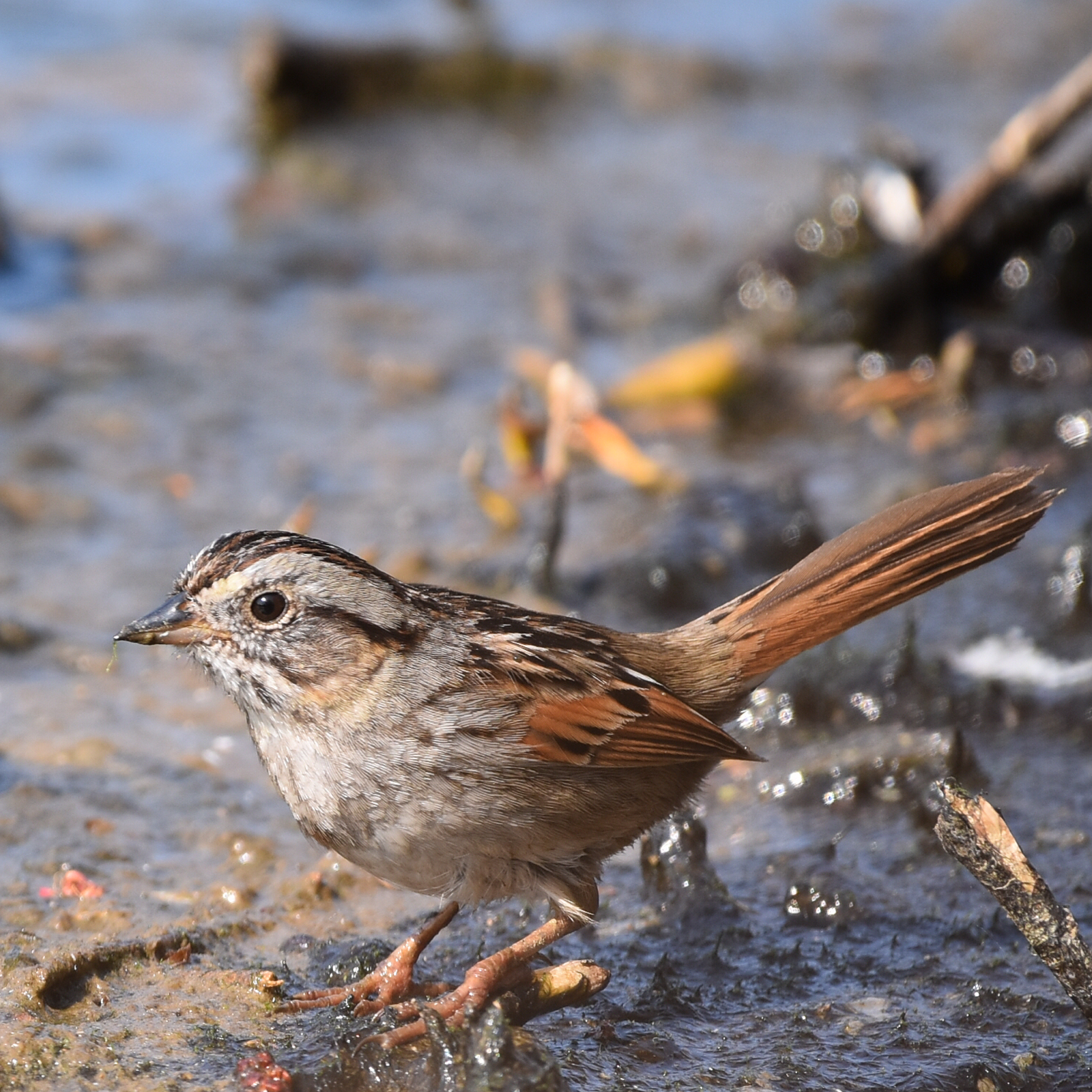
13–15 cm. In winter a brown crown with fine streaks and a faint grey central stripe; in spring the crown turns rusty red. Face grey with a brown eye-stripe and a narrow dark malar stripe; throat white. Wings conspicuously warm rusty-brown. Breast grey, with at most faint, blurry streaks; flanks warm buff-brown, belly white. Back brown with black streaks. First-year birds are less sharply marked, with more buff and fine streaks on the breast. The sexes are alike.
Confusion species
Lincoln's Sparrow Melospiza lincolnii has a buff breast band with crisp black streaks and less rusty wings. Song Sparrow Melospiza melodia is larger, with a coarsely streaked breast and a broad dark malar stripe. Chipping Sparrow Spizella passerina in winter plumage has a dark eye-stripe through the lores, an unstreaked grey breast without warm flanks, and lives in drier, open country.
Habitat
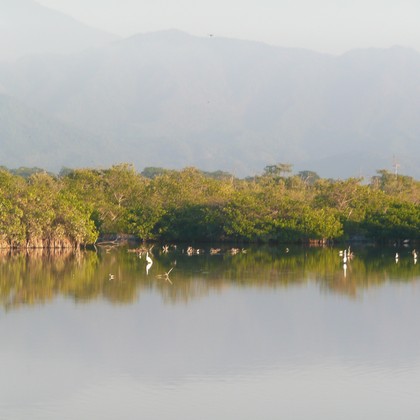
In winter reeds, cattails, sedges and dense wet rank growth at the edges of freshwater marshes, lakes and canals, also brackish coastal marshes. It often forages on mud and among the stems just above the water for insects and seeds.
Where the bird is most at home, classified by the vegetation units of Mexico and Central America.


Range and movements
Breeds in Canada and the north-eastern and north-central United States. Winters in the eastern and southern United States and in Mexico. In the guide area mainly in the north-east (Tamaulipas, Nuevo León, Coahuila) and on the central plateau to Jalisco, Guanajuato and the Valley of Mexico; scarce in Chihuahua and Sonora and in northern Veracruz.
- Winter visitor (c. Oct–Mar)
- dark = core range, pale = thinly spread
How and when to look
Best found by waiting along a reed edge and listening for the metallic chink; soft pishing sometimes brings the bird briefly into view.
Conservation status
Not threatened (LC). Widespread and numerous in North America. The loss of marshes through drainage is the main threat, both on the breeding grounds and in the wintering areas.
Scientific name
Melospiza georgiana | (Latham, 1790)
Latham described the species in 1790 as Fringilla georgiana; because it was later moved to another genus, the author and year stand in brackets. The genus Melospiza was introduced in 1858 by Baird. Melospiza is Greek, from melos 'song' and spiza 'finch'. georgiana refers to Georgia (USA), the type locality. The specimen the first description was based on came from Georgia (USA).