All species › Swifts › Hummingbirds › Snowcap
Position in the tree Birds Aves › Birds with a flexible palate Neognathae › All other modern birds Neoaves › Birds of the elements Elementaves › Nightjars and swifts Strisores
Snowcap | Microchera albocoronata
Witkruinkolibrie | Colibrí copete de nieve
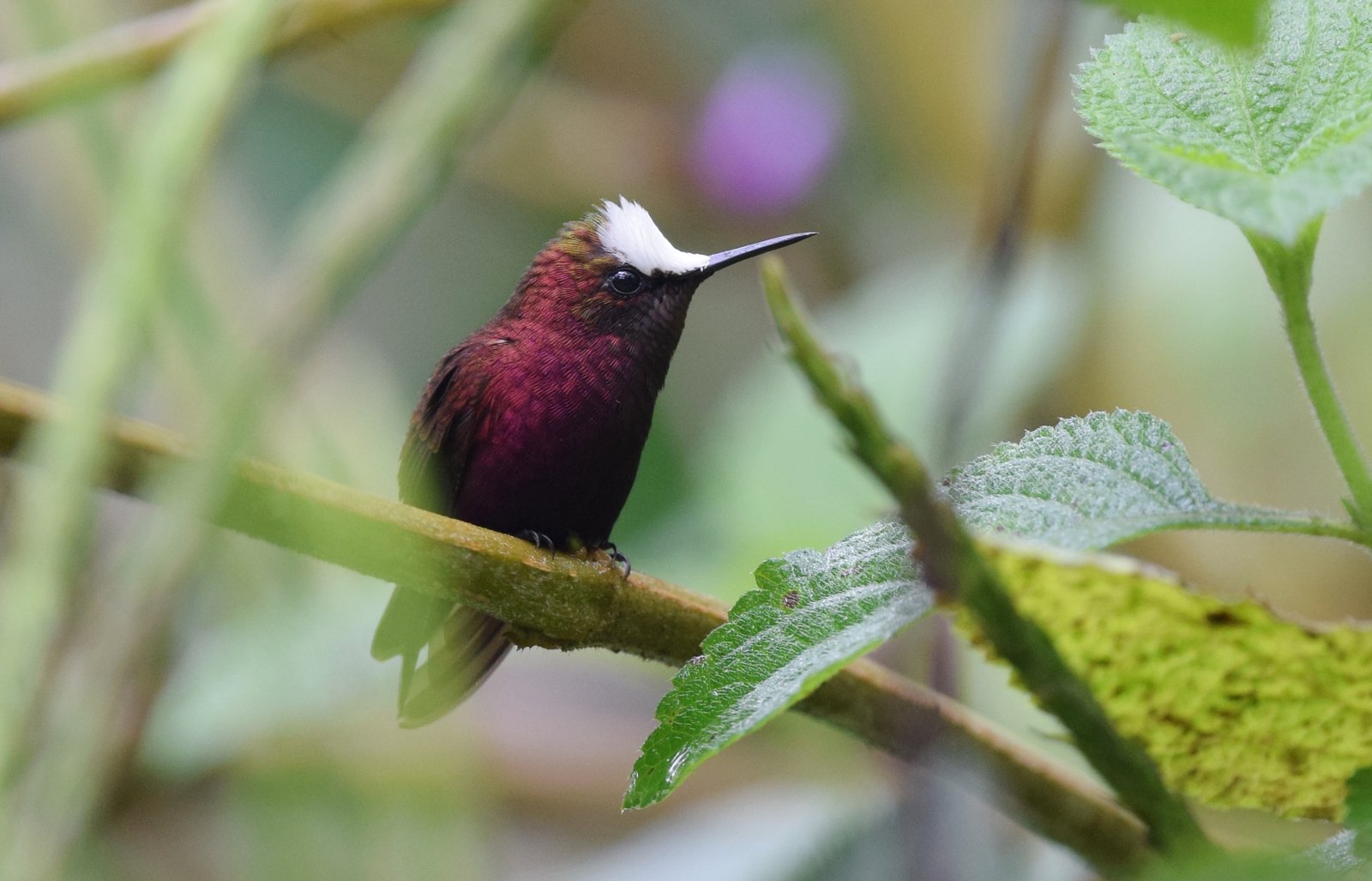
The Snowcap is one of the smallest hummingbirds of the guide area. The male is dark wine-purple with a bright white crown that glows in the dim forest. It lives in the foothills on the Caribbean side from Honduras to Panama and often visits the canopy and edges of the forest.
Voice
A thin, high tsip and a soft, twittering squeaking.
Recording: Ernest Carman — CC BY-NC-SA 4.0 · shortened to the first 60 s, mono · xeno-canto
Identification
6–7 cm, with a short, straight black bill. The male is dark purple to wine-red, with a bright white crown and a white tail with a dark band and dark central feathers; young males are mottled green and purple. The female is green above and greyish-white below, with a small white spot behind the eye and a tail with white tips and a dark band.
Confusion species
The female Coppery-headed Emerald Microchera cupreiceps has a slightly decurved bill and a coppery crown and rump. The female White-tailed Emerald Microchera chionura lives higher up and on the Pacific side. The female Violet-headed Hummingbird Klais guimeti has a blue crown, a grey throat and a green tail without much white.
Habitat
Canopy and edges of humid foothill forest, clearings, old secondary forest and riverbanks, at about 300 to 900 m, locally to 1200 m. It often feeds high in flowering trees such as Inga, but comes down to flowering shrubs at forest edges; it catches small insects. It moves to other elevations following the flowering.
Where the bird is most at home, classified by the vegetation units of Mexico and Central America.



Range and movements
Endemic to the guide area. On the Caribbean slope of Honduras, Nicaragua and Costa Rica, and in Panama on the Caribbean slope east to Coclé and Colón, locally also on the Pacific side in Veraguas.
- Resident
- dark = core range, pale = thinly spread
How and when to look
In Costa Rica in the Caribbean foothills, for example near Turrialba and around Arenal Volcano, at flowering shrubs at the forest edge and at lodges with gardens of Stachytarpheta and other small flowers. The white crown is visible from afar in the shade.
Conservation status
Not threatened. Locally fairly common, but irregular, and scarce in many places. Its range is small and depends on foothill forest, which has been cleared in many areas.
Scientific name
Microchera albocoronata | (Lawrence, 1855)
Lawrence described the species in 1855 as Mellisuga albo-coronata; because it was later moved to another genus, the author and year stand in brackets. The genus Microchera was introduced in 1858 by Gould. Microchera is Greek, from mikros 'small' and khēra 'widow' (i.e. in mourning, black), after the tiny, very dark male. albocoronata is Latin, from albus 'white' and coronatus 'crowned', after the male's white crown. The specimen the first description was based on came from Belén, Veraguas, Panama.