All species › Swifts › Hummingbirds › Crowned Woodnymph
Position in the tree Birds Aves › Birds with a flexible palate Neognathae › All other modern birds Neoaves › Birds of the elements Elementaves › Nightjars and swifts Strisores
Crowned Woodnymph | Thalurania colombica
Kroonbosnimf | Ninfa coronada
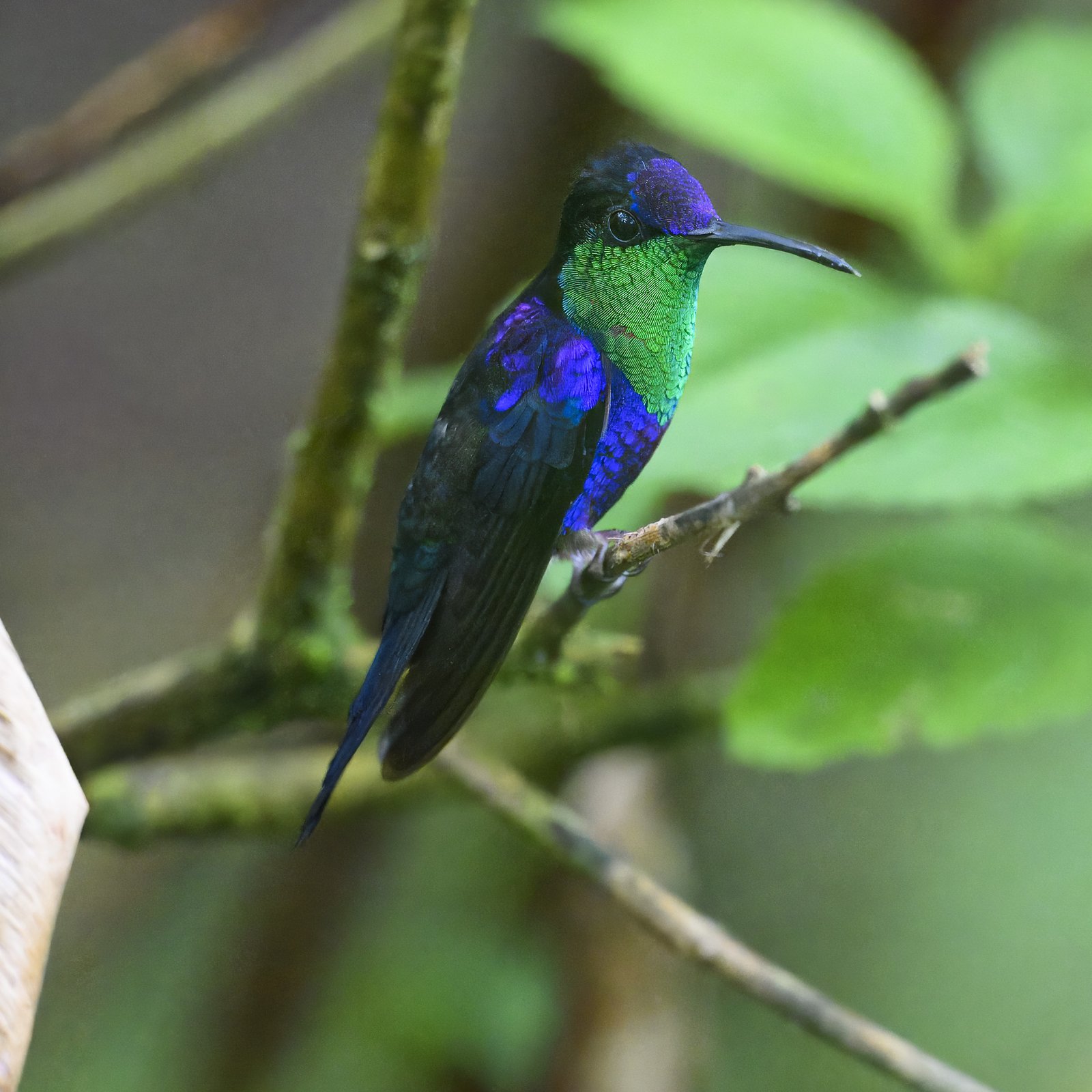
The Crowned Woodnymph is one of the most widespread hummingbirds of the humid forest of Central America, from Belize and Guatemala to Panama. The male is dark, with a violet crown and belly, a glittering green throat and a deeply forked tail. In eastern Panama males have a green rather than a violet crown.
Voice
A dry, sharp tsik or chit, often in series, and in chases a rattling twitter.
Recording: Kent Livezey — CC BY-NC-SA 4.0 · converted to mono · xeno-canto
Identification
9–11 cm, with a straight black bill; the male is larger than the female. The male has a violet crown, a glittering green throat and breast, a violet belly and a violet band across the upper back, and a deeply forked, blue-black tail. In Darién and eastern Panama the crown is green. The female is green above and pale grey below, with a slightly forked dark tail with white tips to the outer feathers.
Confusion species
Violet-headed Hummingbird Klais guimeti is smaller, has a white spot behind the eye and a shorter bill; the male has a violet-blue throat. Males of Bronze-tailed Plumeleteer Chalybura urochrysia and White-vented Plumeleteer Chalybura buffonii lack violet on belly and crown and have a rounded tail. Mexican Woodnymph Eupherusa ridgwayi lives only in western Mexico.
Habitat
Interior and edges of humid lowland and foothill forest, old secondary forest, gallery forest and shade coffee, from sea level to about 1200 m, locally higher. It feeds mainly in the understorey and middle strata at flowers of shrubs, epiphytes and heliconias, and catches small insects.
Where the bird is most at home, classified by the vegetation units of Mexico and Central America.





Range and movements
In the guide area from southern Belize and eastern Guatemala south through Honduras, Nicaragua and Costa Rica to all of Panama, mainly on the Caribbean side, and in south-western Costa Rica and eastern Panama also on the Pacific side. Outside the guide area in Colombia, north-western Venezuela and western Ecuador.
- Resident
- dark = core range, pale = thinly spread
How and when to look
Common in the Caribbean lowlands of Costa Rica, for example around Sarapiquí, and in the Panama Canal area along Pipeline Road; also at the feeders of lodges at the forest edge.
Conservation status
Not threatened. In suitable forest one of the commonest hummingbirds. It depends on forest, but also occurs in old secondary forest and shade coffee.
Scientific name
Thalurania colombica | (Bourcier, 1843)
Bourcier described the species in 1843 as Ornismya colombica; because it was later moved to another genus, the author and year stand in brackets. The genus Thalurania was introduced in 1848 by Gould. Thalurania is Greek, from thalos 'child, scion' and ouranos 'heaven': 'child of heaven', after the dazzling sheen of the males. colombica refers to Colombia, where the species was described from. The specimen the first description was based on came from Colombia (suggested: San Agustín, Magdalena Valley).