All species › Swifts › Hummingbirds › Coppery-headed Emerald
Position in the tree Birds Aves › Birds with a flexible palate Neognathae › All other modern birds Neoaves › Birds of the elements Elementaves › Nightjars and swifts Strisores
Coppery-headed Emerald | Microchera cupreiceps
Koperkopsmaragdkolibrie | Esmeralda capirotada
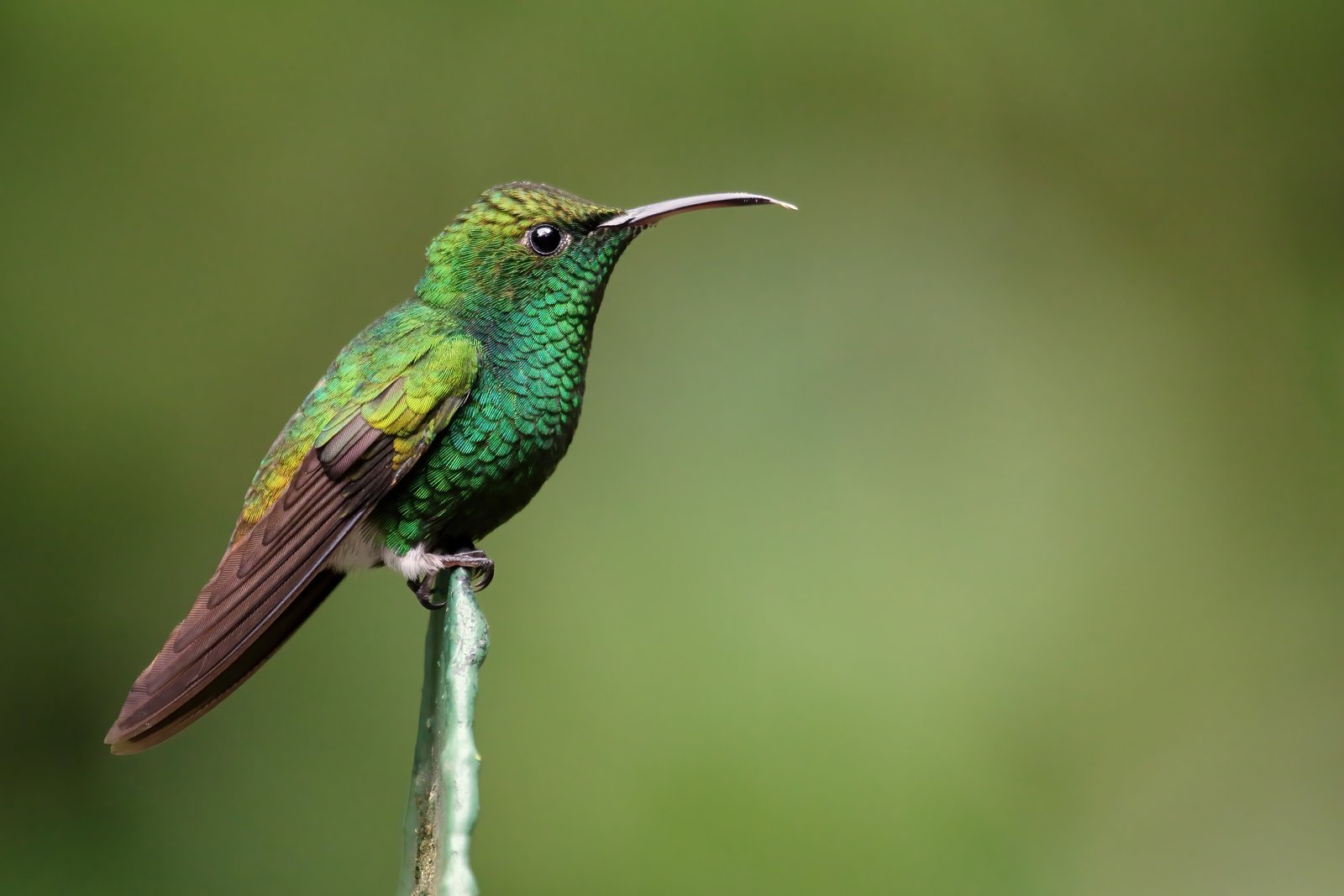
The Coppery-headed Emerald is a small hummingbird found only in Costa Rica, in the foothills and middle elevations of the northern and central mountain ranges. The male is green with a coppery crown and rump and a largely white tail. It often visits feeders and flowering shrubs at lodges.
Voice
A thin, high tsit and a soft, dry chipping.
Recording: GABRIEL LEITE — CC BY-NC-SA 4.0 · converted to mono · xeno-canto
Identification
7–8 cm, with a short, slightly decurved black bill. The male is glossy green, with a coppery to bronze crown, rump and uppertail coverts and a white tail with dark tips and dark central feathers. The female is green above with the same coppery crown and rump, and white below with green spots on the flanks; the tail is white with a dark band.
Confusion species
The male Snowcap Microchera albocoronata is wine-purple with a white crown; the female has a straight bill and no coppery crown. White-tailed Emerald Microchera chionura lives further south on the Pacific side and lacks the coppery crown. Garden Emerald Chlorostilbon assimilis has a dark, forked tail without white.
Habitat
Edges and clearings of humid foothill and montane forest, old secondary forest, roadside forest edges, shade coffee and gardens, at about 300 to 1500 m, most often between 600 and 1200 m. It feeds in the understorey and middle strata at small flowers of shrubs and herbs and catches small insects. It moves to other elevations following the flowering.
Where the bird is most at home, classified by the vegetation units of Mexico and Central America.





Range and movements
Endemic to Costa Rica. On the Caribbean slope of the Cordillera de Guanacaste, the Cordillera de Tilarán and the Cordillera Central, and on the Pacific side of the Cordillera de Tilarán and the Cordillera Central to the edge of the Central Valley.
- Resident
- dark = core range, pale = thinly spread
How and when to look
Regular at feeders and flowering shrubs around Monteverde, at Cinchona and at the La Paz waterfalls. The male shows its white tail when hovering at a flower.
Conservation status
Not threatened. Locally fairly common within its small range. It tolerates edges, secondary forest and gardens, but the range is small and clearance of foothill forest affects it.
Scientific name
Microchera cupreiceps | (Lawrence, 1866)
Lawrence described the species in 1866 as Eupherusa cupreiceps; because it was later moved to another genus, the author and year stand in brackets. The genus Microchera was introduced in 1858 by Gould. Microchera is Greek, from mikros 'small' and khēra 'widow' (i.e. in mourning, black), after the tiny, very dark male. cupreiceps is Latin, from cupreus 'coppery' and -ceps '-headed', after the coppery crown. The specimen the first description was based on came from Barranca, Costa Rica.