All species › Passerines › New World blackbirds, troupials and allies › Scarlet-rumped Cacique
Position in the tree Birds Aves › Birds with a flexible palate Neognathae › All other modern birds Neoaves › Landbirds Telluraves › Falcons, parrots and passerines Australaves › Falcons and passerines Eufalconimorphae › Parrots and passerines Psittacopasserae
Scarlet-rumped Cacique | Cacicus uropygialis
Grote bloedstuitbuidelspreeuw | Cacique lomiescarlata
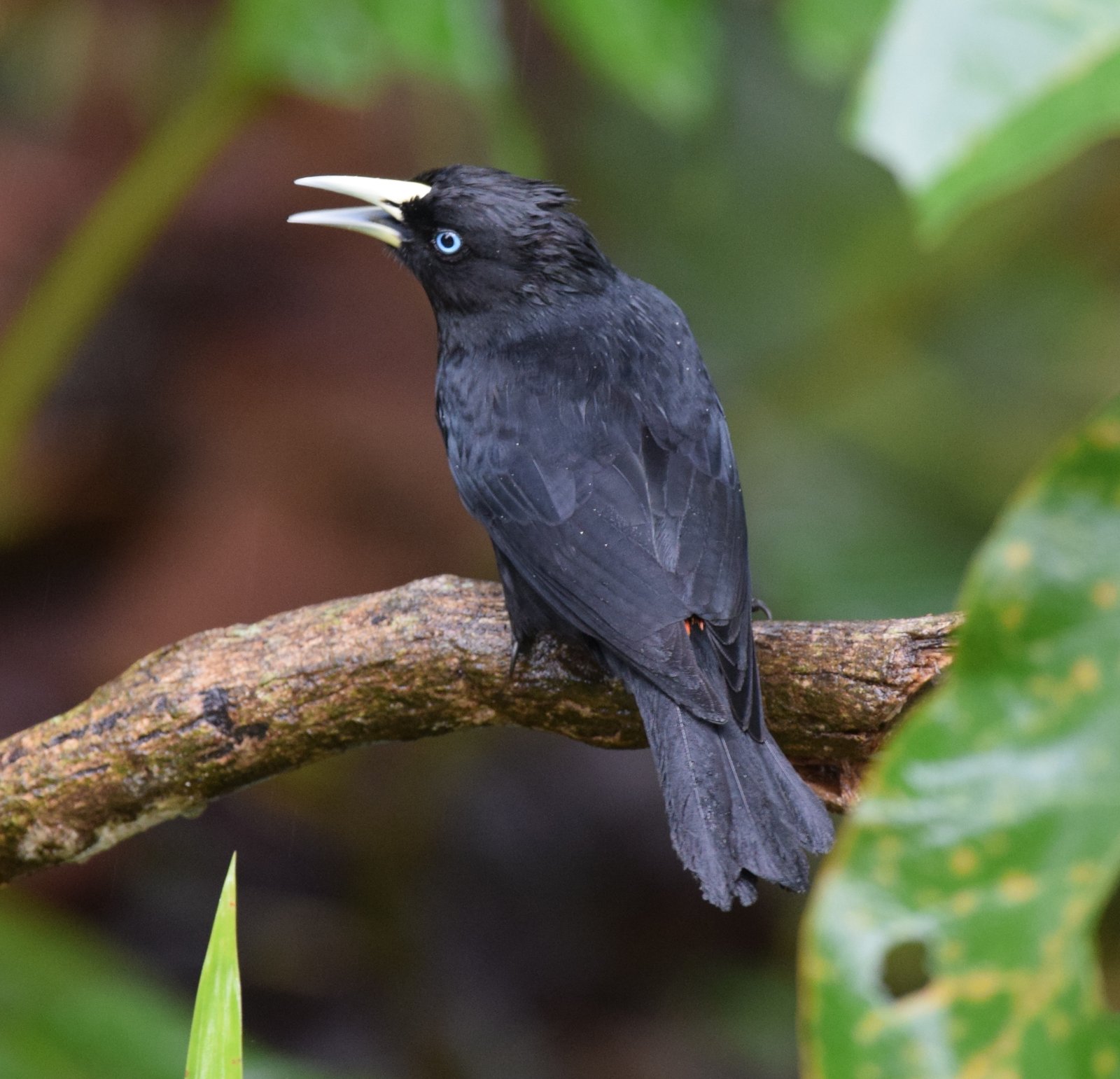
The Scarlet-rumped Cacique is a small, all-black cacique with a scarlet rump that is visible mainly in flight. In the guide area it lives in humid forest from Honduras to Panama, where it often joins mixed flocks in the canopy.
Voice
Varied: clear, whistled notes such as a repeated chewee, liquid phrases and a harsh chek. Calls frequently, also from dense canopy.
Recording: Juan Freile — CC BY-NC-SA 4.0 · converted to mono · xeno-canto
Identification
20–23 cm. All glossy black, with a scarlet lower back and rump that is usually covered by the wings in a perched bird. Bill pointed and pale greenish ivory. Eye pale blue. Female smaller and duller black. Young birds have a dark eye.
Confusion species
Yellow-billed Cacique Amblycercus holosericeus is also all black with a pale bill, but has a yellow eye, no red rump and lives low in dense undergrowth and bamboo. Yellow-rumped Cacique Cacicus cela, found only in Panama, has yellow wing patches, a yellow rump and a yellow tail base. Chestnut-headed Oropendola Psarocolius wagleri is larger and has a chestnut head and a yellow tail.
Habitat
Canopy and edges of humid lowland and foothill forest, also tall secondary forest and clearings with trees, up to about 1,100 m. It lives in pairs or small groups, often in mixed flocks. It searches for insects among leaves and in clusters of dead leaves. It nests singly or in small groups, often near wasp nests.
Where the bird is most at home, classified by the vegetation units of Mexico and Central America.




Range and movements
From eastern Honduras through Nicaragua, Costa Rica and Panama to western Colombia and north-western Ecuador. In Honduras and Nicaragua on the Caribbean slope, in Costa Rica and Panama on both slopes. Resident.
- Resident
- dark = core range, pale = thinly spread
How and when to look
Look for the red rump when the bird flies up; in the canopy it is often only heard, or seen as a black silhouette with a pale bill.
Conservation status
Not threatened (LC). Fairly common in humid forest. More closely tied to forest than the other caciques and therefore sensitive to deforestation.
Scientific name
Cacicus uropygialis | de Lafresnaye, 1843
De Lafresnaye described the species in 1843 and placed it straight away in the genus where it still stands. The genus Cacicus was introduced in 1799 by De Lacépède. Cacicus comes from Spanish cacique 'chief', a Taíno word, after the striking, 'lordly' appearance. uropygialis is New Latin for 'of the rump', from uropygium, after the red rump. The specimen the first description was based on came from Bogotá area, Colombia.