All species › Passerines › New World blackbirds, troupials and allies › Black Oropendola
Position in the tree Birds Aves › Birds with a flexible palate Neognathae › All other modern birds Neoaves › Landbirds Telluraves › Falcons, parrots and passerines Australaves › Falcons and passerines Eufalconimorphae › Parrots and passerines Psittacopasserae
Black Oropendola | Psarocolius guatimozinus
Zwarte oropendola | Oropéndola negra
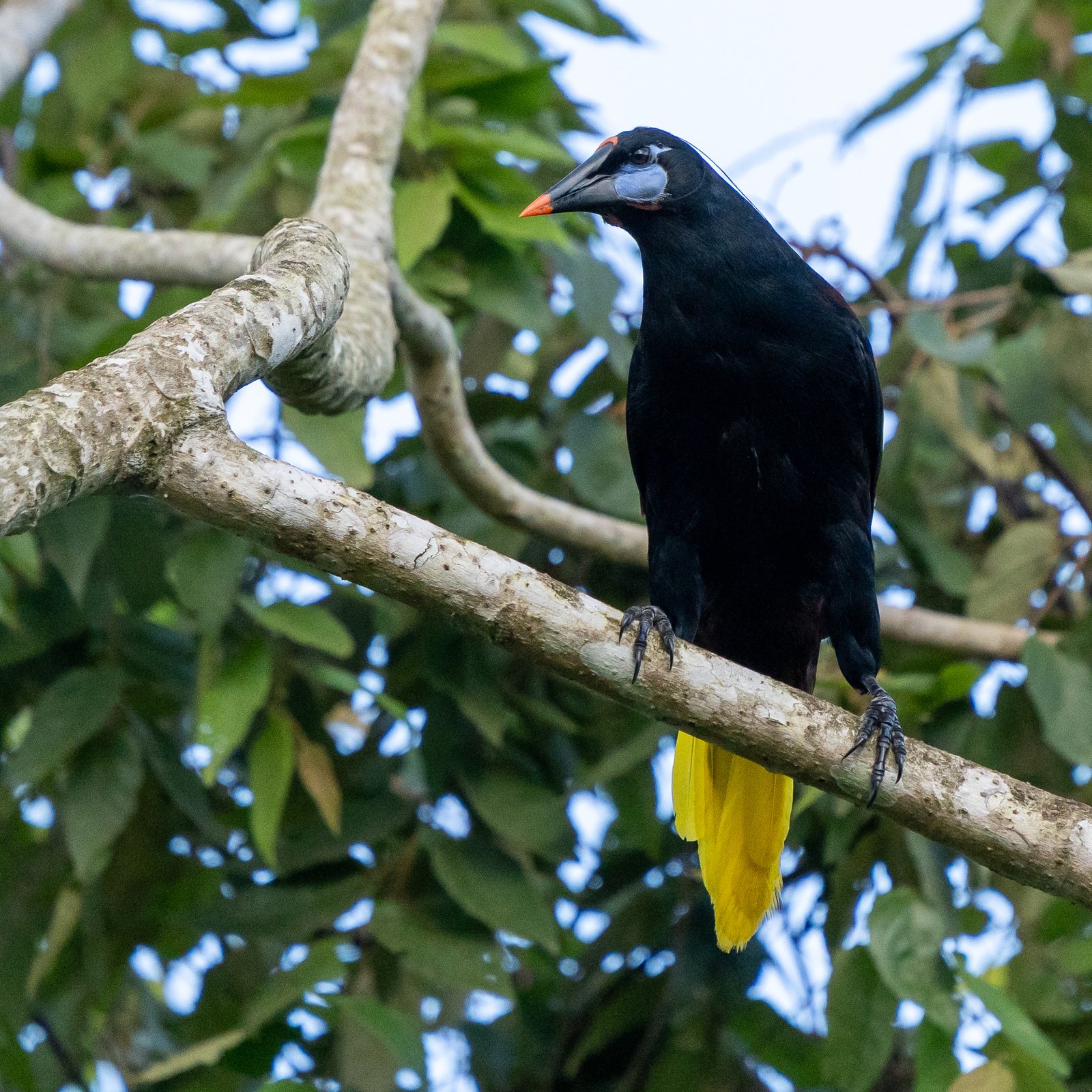
The Black Oropendola is a large oropendola of the Chocó-Darién region. In the guide area it occurs only in eastern Panama. It resembles Montezuma Oropendola, with the same bare, coloured face, but its body is mostly black.
Voice
The male bows forward and gives a series of liquid, bubbling notes ending in a loud gurgling sound, similar to that of Montezuma Oropendola. Call a harsh kak.
Recording: Andrew Spencer — CC BY-NC-SA 3.0 · converted to mono · xeno-canto
Identification
38–46 cm. Male much larger than female. Mostly black, with dark chestnut back, rump and wing coverts. Bare blue skin on the cheek and a pink wattle at the base of the bill. Bill long and black with an orange tip. Tail yellow with dark central feathers. Eye dark. Female similar in colour and much smaller.
Confusion species
Montezuma Oropendola Psarocolius montezuma has the same face but a chestnut body; it reaches east only to central Panama, so the two hardly overlap. Crested Oropendola Psarocolius decumanus has a pale bill, a pale blue eye and no bare facial skin. Chestnut-headed Oropendola Psarocolius wagleri is smaller, with a chestnut head and a pale bill.
Habitat
Humid lowland rainforest and foothill forest, forest edge, riverbanks and clearings with tall trees, up to about 800 m. It eats fruit, nectar and insects. It nests in colonies, often in tall trees along rivers.
Where the bird is most at home, classified by the vegetation units of Mexico and Central America.




Range and movements
Occurs only in eastern Panama and north-western Colombia. In the guide area mainly in Darién and eastern Panamá Province. Resident.
- Resident
- dark = core range, pale = thinly spread
How and when to look
Search from a boat along the rivers of Darién; the colonies often hang in tall trees on the bank.
Conservation status
Not threatened (LC). Small range, but locally fairly common. Deforestation in Darién and north-western Colombia is the main threat.
Scientific name
Psarocolius guatimozinus | (Bonaparte, 1853)
Bonaparte described the species in 1853 as Ostinops guatimozinus; because it was later moved to another genus, the author and year stand in brackets. The genus Psarocolius was introduced in 1827 by Wagler. Psarocolius is Greek, from psar 'starling' and koloios 'jackdaw', for these large, starling-like birds. guatimozinus refers to Guatimozin, the Spanish form of Cuauhtémoc (c. 1495–1525), the last Aztec ruler. The specimen the first description was based on came from middle Magdalena River, Antioquia, Colombia.